What makes it worth more than that is everything attached to it. The bridge is a 400-year-old trading-port monument, an active place of worship, and a building that reopened in August 2024 after a major restoration that divided opinion. This guide covers the story, what to look for spot by spot, the practical side of tickets and hours, and how to see it without spending your morning in a crowd.
The Japanese Covered Bridge at a glance
| Vietnamese names | Cầu Nhật Bản (Japanese Bridge), Chùa Cầu (Pagoda Bridge), Lai Viễn Kiều |
| Location | Where Trần Phú meets Nguyễn Thị Minh Khai, over a small creek feeding the Thu Bồn River |
| Dimensions | About 18 m long, 3 m wide |
| Built | Traditionally dated to the 1590s to early 1600s; exact dates undocumented |
| Heritage status | National relic since 17 February 1990; part of the Hoi An Ancient Town UNESCO site, inscribed 1999 |
| Ticket | Hoi An Ancient Town coupon, last known at 120,000 VND for foreign visitors |
| Time needed | 10 to 20 minutes; 2 to 3 hours with nearby sites |
| Best hour | 6:00 to 7:30, or after 21:00 |
One administrative detail that most pages still get wrong: since the provincial merger of July 2025, Quang Nam province has been absorbed into Da Nang City. The bridge now sits in Hội An ward, Da Nang. Older guides that place it in Quang Nam province are describing a map that no longer exists.
A 400-year story: who built it and why
Faifo and its Japanese quarter
In the late 16th and early 17th centuries, Hoi An, known to European traders as Faifo, was the Nguyễn lords' international port. Japanese red-seal ships traded here under official licence, and a Japanese quarter grew up on one side of the creek, with Chinese merchants settled on the other.
Then Japan closed. The seclusion edicts of the 1630s, including the 1635 ban on Japanese travel abroad, cut the community off from home. Japanese merchants left or assimilated. The Chinese became the dominant trading group, which is why most of today's old town architecture reads as Chinese rather than Japanese.
The link was close while it lasted. In the early 17th century, Nguyễn princess Ngọc Hoa married the Nagasaki merchant Araki Sōtarō, a union that shows how tightly Hoi An and Japan were bound in that brief window.
One bridge, three names
The popular name is Cầu Nhật Bản, the Japanese Bridge. Chùa Cầu, Pagoda Bridge, refers to the shrine attached to the north side, commonly dated to around 1653. The official name is Lai Viễn Kiều, "bridge for friends from afar," given by Lord Nguyễn Phúc Chu in 1719. That name still hangs on the lacquered board above the shrine entrance.
The naming matters. A Vietnamese ruler formally adopted a foreign-built structure and turned it into a statement of welcome. It is the reason the bridge survived as a symbol rather than a curiosity.
Legends versus evidence
Here is where most accounts get slippery. Three claims circulate widely and none of them is documented.
The Namazu legend. A giant catfish lies with its head in India, its back under Vietnam and its tail in Japan. Its thrashing causes earthquakes. The bridge, so the story goes, pins it down like a sword. It is folklore, and good folklore, but not history.
The dog and monkey statues. Tradition says construction began in a monkey year and ended in a dog year, which is why guardian figures of both animals stand at the ends. The official Hoi An heritage page states the order the other way round. A monkey year in 1596 followed by a dog year in 1598 fits the commonly cited 1590s start date, but sources contradict each other and the zodiac reading is interpretation, not record.
"Built by the Japanese." The attribution is traditional. The builder is unknown. The structure you see today is the product of Vietnamese and Chinese rebuilding over centuries, and the stelae inside credit Vietnamese and Chinese donors by name.
Restorations over the centuries
| Year | Event | Confidence |
|---|---|---|
| 1590s–1600s | Traditional construction date | Traditional |
| c. 1653 | Shrine added on the north side | Traditional |
| 1719 | Named Lai Viễn Kiều by Lord Nguyễn Phúc Chu | Documented |
| 1763, 1817, 1865, 1915, 1986 | Commonly cited repairs | Traditional/partly documented |
| French colonial era | Deck flattened for vehicles; arch later reinstated | Documented |
| 1990 | National relic status, 17 February | Documented |
| 1999 | Hoi An Ancient Town inscribed by UNESCO | Documented |
| 2006 | Bridge appears on the 20,000 VND polymer note | Documented |
| 2022–2024 | Major restoration, reopening August 2024 | Documented |
What you see on site, spot by spot
Enter from the Trần Phú side, on the east, because that is how most visitors arrive from the market and the assembly halls.
The east approach
A brick abutment, a short flight of steps, and the first pair of lacquered guardian statues. Whether you meet the monkeys or the dogs first depends on which source you trust, so look at both ends and decide for yourself. The figures are weathered, painted, and clearly not original to the 17th century.
The deck
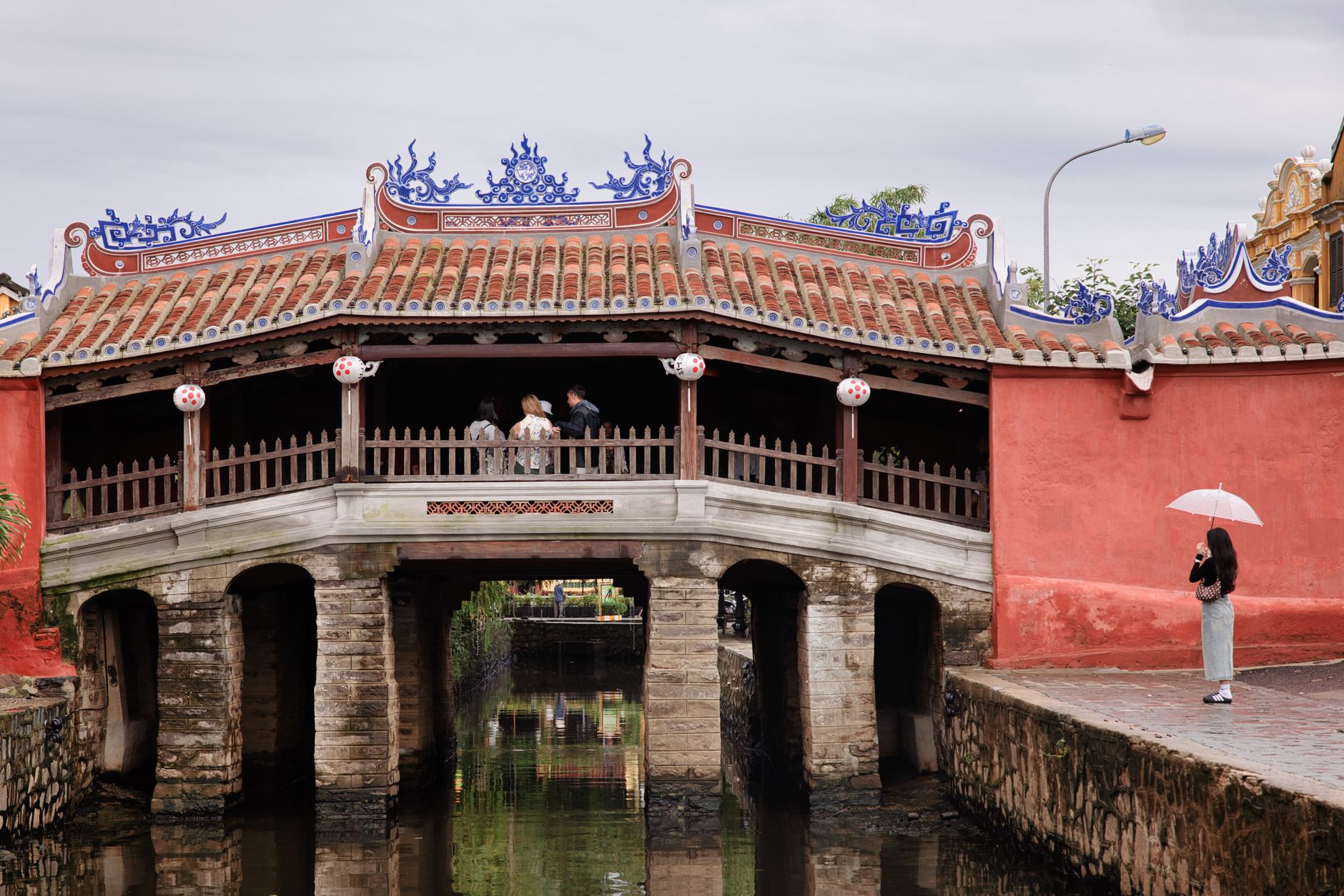
The floor is timber plank, worn smooth in the middle. The deck humps slightly, enough that you feel the arch under your feet. Benches run along both sides, built into the corridor walls, and they are the reason locals still use the bridge as a place to sit rather than a place to pass through.
Above, the roof is tiled in the yin-yang pattern across three connected sections, with porcelain-capped ridge tiles. Side openings look down onto the creek. The scale is small and the detail is dense, which is the opposite of most monuments: you have to slow down to see anything.
Be honest with yourself about size. The deck is crossed in about 30 seconds. If you walk straight through without stopping at the shrine, you have seen a covered walkway, not a heritage site.
The shrine to Trấn Vũ
On the north side, a small temple projects out over the water. It is dedicated to Bắc Đế Trấn Vũ, a Taoist guardian associated with weather and floods, which makes sense for a bridge built over a tidal creek in a flood-prone town.
Inside: an altar, incense, offerings, the Lai Viễn Kiều board above the entrance, and stelae recording donors. Residents still bring offerings on the 1st and 15th of each lunar month. This is an active place of worship, not a museum room, so keep your voice down, do not touch the altar, and do not pose on the altar steps.
The west end
The second guardian pair, then a sudden drop in crowd density. Most tour groups turn around at the shrine. Beyond, Nguyễn Thị Minh Khai street has art galleries and the Phùng Hưng old house at number 4, which is on the old town ticket list and usually quiet.
The view from outside
The shrine façade and its reflection are only visible from the water side. Two standpoints matter. The north bank gives you the shrine front and its reflection. The south side, near the creek mouth, gives the full silhouette of the bridge with the roof line intact. Both are a two-minute walk from the deck, and both are where the postcard photographs are actually taken.
After the 2024 restoration: what changed and the debate
Works ran from late December 2022 to mid-2024, and the bridge reopened in early August 2024. The reported budget was around 20 billion VND (about US$800,000 at the time), with Japanese specialists consulted.
Rotten beams were replaced, the roof was re-tiled, and the structure was stabilised. Before the works, the bridge had been propped up with scaffolding, and the number of people allowed on the deck at once was capped, reportedly at around 20.
The controversy came after. Many residents and visitors felt the finish looked too new: fresher timber colour, brighter lacquer, cleaner lines. Heritage officials defended the work as consistent with conservation principles, arguing that structural survival comes before patina.
Both positions are reasonable. What matters for a visitor is the expectation. If you arrive expecting a weathered 400-year-old structure, the bridge will look younger than the photos you have seen. The patina will return over years, not months.
How it compares with similar places nearby
| Place | Distance from Hoi An | Character | Worth it? |
|---|---|---|---|
| Thanh Toàn tile-roofed bridge | About 7 km (Hue side of the region) | Rural 18th-century covered bridge, commonly dated 1776, among rice fields | Quieter, no ticket check, more lived-in; less historical weight |
| Phúc Kiến and Quảng Đông assembly halls | 200–400 m | Large ornate merchant halls with deep interiors | Better value per ticket coupon if you want detail |
| Dragon Bridge, Da Nang | About 30 km | Modern steel bridge, opened 2013, fire-and-water show on weekend nights | A spectacle, not a heritage site; complements rather than replaces |
The Dragon Bridge is not a substitute. It is a different kind of thing entirely, and the two are frequently confused in search results. One is a small wooden shrine bridge in a walking old town. The other is a modern engineering landmark with a weekend light show.
Is it worth it? An honest verdict
Who will love it: history and architecture enthusiasts, photographers willing to come at dawn or after dark, and anyone interested in the Japan–Vietnam trading relationship, which is a genuinely underrated chapter of Southeast Asian history.
Who may be disappointed: visitors expecting a large monument, anyone arriving between 9:00 and 11:00 or 16:00 and 20:00 when the deck is a slow-moving queue, and those put off by the freshly restored look.
The verdict: essential as part of an old town walk, not worth a dedicated trip on its own. Use one of your five ticket coupons here only if you will actually slow down and read the shrine. Otherwise, spend the coupon on an assembly hall and see the bridge from the bank and at night, which is free and arguably better.
Tickets and opening hours
All figures below are as of October 2026. Prices and rules have changed several times since 2023, so treat any older guide with suspicion.
The Hoi An Ancient Town ticket
| Visitor type | Price (VND) | Approx. USD | Approx. EUR |
|---|---|---|---|
| Foreign visitor | 120,000 | US$4.60 | €3.90 |
| Vietnamese citizen | 80,000 | US$3.10 | €2.60 |
The ticket covers entry to five sites chosen from a list of about 20: old houses, assembly halls, museums, and the bridge. Conversions are approximate, at roughly 26,000 VND per US$1 and 30,500 VND per €1.
Several websites still say the bridge is free to cross. That is out of date. Since stricter enforcement began in 2023, foreign visitors entering the old town are expected to hold a ticket, and controllers stationed at the bridge tear a coupon for interior access. Enforcement has been inconsistent over time, which is why the old claim survives, but plan on buying a ticket.
Validity rules, including whether a ticket covers a single visit or a stay of several days, have also changed. Read the conditions printed on your ticket rather than trusting a blog.
Where to buy
Ticket booths stand at the main entry points to the old town, including Trần Phú, Nguyễn Thị Minh Khai, Bạch Đằng, Lê Lợi and Phan Chu Trinh streets. Payment is normally cash in VND. Do not assume a card will work.
Opening hours
The bridge structure itself is accessible at all hours. The shrine interior and ticket checks follow heritage-site hours, last reported from roughly 7:00 in the morning until the evening. One source gives 7:00 to 17:30, others report a later close. Hours can shift seasonally and during floods, so confirm on arrival.
How to get there
| From | Distance | Mode | Time | Approx. fare |
|---|---|---|---|---|
| Hoi An Central Market | 600–700 m | Walk along Trần Phú | 8–10 min | Free |
| Bạch Đằng riverside | About 300 m | Walk | 4–5 min | Free |
| An Bàng or Cửa Đại beach | 4–6 km | Grab car | 10–15 min | 70,000–110,000 VND |
| An Bàng or Cửa Đại beach | 4–6 km | Grab bike | 10–15 min | 35,000–50,000 VND |
| An Bàng or Cửa Đại beach | 4–6 km | Bicycle | 20–25 min | 30,000–50,000 VND per day rental |
| Da Nang city or airport | About 30 km | Grab car | 40–55 min | 350,000–450,000 VND (US$13–17) |
| Da Nang city or airport | About 30 km | Shuttle bus | 45–60 min | Available; routes have changed since the 2025 merger |
Motorised traffic is restricted in the old town core during set daytime and evening hours, so cars drop off at the edge of the pedestrian zone on Lê Lợi, Trần Hưng Đạo or Hoàng Diệu, not at the bridge. Paid motorbike parking lots sit on the old town perimeter at around 5,000 to 10,000 VND. Bicycles and motorbikes cannot be ridden across the bridge.
If you are coming from Da Nang by public bus, check the current route and stop locally. The 2025 provincial merger changed administrative boundaries, and bus information published before that date may no longer apply.
When to go and how to beat the crowds
| Time slot | Crowd level | Light | Shrine open? |
|---|---|---|---|
| 6:00–7:30 | Very low | Soft, low sun | Often not yet |
| 7:30–9:00 | Low to moderate | Good | Yes |
| 9:00–11:00 | High | Harsh | Yes |
| 11:00–16:00 | Moderate | Flat | Yes |
| 16:00–20:00 | Very high | Golden then lantern-lit | Yes |
| After 21:00 | Low | Lantern light only | Usually closed |
The best window is 6:00 to 7:30 for an empty deck and soft light, before the coaches from Da Nang arrive. The trade-off is that ticket controllers may not be posted and the shrine may not be open. After 21:00, the lit bridge is beautiful and the crowds thin out.
Best season and the flood warning
February to April is the most comfortable weather. May to August is hot, often 35°C and above, but dry. September to December is the rainy season, and October and November regularly bring floods to the low streets around the bridge, including Bạch Đằng, Nguyễn Thị Minh Khai and Trần Phú. Access can close for days at a time. Check local news and ask your accommodation before setting out in those months.
Full moon nights and festivals
The monthly Lantern Night falls on the 14th day of each lunar month. Electric lights are dimmed in favour of lanterns, and the old town is especially crowded. The next dates after October 2026 fall in late November and late December 2026, then around 20 to 21 January 2027, but confirm against a lunar calendar because the date moves.
Tết, Lunar New Year, falls on 6 February 2027. Expect heavy crowds and some closures. The Trấn Vũ festival at the shrine is held on the 20th day of the 7th lunar month, which lands in late August 2027. Hoi An–Japan cultural exchange events usually run in summer; check locally for announced dates.
Rules, etiquette and real risks
- Dress code: shoulders and knees covered when entering the shrine. No touching the altar, no posing on the altar steps.
- Photography: fine on the bridge. Be discreet inside the shrine and do not block the deck for long shoots.
- Drones: require a licence in Vietnam. Flying over the old town without one risks fines and confiscation.
- Crowd safety: watch for pickpockets in the evening crush on the deck.
- Touts: lantern-boat and photo touts work the banks nearby. Agree the boat price before boarding.
- Accessibility: steps at both ends and an arched deck make wheelchair access difficult.
- Heat: carry water between May and August.
What to combine within walking distance
A 2 to 3 hour self-guided loop, starting at the bridge.
Start on the west side with the Phùng Hưng old house at 4 Nguyễn Thị Minh Khai and the quieter galleries along the street. Then walk back along Trần Phú heading east, where the sites cluster tightly:
- Quảng Đông (Cantonese) Assembly Hall, 176 Trần Phú
- Museum of Trade Ceramics, 80 Trần Phú
- Phúc Kiến Assembly Hall, 46 Trần Phú
- Quan Công temple, 24 Trần Phú
One block south, the Tấn Ký old house at 101 Nguyễn Thái Học is a good use of a coupon. For food, try cao lầu, the local noodle dish, and the bánh mì shops along Phan Chu Trinh.
The insider add most visitors miss: the 17th-century Japanese merchant tombs in the fields 1 to 3 km north of the old town, including the tomb of Tani Yajirobei, dated 1647. There is minimal signage and almost nobody there. Go by bicycle. They are the only other physical trace of the Japanese community that built the bridge.
Frequently asked questions
Q: What is the Japanese Bridge in Hoi An? It is an 18-metre covered wooden bridge with a small shrine attached, traditionally attributed to Hoi An's Japanese merchant community in the 1590s to early 1600s. It was officially named Lai Viễn Kiều in 1719, and it is the emblem of Hoi An Ancient Town, prominent enough to appear on the 20,000 VND note.
Q: Do you need a ticket to cross the Japanese Covered Bridge? Foreign visitors are expected to hold the Hoi An Ancient Town ticket, last known at 120,000 VND (about US$4.60), and a coupon is torn for interior access. Enforcement has varied since 2023, so older claims that the bridge is free to cross are out of date as of October 2026.
Q: What is the best time to visit the Japanese Covered Bridge? Between 6:00 and 7:30 for an empty deck, or after 21:00 for the lit bridge with thinner crowds. The most comfortable season is February to April. October and November carry a real risk of flooding that can close access.
Q: Why are there dog and monkey statues on the bridge? Tradition says they mark the zodiac years when construction began and ended, though sources disagree on which came first. Another reading links them to Japanese folklore about guardians against the earthquake catfish Namazu. Neither explanation is documented.
Q: Was the Japanese Covered Bridge really built by the Japanese? The attribution is traditional and the builder is unknown. What visitors see today reflects four centuries of Vietnamese and Chinese rebuilding, most recently in the 2022 to 2024 restoration.
Q: How long do you need at the Japanese Covered Bridge? About 10 to 20 minutes for the bridge and shrine, or 2 to 3 hours if you combine it with the assembly halls and old houses along Trần Phú street.
Q: Is the Japanese Bridge the same as the Dragon Bridge? No. The Dragon Bridge is a modern steel bridge in Da Nang, about 30 km away, opened in 2013 and known for its weekend-night fire and water show. The Japanese Covered Bridge is a small heritage structure in Hoi An's old town.
Q: Can you visit the Japanese Covered Bridge during the flood season? Often yes, but floods in October and November can submerge the surrounding streets and close access for a day or more. Check local news and ask your accommodation before setting out.