Jade Emperor Pagoda at a glance
| Names | Chùa Ngọc Hoàng (Jade Emperor Pagoda); Phước Hải Tự (official name since 1984); originally Ngọc Hoàng Điện; nicknamed "Tortoise Pagoda" |
| Address | 73 Mai Thị Lựu, Tân Định ward (listed as District 1 on most maps and signs) |
| Entry | Free, donations welcome |
| Hours | About 7:00 to 17:30 daily as of October 2026; longer hours on lunar festival days (sources disagree, see below) |
| Time needed | 30 to 90 minutes |
| Status | Active place of worship under the Vietnam Buddhist Sangha; national architectural and artistic monument since 1994 |
The address needs a note. The pagoda sat in Đa Kao ward, District 1, for most of its life. Vietnam's July 2025 administrative reorganisation abolished the district level, and the site now falls in Tân Định ward. Google Maps, Grab drivers and the pagoda's own signage still say District 1, and that is what you should type.
The story of the pagoda
A Cantonese merchant's hall for the Jade Emperor
The pagoda exists because of one man. Lưu Minh, a Cantonese immigrant from Guangdong, built the hall to honour the Jade Emperor and to give his congregation a meeting place. His religious name is recorded as Lưu Đạo Nguyên, sometimes transliterated Liu Daoyuan.
Vietnamese sources link him to the Minh Sư current, a "three teachings in one" movement that blended Buddhism, Taoism and Confucianism. That background explains the mixed pantheon you see inside: a Taoist emperor at the centre, Buddhist figures alongside him, and Confucian-style bureaucratic order running through the whole arrangement. Place the building in the Hoa (ethnic Chinese) community of early 20th-century Saigon and the whole layout starts to make sense.
Why the founding date is disputed
Published sources give circa 1892, circa 1900, 1906 and 1909. The 1909 date is the one most repeated in English-language guides. Vietnamese heritage sources tend to say "around the turn of the 20th century" and leave it there.
The exact year is not settled. Treat the plausible range as roughly 1892 to 1909, and be suspicious of any page that states a single year with total confidence.
From Taoist hall to Buddhist pagoda
In 1982, Most Venerable Thích Vinh Khương took over the site and it joined the Vietnam Buddhist Sangha. In 1984 it was renamed Phước Hải Tự, often translated as "Temple of Fortune and the Sea" or "Sea of Blessings".
This is how a Taoist điện became a registered Buddhist chùa. It also explains why the Jade Emperor shares space with the Medicine Buddha and Guanyin. Locals never stopped calling it Chùa Ngọc Hoàng, and that is the name you will hear on the street.
Heritage status and the 2016 Obama visit
The pagoda was recognised as a national architectural and artistic monument in 1994. On 24 May 2016, US President Barack Obama visited during his official trip to Vietnam.
That visit matters more than it might seem. It put the pagoda onto international itineraries and contributed directly to the tour-group crowds you will meet mid-morning today.
Correcting a common error on location
Some guides place the pagoda "on the water, opposite Nhà Rồng wharf". It is not. Nhà Rồng is on the Saigon River, roughly 3 km south. The pagoda sits a few hundred metres from the Thị Nghè canal, in Đa Kao. If a description mentions the riverfront, it is describing a different place.
Who is the Jade Emperor?
His names and place in Chinese and Vietnamese belief
In Chinese he is Yù Huáng (玉皇) or Yù Dì (玉帝), with the full title Yùhuáng Shàngdì. In Vietnamese he is Ngọc Hoàng Thượng Đế, and colloquially he merges with "Ông Trời", Mr Heaven, the figure ordinary Vietnamese invoke when they say "heaven knows" or "heaven will decide".
Some Chinese folk traditions give his mortal name as Zhang Bairen (張百忍). Treat that as folk tradition rather than doctrine.
His role is straightforward: he is the supreme ruler of Heaven in Chinese popular religion, presiding over a celestial bureaucracy that mirrors the imperial court. Below him sit ministries, records-keepers, judges and messengers. The hall you are about to walk into is a physical model of that court.
Jade, in Chinese culture, symbolises purity, incorruptibility and imperial virtue. That is where the title comes from.
The everyday Vietnamese link: the Kitchen Gods
Every Vietnamese household knows the Jade Emperor through Tết Ông Công Ông Táo. On the 23rd day of the 12th lunar month, the Kitchen Gods ride carp up to Heaven to report to him on the family's year. The next occurrence falls around 30 January 2027, ahead of Tết on 6 February 2027; confirm on a Vietnamese lunar calendar before relying on it.
This is why a Chinese deity is familiar to all Vietnamese, not only to the Hoa community. When a grandmother lights incense here, she is not visiting a foreign god.
Chùa, đền, miếu, điện: what "pagoda" means in Vietnam
A chùa is a Buddhist pagoda. A đền is a temple honouring a hero or deity. A miếu is a small shrine. An điện is a hall or palace of a deity.
In Vietnam, "pagoda" usually means a Buddhist chùa, not a tower. This site began as a Taoist điện and is now officially a chùa, which is why English names vary between "pagoda" and "temple" depending on who is writing.
What you see, spot by spot
The compound covers about 2,300 m², so it is compact. Everything below is in visiting order.
The gate and the courtyard
The gate is unusual for Saigon. It is a single entrance about 6 m wide and 4.5 m high, with pink pillars and a tiled roof, rather than the three-door, multi-roof gates common in the city's pagodas. A smaller side entrance has stone doorposts carrying red Chinese inscriptions.
Step through and the temperature drops. Shade trees, motorbike parking, a Dharmapala guardian shrine, and a large outdoor incense burner with a candle and oil area fill the courtyard. The street noise fades within a few steps.
Look up before you go in. The roof carries yin-yang tiles and glazed ceramic figurines along the ridges and gables, and most visitors never raise their eyes.
The turtle pond
The release pond (hồ phóng sinh) is where the "Tortoise Pagoda" nickname comes from. Vendors near the gate sell small turtles, sometimes fish or birds. Worshippers buy them and release them for merit, and some inscribe prayers on the shells.
The water is often murky and the pond overcrowded, and released pet-trade turtles are frequently non-native species. Buying animals sustains the trade. Watching is fine; buying is a personal choice, but it is worth knowing what you are participating in.
The front hall and the two fierce generals
The door gods (Môn Quan) and the Earth God (Thổ Địa) guard the entrance. Then come the two towering guardian generals, the dragon-subduing general and the tiger-taming general (Phục Hổ Tướng Quân), each with the defeated beast beneath his feet. Published sources put them at roughly 4 m tall.
This is the first real jolt of the visit and a good photo spot, no flash.
The Jade Emperor's sanctuary
The Jade Emperor sits enthroned in the central hall, and his court arranges itself around him: the Four Great Guardians (Tứ Đại Kim Cương), and Nam Tào, who records births, with Bắc Đẩu, who records deaths.
The Buddhist additions are impossible to miss: the Medicine Buddha (Phật Dược Sư) and Chuẩn Đề, the many-armed Cundi. Huyền Thiên Thượng Đế, the Dark Warrior of the North, is traditionally shown with a turtle and a snake, which ties neatly back to the pond outside.
The light is dim, the lacquer red, the gilding thick and the incense smoke heavy enough to sting.
The City God and the Hall of the Ten Hells
The City God (Thành Hoàng) presides as the hall's judge, and his horses may be visible; some published sources mention a red horse that worshippers touch. One account describes a money ritual involving small donations and red paper. Mention it as reported, since accounts are inconsistent.
The carved wooden panels of the Ten Kings of Hell (Thập Điện Diêm Vương) are the section worth slowing down for. Read them one court at a time: each panel shows a judge, a set of sins and the matching torments. Once you spot the pattern, the panels turn from decoration into a moral comic strip.
Some scenes are graphic. Parents with young children should preview the panels before walking a child past them.
Kim Hoa Thánh Mẫu and the twelve midwives
This shrine draws more people than the Jade Emperor's altar, even on weekdays. Couples come to pray for children.
Kim Hoa Thánh Mẫu is the Holy Mother of fertility. Around her stand the twelve Bà Mụ, the midwife goddesses, and two interpretations circulate. In Vietnamese folk belief, each teaches a newborn a skill such as smiling or suckling. Some English guides say each represents a human trait and a year of the 12-year zodiac. Both readings exist; neither is wrong.
Nearby are the matchmaking deities, Ông Tơ Bà Nguyệt. Young people whisper a name and touch the statues to pray for love.
Do not photograph people praying here. The prayers are intimate, and infertility is a sensitive subject.
Upstairs and the details most visitors miss
A staircase leads up to a room with Guanyin (Quan Âm), and some sources also mention a portrait of Bodhidharma. Access to upper floors is sometimes closed, so treat it as a bonus rather than a fixture.
Many of the statues are made of reinforced papier-mâché (giấy bồi), a southern Chinese craft, not wood as many guides imply. Around 300 figures are often cited, and one published source says about 100 of them are paper. The wooden panels and the papier-mâché figures together are what make the collection notable.
Small things worth stopping for: calligraphy boards, carved altar fronts, and the glazed ceramic scenes along the roofline.
Rituals you will see and how to take part
Worshippers light incense in odd numbers, usually outdoors at the burner; management may restrict indoor burning, so follow the signs. Oil offerings work like this: buy a small bottle, pour it into a lamp, and silently state a name and a wish. Candles, flowers, fruit and paper offerings are all standard. Merit release happens at the pond.
Visitors are welcome to take part. Watch first, buy incense on site rather than from the street, and leave a small donation. A customary range is 10,000 to 50,000 VND (about 0.40 to 2 USD), but it is a custom, not a rule.
How it compares with other temples in Saigon
| Temple | Date | Tradition | Size and atmosphere | Distance from the centre |
|---|---|---|---|---|
| Jade Emperor Pagoda | circa 1892 to 1909 | Chinese folk religion, Taoist origins, now Buddhist | Small, dense, smoky, busy | In the centre |
| Thiên Hậu Temple, Chợ Lớn | 18th century | Cantonese, sea goddess | Medium, giant hanging incense coils | About 5 km |
| Giác Lâm Pagoda, Tân Bình | 1744 | Vietnamese Buddhist | Medium, quiet, garden setting | About 6 km |
| Vĩnh Nghiêm Pagoda | 1960s | Vietnamese Buddhist | Large complex, tall tower | About 4 km |
| Trần Hưng Đạo Temple, Võ Thị Sáu | 20th century | Vietnamese hero cult | Small, calm | Under 1 km |
The Jade Emperor Pagoda wins on statue density, Taoist iconography and central location. It loses on space, calm and architectural grandeur. If you have time for only one temple and want scale, go to Vĩnh Nghiêm. If you want the strangest 30 minutes of your day, come here.
Is it worth visiting? An honest verdict
Travellers interested in Chinese folk religion will find more to look at per square metre than almost anywhere else in the city. Photographers comfortable with low light will be happy. Anyone wanting a living place of worship 10 minutes from downtown gets exactly that.
Visitors expecting a grand complex will be disappointed. It is small, and a full visit can take 30 minutes. Smoke-sensitive and asthmatic visitors should think twice. Anyone who dislikes crowds should avoid lunar holidays. And travellers who have already seen major temples in China, Hong Kong or Taiwan sometimes find it slight by comparison.
The verdict: worth the detour if you combine it with nearby sights or arrive early. It is not worth a dedicated cross-city trip if your time in Saigon is under one day.
Practical information
Tickets and opening hours
Entry is free as of October 2026, with donation boxes inside.
Hours are where published sources fall apart. Variants cited include 7:00 to 18:00, 7:00 to 17:30, and 8:00 to 17:00. The most specific recent source gives 7:00 to 17:30 daily. Extended hours of roughly 5:00 to 19:00 are reported on the 1st and 15th days of each lunar month.
Hours change, especially around festivals, and no regular weekly closure is reported. Treat the figures above as approximate and expect the gate to be open when worshippers are.
Address and the 2025 ward change
Type "73 Mai Thị Lựu" or "Chùa Ngọc Hoàng" into Grab or Google Maps. Both resolve correctly. Mai Thị Lựu is a narrow street off Điện Biên Phủ and Đinh Tiên Hoàng, so car drop-off can be tight; a motorbike is often easier.
How long to allow
30 to 45 minutes covers the highlights. 60 to 90 minutes lets you read the Ten Hells panels, watch a few rituals and sit in the courtyard.
How to get there
All fares below are approximate as of October 2026, at roughly 26,000 VND to the US dollar and 30,000 VND to the euro.
| Mode | From | Duration | Approx. cost | Best for |
|---|---|---|---|---|
| Walk | Notre Dame Cathedral | 25 to 30 min (2 km) | Free | Cool mornings, confident pedestrians |
| Walk | Bến Thành Market | 40 min (3 km) | Free | Only before 9:00 |
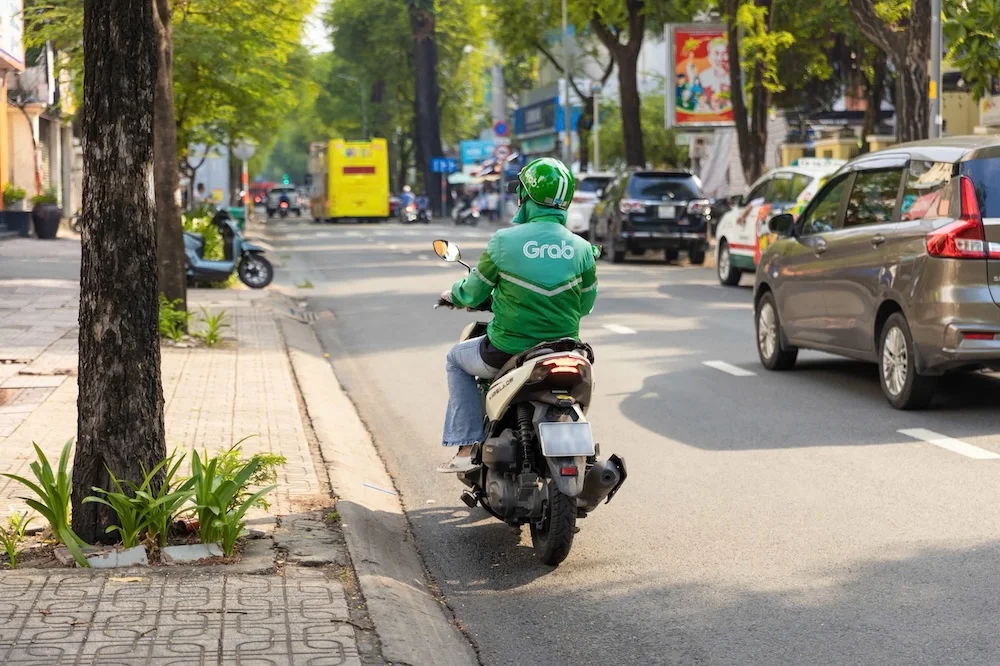
| Grab or Be motorbike | Bến Thành | 10 to 15 min | 20,000 to 35,000 VND (0.80 to 1.35 USD) | Solo travellers, fastest option |
| Grab car | Downtown | 10 to 20 min | 50,000 to 80,000 VND (2 to 3 USD) | Groups, rainy days |
| Metered taxi (Vinasun, Mai Linh) | Downtown | 10 to 20 min | 55,000 to 80,000 VND (2 to 3 USD) | No app needed; insist on the meter |
| Bus | Routes 18, 93, 150, 152 | Varies | 5,000 to 7,000 VND | Cheapest, but routes change often |
| Metro Line 1 | Ba Son station, then 2 km | 30 min plus transfer | Low | Travellers coming from Thủ Đức |
A few honest notes on this table. Walking in Saigon means heat, broken or blocked sidewalks and crossing traffic, so the times above assume a brisk pace and a red light or two. Bus routes change often enough that the BusMap app is more reliable than any printed list. Metro Line 1 opened in December 2024, but Ba Son station is still about 2 km from the pagoda, so it mainly helps travellers arriving from the east.
From Tân Sơn Nhất airport the distance is about 6 to 7 km, usually 20 to 45 minutes depending on traffic. Some guides claim 1 to 1.5 hours, which is pessimistic outside the worst rush hour.
Best time to visit
Arrive at opening and leave by 9:00 for soft light, fewer tour groups and morning worshippers. Late afternoon is the second-best window. Late morning brings the buses.
The dry season from December to April is the most comfortable. March to May is the hottest stretch. In the rainy season, roughly May to November, heavy afternoon downpours make mornings the better choice; a downpour is also a decent excuse to shelter inside and watch the courtyard empty.
The lunar calendar changes everything. The 1st (mùng 1) and 15th (rằm) of each lunar month bring crowds, earlier opening and the best atmosphere. Choose them for the experience, avoid them for calm.
| Occasion | Lunar date | Next Gregorian date | Expect |
|---|---|---|---|
| 1st of the 10th lunar month | Mùng 1 | Around 9 November 2026 | Busy, early opening |
| 15th of the 10th lunar month | Rằm | Around 23 November 2026 | Busy, full moon crowds |
| Tết | 1st of the 1st lunar month | 6 February 2027 | Very busy, festive |
| Jade Emperor's festival (vía Ngọc Hoàng) | 9th of the 1st lunar month | 14 February 2027 | The biggest day: thousands of pilgrims, ceremonies, long queues |
| Rằm tháng Giêng | 15th of the 1st lunar month | 20 February 2027 | Very busy |
All lunar conversions above are calculated estimates. Confirm them against a Vietnamese lunar calendar before you plan around them.
Etiquette, rules and real risks
Cover shoulders and knees. Sarongs and wraps are not reliably available at the gate, so bring a scarf.
Enter halls through the side doors rather than the central door, and step over the raised threshold rather than on it. Shoe rules differ between Chinese-style halls and Vietnamese Buddhist pagodas, so check the signs and follow what worshippers do.
Do not touch altars or statues unless worshippers are doing so as part of a ritual, as they do at the matchmaking and fertility figures. Keep your voice low. Do not point your feet at altars when sitting.
Photography is generally allowed without flash. Never photograph people praying at the fertility shrine. Some notices ask visitors to request permission before filming inside the shrines, and tripods and drones are a firm no.
The real risks are mundane: pickpocketing on festival days, heavy smoke for asthmatics and pregnant visitors, heat exhaustion on the walk from downtown, pushy vendors at the gate, and motorbike traffic on narrow Mai Thị Lựu.
What to combine nearby
- Trần Hưng Đạo Temple: under 1 km, a Vietnamese hero cult rather than Chinese deities.
- Saigon Zoo and Botanical Gardens, with the Museum of Vietnamese History in its grounds: about 1 km.
- Tân Định Church (the pink church) and Tân Định Market for lunch: about 1.5 km.
- Hồ Con Rùa (Turtle Lake roundabout): about 1.5 km.
- Notre Dame Cathedral and the Central Post Office: about 2 to 2.5 km.
- War Remnants Museum: about 2 km.
A sensible morning: pagoda at opening, then the Trần Hưng Đạo Temple, then the zoo and museum, then lunch near Tân Định Market. Confirm distances on a map before setting out, since construction and one-way streets shift the walking routes.
FAQ
Q: Is the Jade Emperor Pagoda worth visiting? Yes, if you are interested in Chinese folk religion and can combine it with nearby sights. The statue collection and active worship are the draw. Visitors expecting a large, grand complex may find it small and smoky, so allow 30 to 60 minutes and go early.
Q: What is the Jade Emperor's name? In Chinese he is Yù Huáng or Yùhuáng Shàngdì, and in Vietnamese Ngọc Hoàng Thượng Đế. Some Chinese folk traditions give his mortal name as Zhang Bairen. He is the supreme ruler of Heaven in Chinese popular religion.
Q: What god is associated with jade? The Jade Emperor, whose title uses jade as a symbol of purity and imperial virtue. In Vietnam he is also the deity the Kitchen Gods report to before Tết.
Q: What is a pagoda in Vietnam? A "chùa" is a Buddhist place of worship, not necessarily a tower, as distinct from a đền (temple), miếu (shrine) or điện (hall of a deity). This site began as a Taoist điện and became a registered Buddhist chùa in the 1980s.
Q: Is there an entrance fee and what are the opening hours? Entry is free, with donations welcome. The last known hours are about 7:00 to 17:30 daily, with earlier opening and later closing on the 1st and 15th of each lunar month. Published sources disagree, so treat the hours as approximate as of October 2026.
Q: Can I take photos inside? Generally yes, without flash. Avoid photographing people praying, especially at the fertility shrine, and follow any posted restrictions.
Q: Why is it called the Tortoise Pagoda? Because of the pond in the courtyard, where worshippers release turtles for merit. The practice raises welfare concerns, since released pet-trade turtles are often non-native and the pond is overcrowded.
Q: Is it suitable for children? Yes, for most children, but the Ten Hells panels show graphic punishments that may frighten young children, and the incense smoke can be heavy.
Your questions and tips
A question, an update, an experience to share? Our team reads every message before it is published.
No comments yet. Ask the first question or share a tip!