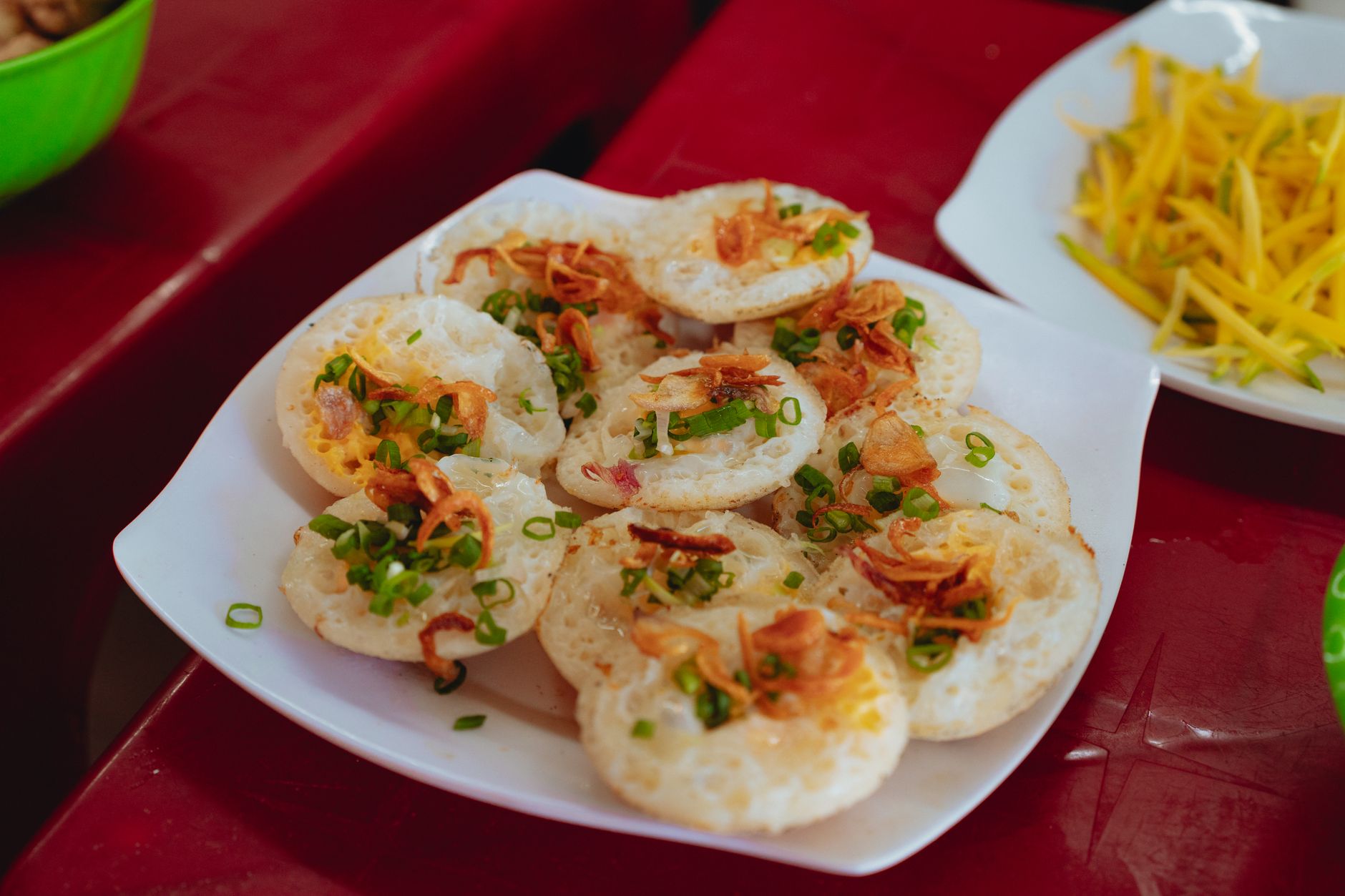
One is rich, creamy, and coconut-forward. The other is firm, eggy, and restrained. One demands to be wrapped in lettuce and dipped in sweet-sour fish sauce. The other can be eaten plain, with the yolk running across your plate.
This guide breaks down every difference that matters to a traveler. The batter science. The regional variations. The correct wrapping technique. And where to find the best version of each.
What are banh khot and banh can? The quick definition
Both are mini pancakes cooked in specialized cast-iron molds with multiple round indentations. The molds sit over a flame, each cavity filled with batter and toppings. The result is a small, round pancake with a crispy edge and a soft center.
Banh khot comes from Vung Tau, a coastal city southeast of Ho Chi Minh City. The batter uses rice flour and coconut milk, creating a rich, creamy interior. A whole shrimp is pressed into each pancake before cooking.
Banh can comes from Dalat and the Central Highlands. The batter is simpler — rice flour and water only. After the batter sets, a quail egg is cracked on top. The egg provides all the richness.
Despite their visual similarity, these are distinct regional specialties with different textures, flavors, and dipping philosophies.
| Feature | Banh khot | Banh can |
|---|---|---|
| Origin | Vung Tau (coastal) | Dalat (highlands) |
| Batter base | Rice flour + coconut milk | Rice flour + water |
| Key flavor | Rich, creamy, coconut | Neutral, egg-forward |
| Topping star | Whole shrimp | Quail egg |
| Dipping sauce style | Sweet-sour with shredded papaya | Thin, salty, sometimes spicy |
| Best eaten | Wrapped in lettuce or rice paper | Direct or wrapped |
The origin story: Why geography created two different pancakes
The differences start with the ingredients available in each region.
Vung Tau is a fishing port on the South China Sea. Coconut palms line the coast. Seafood is abundant. The local cuisine reflects this abundance. Coconut milk adds richness to many dishes, from banh khot to seafood hot pots. The shrimp in banh khot are caught locally, often the same morning.
Dalat sits in the Central Highlands at 1,500 meters above sea level. The climate is cool year-round, with average temperatures of 15-24°C. The soil supports vegetable farms, flower gardens, and poultry. Eggs are plentiful and cheap. Coconut palms do not grow here.
The French colonial period shaped both dishes. The specialized cast-iron mold used for both pancakes resembles the French mini-crêpe pan. The word "can" in banh can likely derives from the French "canne" or "cane," referring to the mold's handle. Street vendors adapted the French technique using local ingredients.
Batter breakdown — what makes each pancake different
Banh khot batter: Coconut milk as the star
The batter starts with rice flour, coconut milk, turmeric, and sometimes shrimp powder. The coconut fat creates a soft, almost custard-like interior. The edges turn lacy and brown where the batter meets the hot oil.
No eggs go into the batter itself. The richness comes entirely from coconut milk. Good banh khot batter has the consistency of heavy cream — thick enough to hold shape, thin enough to spread in the mold.
The cooking temperature matters. Too low, and the coconut milk separates, leaving a greasy pancake. Too high, and the outside burns before the inside cooks. A skilled vendor adjusts the flame constantly.
Banh can batter: Simple, neutral, egg-forward
Banh can batter uses rice flour and water only, sometimes with a pinch of salt. The batter is thinner than banh khot batter, closer to the consistency of milk.
The quail egg provides all the richness. The egg is cracked on top of the batter after it sets in the mold. The yolk stays runny, the white firms up around it.
The pancake stays firmer and less creamy than banh khot. The texture is more uniform, with less contrast between edge and center.
Side-by-side texture profile
| Texture element | Banh khot | Banh can |
|---|---|---|
| Crispiness of edge | Very crispy, lacy, brown | Moderately crispy, even |
| Center texture | Soft, custard-like, creamy | Firm, slightly chewy |
| Richness | High (coconut fat) | Moderate (egg yolk only) |
| Oiliness | Can be greasy if poorly made | Generally less oily |
| Mouthfeel | Melts in the mouth | Requires chewing |
Toppings and fillings — shrimp, egg, and everything else
Banh khot: Whole shrimp, green onion, mung bean
The classic Vung Tau version has a small whole shrimp pressed into the batter before cooking. Some vendors use two shrimp per pancake. The shrimp cooks in the batter, staying tender and sweet.
Sliced green onion goes on top. Some versions add mung bean paste for extra creaminess. The bean paste is spread on the pancake after cooking, adding another layer of texture.
Banh can: Quail egg, dried shrimp, pork fluff
After the batter sets in the mold, a quail egg is cracked on top. The egg cooks gently, the white firming up while the yolk stays runny.
Additional toppings include dried shrimp (tép khô), shredded pork fluff (chà bông), or scallion oil. Some versions add a slice of Chinese sausage (lạp xưởng). The sausage adds sweetness and fat.
Regional variations within each dish
Banh khot variations:
- Vung Tau: Classic version with whole shrimp, golden batter from turmeric
- Ho Chi Minh City: Larger pancakes, more coconut milk, sometimes no shrimp
- Da Nang: Smaller pancakes, less coconut, firmer texture
- Can Tho: Added mung bean paste, sweeter dipping sauce
Banh can variations:
- Dalat: Quail egg standard, dried shrimp on top
- Nha Trang: Adds squid to the topping
- Phan Rang: Spicier version with fresh chili in the batter
- Buon Ma Thuot: Larger portions, more toppings, soy-based dipping sauce
The dipping sauce — nuoc cham vs. nuoc mam pha vs. other dips
Banh khot dipping sauce: Sweet, sour, with shredded papaya
A modified nuoc cham. Fish sauce, lime juice, sugar, garlic, and chili. Shredded green papaya or carrot adds crunch and absorbs the sauce.
The sweetness balances the rich coconut batter. The acidity cuts through the fat. The shredded vegetables add texture to the soft pancake.
Banh can dipping sauce: Light, salty, sometimes spicy
A thinner, saltier fish sauce dip. Sometimes with sliced chili and garlic only. No shredded vegetables.
In Dalat, some vendors serve a dark, thicker sauce made from soy sauce or fermented shrimp paste (mắm nêm). This sauce is polarizing. First-timers should taste before committing.
Other accompaniments
Both dishes come with fresh herbs: mint, basil, perilla, and lettuce. Pickled vegetables (carrot and daikon) add acidity. Some vendors provide rice paper (bánh tráng) for wrapping.
Banh khot is almost always wrapped. Banh can can be eaten directly or wrapped, depending on the vendor and the eater's preference.
How to eat banh khot and banh can — the right way
The wrap technique for banh khot
- Take a lettuce leaf or piece of rice paper
- Add fresh herbs (mint, basil, perilla)
- Place the pancake on top
- Add pickled vegetables
- Roll tightly
- Dip into the sweet-sour sauce
- Eat in one bite
The goal is a single bite that balances crispy, creamy, fresh, and sour. The lettuce provides crunch. The herbs add aroma. The pancake brings richness. The sauce ties everything together.
The wrap technique for banh can
The same basic process applies, but the egg yolk requires gentler handling. The yolk can break easily, making a mess.
Some eaters skip the wrap entirely. They eat the pancake directly with herbs on the side. This is perfectly acceptable and often more practical.
If wrapping, handle the pancake carefully. Place it on the lettuce with the egg yolk facing up. Roll loosely. Do not squeeze.
Common mistakes travelers make
Over-dipping makes the pancake soggy. A quick dip is enough.
Wrapping too tight bursts the yolk. Loose rolls work better.
Using too much herb overpowers the egg. A few leaves are enough.
Eating cold is a crime. Both dishes suffer after 5 minutes off the griddle. Eat immediately.
Pro tip: Watch how locals eat. Dalat residents often eat banh can directly from the skewer or with chopsticks, dipping each piece quickly and eating it in two bites. Vung Tau residents wrap banh khot carefully and eat it whole.
Where to eat the best banh khot in Vietnam
Vung Tau — the birthplace
Hoang Hoa Tham Street has the highest concentration of banh khot vendors. The night market near Bai Truoc (Front Beach) is another reliable area.
Look for these signs of quality:
- Golden batter from turmeric, not pale yellow
- Whole shrimp visible through the thin batter
- Lacy, brown edges on each pancake
- High turnover — a queue means fresh pancakes
Ho Chi Minh City — the second home
District 4 has excellent banh khot, especially along Vo Van Kiet Street. District 7 has several well-known stalls catering to expats and tourists.
Quality indicators in Saigon:
- Batter should be thin enough to see the shrimp through
- Edge should be lacy and brown, not pale
- Coconut milk should be visible as a creamy layer
Other cities with notable banh khot
Da Nang serves smaller, firmer pancakes with less coconut. Nha Trang adds seafood to the topping. Can Tho uses more mung bean paste.
Where to eat the best banh can in Vietnam
Dalat — the undisputed capital
The night market (chợ đêm Đà Lạt) has dozens of banh can stalls. The area around Hoa Binh Square is another reliable zone. Nguyen Van Troi Street has several long-standing vendors.
Look for these signs of quality:
- Fresh quail eggs with bright orange yolks
- Dried shrimp that are plump, not shriveled
- Traditional clay griddles (metal is modern, clay is traditional)
- Batter that sizzles immediately on contact
Other highland cities
Buon Ma Thuot serves larger portions with more toppings. Pleiku adds a spicier dipping sauce. Both cities use chicken eggs more often than quail eggs.
Pro tip: In Dalat, the best banh can vendors use clay griddles. The clay distributes heat more evenly than metal. Ask for "bánh căn đất nung" (clay griddle banh can) to find the traditional version.
Banh khot vs. banh can — which one should you try?
Choose banh khot if:
- You love coconut flavor
- You want a richer, creamier texture
- You enjoy wrapping food in lettuce
- You prefer sweet-sour dipping sauces
Choose banh can if:
- You love eggs
- You want a lighter, less oily dish
- You prefer eating directly without wrapping
- You enjoy runny egg yolks
Dietary considerations:
Banh khot is gluten-free (rice flour, no wheat). But it is high in saturated fat from coconut milk. A serving of 10-15 pancakes contains significant coconut cream.
Banh can is lighter in fat but high in cholesterol from the egg yolk. Each pancake uses one quail egg. A serving of 10-15 pancakes means 10-15 egg yolks.
Neither dish is traditionally vegetarian. Banh khot contains shrimp. Banh can contains egg. The dipping sauce for both uses fish sauce.
How to find the best vendor — what locals look for
Visual cues matter more than online reviews. Street food vendors change location. Reviews go out of date. These signs never do.
| Cue | What to look for | Red flag |
|---|---|---|
| Batter consistency | Flows smoothly, not too thick or thin | Lumpy, separated, or watery batter |
| Oil temperature | Sizzles immediately, not smoking | No sizzle (too cool) or smoking (too hot) |
| Turnover rate | Queue of customers, empty molds filled quickly | Pre-cooked pancakes sitting out |
| Dipping sauce | Balanced sweet-sour-salty, fresh ingredients | Separated, cloudy, or overly salty sauce |
| Equipment | Clean molds, fresh oil, covered ingredients | Burnt residue on molds, dark oil, uncovered toppings |
Making banh khot and banh can at home — is it worth it?
The specialized molds are cheap. Kitchen supply shops sell them for 50,000-100,000 VND ($2-4). The ingredients are simple.
The technique takes practice. The biggest challenge is getting the batter-to-oil ratio right for the crispy edge. Too much oil makes greasy pancakes. Too little oil makes flat, soggy pancakes.
Banh can is easier to start with. The batter is simpler. The cooking process is more forgiving. The egg hides minor imperfections.
Banh khot requires more skill. The coconut milk burns easily. The batter needs the right consistency. The shrimp must be placed at the right moment.
Warning: Do not attempt either dish without the proper mold. A regular frying pan will not produce the same result. The mold's design creates the characteristic shape and crispy edge.
Common misconceptions about banh khot and banh can
Misconception 1: Banh khot and banh can are the same dish. They look similar but use different batters, toppings, and sauces. One is coconut-rich. One is egg-forward.
Misconception 2: Banh can is a smaller banh xeo. Banh xeo is a large, crispy crepe filled with bean sprouts and shrimp. Banh can is a small, thick pancake topped with egg. Different batter, different cooking method, different dish.
Misconception 3: Banh khot always has shrimp. The classic version does. But some vendors in Ho Chi Minh City serve shrimp-less versions with just batter and green onion. These are rare and considered inferior by purists.
Misconception 4: Both dishes are vegetarian. Banh khot contains shrimp. Banh can contains egg. The dipping sauce contains fish sauce. Vegetarian versions exist in tourist areas but are not traditional.
Traveler's checklist for eating banh khot and banh can
- Carry wet wipes. Your fingers will get greasy.
- Bring small change. Street food vendors rarely have change for large bills.
- Avoid empty stalls. Freshness matters. A queue means the pancakes are coming off the griddle now.
- Learn the phrases: "Cho tôi mười cái bánh khọt" (Ten banh khot please) or "Cho tôi mười cái bánh căn" (Ten banh can please).
- Ask for no MSG if you are sensitive. "Không bột ngọt" (No MSG).
- Eat immediately. Both dishes lose quality within minutes.
- Expect prices of 5,000-10,000 VND ($0.20-0.40) per pancake. A full meal costs 50,000-200,000 VND ($2-8).
FAQ
Q: What is the difference between banh khot and banh can? The main differences are the batter (banh khot uses coconut milk, banh can uses just rice flour and water), the topping (banh khot has a whole shrimp, banh can has a quail egg cracked on top), and the dipping sauce (banh khot uses a sweet-sour nuoc cham with shredded papaya, banh can uses a thinner, saltier fish sauce).
Q: Is banh khot the same as banh can? No. They look similar because both are small round pancakes cooked in specialized molds, but they are distinct regional dishes. Banh khot comes from Vung Tau and is rich with coconut milk. Banh can comes from Dalat and is topped with a quail egg.
Q: Where is the best banh khot in Vietnam? Vung Tau is the birthplace and has the highest concentration of quality vendors, especially around Hoang Hoa Tham Street and the Bai Truoc night market. Ho Chi Minh City also has excellent banh khot, particularly in District 4 and District 7.
Q: Where is the best banh can in Vietnam? Dalat is the undisputed capital. The night market (chợ đêm Đà Lạt) and the stalls around Hoa Binh Square serve the most authentic versions. Look for vendors using traditional clay griddles rather than metal ones.
Q: Is banh khot gluten-free? Yes, traditionally. The batter is made from rice flour, coconut milk, and turmeric — no wheat flour. However, some vendors may add wheat flour for texture, so travelers with celiac disease should confirm with the vendor.
Q: How many banh khot or banh can should I order? A typical serving is 10-15 pieces per person as a snack or light meal. For a full meal, 15-20 pieces is common. Prices range from 5,000-10,000 VND ($0.20-0.40) per piece, so a full serving costs 50,000-200,000 VND ($2-8).
Q: Can I eat banh khot or banh can if I am vegetarian? Not easily. Banh khot traditionally contains shrimp, and banh can contains egg. Some tourist-oriented vendors in Ho Chi Minh City and Dalat offer vegetarian versions with mushrooms or tofu, but they are rare. The dipping sauce typically contains fish sauce.
Q: What is the correct way to eat banh khot? Take a lettuce leaf or rice paper, add fresh herbs (mint, basil, perilla), place the pancake, add pickled vegetables, roll tightly, then dip into the sweet-sour nuoc cham. Eat in one bite to get the full balance of textures and flavors.