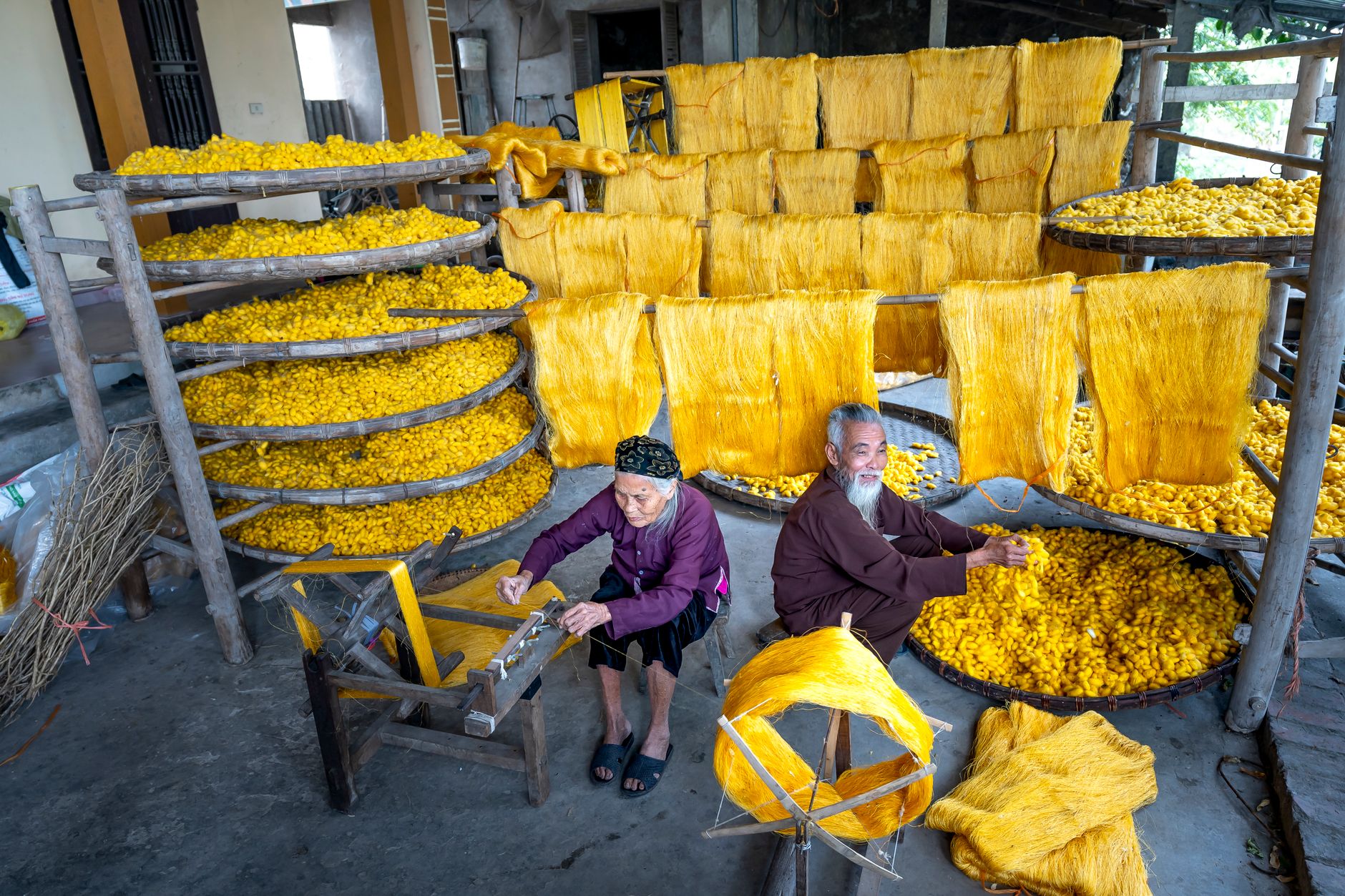
The journey from cocoon to cloth
Understanding silk production takes about ten minutes. Watching it happen takes longer. The process starts with silkworms feeding on mulberry leaves for around 25 days. Each worm spins a single continuous thread of silk around itself to form a cocoon. That thread can stretch over 900 meters.
Workers boil the cocoons to loosen the sericin, a natural gum that holds the threads together. They then find the loose end of each cocoon and unwind it onto a reel. This is called reeling. It takes roughly 2,500 cocoons to produce one kilogram of raw silk. A single meter of fabric needs about 100 cocoons.
The raw silk threads are twisted together to create yarn. This yarn gets dyed, either with modern chemical dyes or traditional natural dyes made from indigo, turmeric, and mangrove bark. Finally, weavers work the yarn on looms. Traditional wooden looms produce around one meter of fabric per day. Electric looms can produce ten times that amount.
The entire process, from egg to finished fabric, takes about 40 days. Villages in Vietnam have done this the same way for centuries, passing techniques down through families.
Van Phuc: a thousand-year-old silk village on Hanoi's doorstep
Van Phuc sits in Ha Dong district, about 10 kilometers southwest of Hanoi's Old Quarter. The village claims a history of silk weaving stretching back more than 1,000 years. During the Ly dynasty, Van Phuc silk was reserved for the royal court. Today, around 800 households still work in silk production.
The main street, called Ha Dong Silk Street, runs through the village. Shops line both sides, displaying rolls of fabric in every color. Behind the shops, workshops house the looms. Most visitors spend two to three hours walking the street, watching weavers, and browsing fabric.
Van Phuc specializes in a fabric called "van" silk, a high-quality mulberry silk known for its sheen and durability. The village also produces "sa" silk, a lighter fabric used for summer clothing and ao dai. Prices here run lower than in tourist shops in Hanoi's Old Quarter because there are fewer middlemen.
Getting to Van Phuc is straightforward. Take bus number 02 from the Old Quarter to the Ha Dong stop, then walk 10 minutes. A Grab taxi costs around 150,000 to 200,000 VND ($6 to $8) each way. The village works best as a morning trip, with lunch at one of the local restaurants serving bun cha or cha ca.
The best time to visit is mid-morning, when the workshops are active and the light is good for photography. Ask before photographing weavers at work. Many appreciate a small tip of 20,000 to 50,000 VND ($1 to $2) if you take their portrait. Read more about photography etiquette in Vietnam for the full picture.
The silk village outside Hoi An
Hoi An's silk village sits about 3 kilometers from the ancient town center, on the road toward Tra Que vegetable village. Officially named Hoi An Silk Village, it opened in 2011 as a combination of working workshop, museum, and boutique. Unlike Van Phuc, which feels like a living neighborhood, Hoi An's silk village is a curated experience.
The complex includes a mulberry garden, a silkworm house, a reeling station, and rows of looms. Staff guide visitors through each stage of production. The tour takes about 45 minutes and ends at the showroom, where scarves, ao dai, and fabric by the meter are for sale.
Hoi An's silk village also runs a tailoring service. This is one of the few places in town where you can buy silk on-site and have it made into a garment within 24 to 48 hours. A custom ao dai costs 1,500,000 to 3,500,000 VND ($60 to $140) depending on fabric and embroidery. Read more about the ao dai's history and cultural significance.
The village charges no entry fee for the workshop area. The guided tour, which includes a silkworm feeding session, costs 100,000 VND ($4). The showroom prices run higher than Van Phuc, reflecting the tourist location. A basic silk scarf starts at 250,000 VND ($10). Compare this with the same scarf in Hoi An's night market, where the starting price is often 150,000 VND ($6) but the silk content is questionable.
How to tell real silk from fake
The silk market in Vietnam has a counterfeit problem. Many stalls sell "silk" that is actually polyester, rayon, or a silk blend with less than 30 percent real silk. This is especially common in tourist-heavy areas like Hoi An's night market, Hanoi's Old Quarter, and Ben Thanh Market in Ho Chi Minh City.
The burn test is the most reliable method. Pull a loose thread from the fabric and light it with a lighter. Real silk burns with a smell like burning hair. The ash is dark, brittle, and crumbles between your fingers. Polyester melts, smells like plastic, and leaves a hard bead. Rayon burns quickly with a paper-like smell but leaves fine ash.
The touch test works too. Real silk feels smooth but not slippery. It adapts to your body temperature. Polyester feels cold and slick. When you crumple real silk, it wrinkles softly. Polyester springs back. Silk also makes a soft rustling sound when rubbed together, called "scroop." Polyester is silent.
The price test filters out most fakes. Real mulberry silk cannot be sold for less than 200,000 VND ($8) per meter at wholesale. If a scarf costs 100,000 VND ($4), it is not real silk. If a full ao dai costs under 800,000 VND ($32), the fabric is blended or synthetic. Trust the math, not the sales pitch.
For guaranteed quality, buy from registered workshops in Van Phuc or Hoi An Silk Village. Look for the label of the Vietnam Silk Association. This certification appears on fabric rolls and garment tags. It is not foolproof, but it raises the odds in your favor.
A comparison table for the two villages
| Feature | Van Phuc | Hoi An Silk Village |
|---|---|---|
| Location | 10 km from Hanoi | 3 km from Hoi An old town |
| Entry fee | Free | Free for workshop, 100,000 VND ($4) for tour |
| Silk types | Van silk, sa silk, mulberry silk | Mulberry silk, lotus silk, blends |
| Price per meter | 300,000 to 600,000 VND ($12 to $24) | 400,000 to 800,000 VND ($16 to $32) |
| Tailoring | Limited, few tailors on site | Full service, 24 to 48 hour turnaround |
| Atmosphere | Working village, authentic | Curated experience, tourist-friendly |
| Best for | Bargain hunters, cultural immersion | First-timers, custom garments |
| Time needed | 2 to 3 hours | 1.5 to 2 hours |
Lotus silk: the expensive cousin
Vietnam produces another type of silk that few travelers know about. Lotus silk comes from the stems of lotus flowers, not silkworms. The process is labor-intensive. Workers harvest lotus stems, break them, and pull out thin fibers. These fibers are spun by hand into thread. It takes about 5,000 lotus stems to produce one meter of fabric.
Lotus silk is soft, breathable, and has a natural beige color. It costs significantly more than mulberry silk. A scarf made of lotus silk sells for 1,000,000 to 2,500,000 VND ($40 to $100). A full garment can cost upwards of 5,000,000 VND ($200). Hoi An Silk Village and a few workshops near Hanoi produce lotus silk. It is a niche product, but worth knowing about if you want something rare.
The production of lotus silk happens mainly in summer, when lotus flowers bloom. Visiting between June and August gives you a chance to see the process live. This aligns with the rainy season in northern Vietnam, so plan accordingly. Check the weather guide for monsoon months before scheduling a silk village visit.
Where to buy silk beyond the villages
If you cannot make it to the villages, several reliable shops in major cities sell certified silk. In Hanoi, the Van Phuc Silk shop at 76 Hang Gai Street carries fabric from the village. Prices run 10 to 20 percent higher than at the source. In Hoi An, the A Dong Silk shop at 40 Tran Phu Street has a strong reputation for quality and fair pricing.
For tailors who work with silk, the rule is simple: bring your own fabric. Tailors in Hoi An and Hanoi will happily make a garment from silk you bought elsewhere. This often saves money because tailor shop fabric markups run high. A custom shirt from your own silk costs 400,000 to 700,000 VND ($16 to $28) for tailoring alone.
Beware of "silk tours" that bundle a village visit with a mandatory stop at a "factory showroom." These are commission-based operations. The silk quality is often lower and the prices higher than independent workshops. The best approach is to go independently, take your time, and buy from a workshop where you can watch the loom running.
The future of Vietnam's silk villages
Silk production in Vietnam faces real challenges. Cheap imported silk from China undercuts local prices. Younger generations show less interest in weaving, which is slow and poorly paid. A skilled weaver earns 200,000 to 300,000 VND ($8 to $12) per day, less than a construction worker.
Still, there are signs of revival. Domestic demand for ao dai has grown, and the national dress is worn more frequently in schools and offices. The ao dai's popularity supports silk weavers. Read about how the ao dai story continues to evolve. Export markets in Japan and Europe pay premium prices for certified Vietnamese silk. Some villages, like Van Phuc, have started cooperatives to share resources and train new weavers.
Travelers contribute to this economy. Every meter of silk bought at a village workshop puts money directly into a weaver's pocket. That matters more than any government program. Buying silk in Vietnam is not just souvenir shopping. It is a vote for keeping a craft alive.
Practical tips for your silk village visit
Carry cash. Most village workshops do not accept cards. ATMs exist in Hanoi and Hoi An city centers but not in the villages themselves. Bring smaller denominations. Negotiation is expected, but keep it respectful. A 10 to 15 percent discount is reasonable. Read the bargaining guide for more details.
Wear comfortable shoes. Van Phuc's main street is paved, but the workshop alleys are uneven. Hoi An Silk Village has smooth walkways. Both are stroller-friendly. Bring water in summer. The workshops get hot, especially around the boiling cocoons.
If you want to see the full production cycle, time your visit. Silkworms are raised year-round, but the busiest production months are March to May and September to November. During Tet, the lunar new year, most workshops close for a week. Check the Tet guide for exact dates.
For families, the silkworm house at Hoi An Silk Village is a hit with kids. Watching worms spin cocoons rarely fails to fascinate. The Hoi An village also has a small cafe serving lotus tea and mulberry juice. Van Phuc has fewer amenities, so eat before you go or plan to return to Hanoi for lunch.
Both villages are easy to combine with other sights. Van Phuc sits near the Ha Dong area, which has several pagodas worth a quick visit. Hoi An Silk Village is a short ride from Tra Que vegetable village and the An Bang beach. A half-day itinerary covering silk and vegetables works well. Read the Hoi An travel guide for a full list of options.
FAQ
Q: How much does real silk cost in Vietnam? A: Real mulberry silk costs 300,000 to 800,000 VND ($12 to $32) per meter at village workshops. Scarves run 200,000 to 500,000 VND ($8 to $20). Full ao dai made from silk cost 1,500,000 to 3,500,000 VND ($60 to $140). Prices below these ranges indicate synthetic blends.
Q: Is it better to buy silk in Van Phuc or Hoi An? A: Van Phuc offers lower prices and a more authentic working village atmosphere. Hoi An Silk Village provides a curated experience with English-speaking guides and full tailoring services. Choose Van Phuc for bargains and cultural immersion. Choose Hoi An for convenience and custom garments.
Q: Can I wash silk bought in Vietnam? A: Yes, but carefully. Hand wash in cold water with a mild detergent. Do not wring or twist. Roll in a towel to remove excess water, then hang to dry away from direct sunlight. Dry cleaning is safest for structured garments like ao dai.
Q: How long does a custom silk garment take to make? A: A simple scarf or tie takes 2 to 4 hours. A shirt or blouse takes 24 hours. An ao dai with embroidery takes 2 to 3 days. Factor in a fitting session. Most tailors in Hoi An can ship internationally for an extra fee.
Q: What is the difference between mulberry silk and lotus silk? A: Mulberry silk comes from silkworms fed on mulberry leaves. It is smooth, strong, and takes dye well. Lotus silk comes from lotus stem fibers, is hand-spun, softer, and has a natural beige color. Lotus silk costs two to three times more due to the labor involved.
Q: Are silk paintings from Vietnam worth buying? A: Yes, if you buy from established artists. Silk paintings from Van Phuc and Hoi An range from 500,000 to 5,000,000 VND ($20 to $200). Check the quality of the silk and the painting technique. Cheap reproductions printed on silk-like fabric are common. Buy from galleries, not street stalls.
Q: Can I visit the silk villages during the rainy season? A: Yes. The villages are indoors or under covered walkways. Rain does not disrupt production. The main issue is transport. Roads from Hanoi to Van Phuc can get congested in heavy rain. Read the rainy season guide for more details on planning.