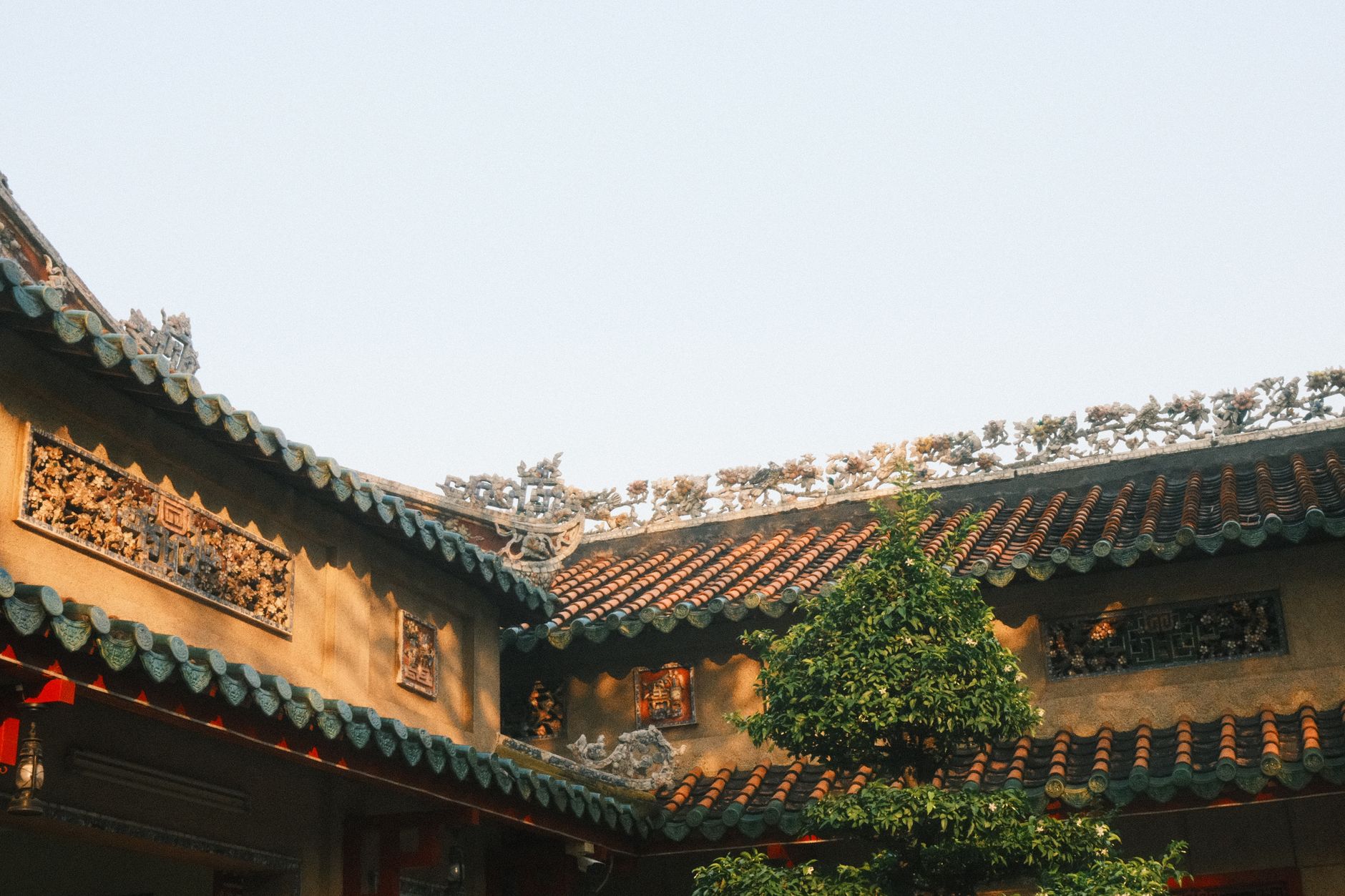
Pagoda, temple, đình: knowing what you are visiting
It is the question everyone asks, and most English-language sources answer it badly. Localvietnam.com claims, for example, that monks live in temples. That is false.
A pagoda (chùa) is a Buddhist place. Monks or nuns reside there, and the main building is dedicated to the Buddha and the bodhisattvas. A temple (đền) honours a national hero, a deity or a local spirit. It has no resident clergy: a caretaker, the thủ từ, maintains it and receives the faithful.
| Vietnamese term | Translation | Dedicated to | Clergy | Example |
|---|---|---|---|---|
| Chùa | Pagoda | Buddha, bodhisattvas | Monks or nuns | Tran Quoc (Hanoi) |
| Đền | Temple | Heroes, spirit, deity | Caretaker (thủ từ) | Temple of Literature |
| Đình | Communal house | Village tutelary spirit | Caretaker | Đình near Hoi An |
| Miếu | Small shrine | Local deity | None | Many along roadsides |
| Phủ / điện | Palace | Mother Goddesses (Đạo Mẫu) | Mediums during rituals | Tay Ho Palace (Hanoi) |
| Văn Miếu | Confucian temple | Confucius and scholars | Caretaker | Temple of Literature |
| Hội quán | Chinese congregation hall | Chinese deity | Congregation committee | Phúc Kiến (Hoi An) |
| Tháp | Tower | Originally Hindu | None (site) | Po Nagar (Nha Trang) |
| Thánh thất / Tòa Thánh | Caodaist temple | Cao Đài | Caodaist priests | Tây Ninh |
| Wat / chùa Khmer | Theravada pagoda | Buddha | Khmer monks | Âng (Trà Vinh) |
The misleading English names
Three cases come up again and again.
The "Jade Emperor Pagoda" (Phước Hải Tự), in Ho Chi Minh City, is a Taoist temple. The "Ong Pagoda" in Chợ Lớn is a Chinese congregation hall dedicated to Quan Đế. And the "Thay Temple" found on Tripadvisor is actually Chùa Thầy, a Buddhist pagoda.
Useful reflex: look up the Vietnamese name on Google Maps before you leave. The first word (chùa, đền, đình, phủ) tells you what you are dealing with.
And the "Angkor temples"?
Angkor is in Cambodia, not Vietnam. The Vietnamese equivalents are the Cham towers (My Son, Po Nagar, Po Klong Garai) and the Khmer pagodas of the Mekong Delta. The confusion is common in search results, including on social media.
The religions behind the shrines
Vietnam is often presented as a Buddhist country. The statistical reality is more nuanced, and the figures contradict one another depending on the source.
The 2019 census indicates that about 86% of the population declares no religion. Among declared believers, there are about 5.9 million Catholics and 4.6 million Buddhists. Other estimates, such as those of the Pew Research Center or the Buddhist Church of Vietnam, give 15 to 16% Buddhists, sometimes far more.
The gap is explained by one simple thing: "no religion" does not mean "no practice". Ancestor worship is almost universal, the family altar exists in most homes, and many Vietnamese visit pagodas without declaring themselves Buddhist.
The religious landscape is syncretic. Tam giáo combines Buddhism, Confucianism and Taoism in a single place of worship. Mahayana Buddhism dominates in the North and Centre, while Theravada structures the Khmer communities of the South. The worship of the Mother Goddesses (Đạo Mẫu) has been on the UNESCO intangible heritage list since 2016, and that of the Hùng kings since 2012. Caodaism was born in 1926, Hòa Hảo in 1939. Hindu (Balamon) and Muslim (Bani) Cham communities survive in the Centre.
Reading a Vietnamese pagoda
A pagoda reads like a book. The doors, statues and symbols have meaning, and the visitor who knows them understands in ten minutes what others take an hour to photograph.
The layout and the path
You enter through the tam quan, the triple gateway. The central door is reserved for deities and processions: visitors pass through the sides. Then comes a courtyard, then the main hall, where the altars are.
Some layouts follow the shape of Chinese characters (丁, 工, 国), with successive inner courtyards. The thresholds are raised: you step over them, you do not walk on them.
Recurring statues and figures
In the main hall, three Buddhas represent the past, the present and the future. Shakyamuni often occupies the central altar. Quan Âm (Avalokiteshvara), sometimes with a thousand arms, occupies a side aisle: the version at Bút Tháp, carved in 1656, is one of the most famous in the country.
Armed guardians watch at the entrance. Further on, the aligned arhats recall the Buddha's disciples. The altar of Đức Ông and that of the Mothers, present in many pagodas, bear witness to syncretism: people come there to ask for a specific favour, not only to meditate.
The swastika and other symbols
The chữ Vạn (卍) is omnipresent on the chests of statues and on decorative motifs. It is an ancient Buddhist symbol, with no connection to Nazism, and there is no reason to be concerned about it. For a European visitor, this point is worth recalling.
The lotus figures enlightenment, the dragon imperial power, the phoenix rebirth, the turtle longevity. Red and gold dominate interiors. Saffron is the colour of monastic robes.
Recognising the style at a glance
| Tradition | Region | Roof | Colours | Statues | Atmosphere |
|---|---|---|---|---|---|
| Mahayana | North, Centre | Curved roofs with raised corners | Red, gold | Buddhas, Quan Âm, arhats | Morning chanting, dense incense |
| Theravada (Khmer) | Mekong Delta | Multi-tiered, gilded roofs | Yellow, white | Single Buddha, naga | Calm, monks in saffron robes |
| Caodaist | Tây Ninh, South | Towers and dome, divine eye | Blue, yellow, red | Eye of Cao Đài, saints | Chanted services, visible hierarchy |
| Cham | Centre | Brick towers, no roof | Red brick | Linga, goddesses | Ruins, worship still alive |
| Chinese (hội quán) | Hoi An, Chợ Lớn | Low roofs, inner courtyards | Bright red | Quan Đế, Thiên Hậu | Spiral incense smoke |
The major sites of the North
The North is the cradle of Vietnamese Buddhism and the heart of the great pilgrimages. It is also the region where sites are most dense, and where you have to choose.
Central Hanoi
The Temple of Literature (1070) is the most visited site in the capital. Its 82 doctor steles have been on the UNESCO Memory of the World register since 2010. Allow one hour.
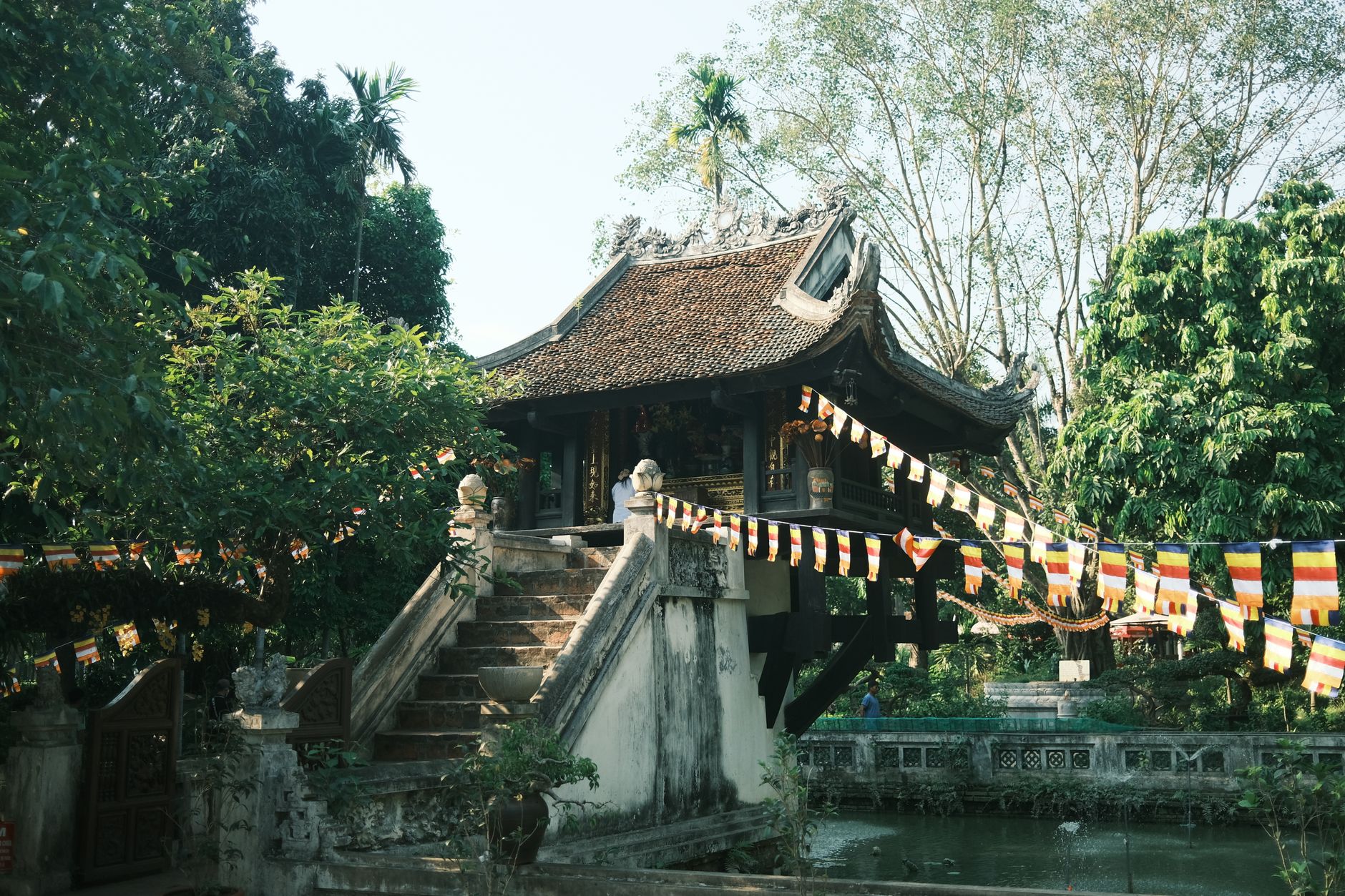
The One Pillar Pagoda (1049) was destroyed in 1954 and rebuilt in 1955. It takes fifteen minutes to visit, often combined with the Temple of Literature.
Tran Quoc is the oldest pagoda in Hanoi. Its 11-storey tower was added in 1998. Quan Su, headquarters of the Buddhist Church of Vietnam, closes between 11:30 am and 1:30 pm.
Ngoc Son, Bach Ma and Quan Thanh are among the four guardian temples of ancient Thang Long. The Tay Ho palace, dedicated to the Mother Goddesses, is very busy on the 1st and 15th of the lunar month.
Around Hanoi
Chùa Thầy and Tây Phương are about 40 km from the capital. Tây Phương has 239 steps and houses 18th-century arhat statues.
Chùa Dâu, in the former province of Bắc Ninh (now merged), is considered the oldest pagoda in the country. Bút Tháp, nearby, houses the thousand-armed Quan Âm.
The Perfume Pagoda is about 60 km away. You take a boat on the Yến river, then climb on foot or by cable car to the Hương Tích cave.
Yên Tử, about 130 km away, is the cradle of the Trúc Lâm school founded by Trần Nhân Tông. The site rises above 1,000 m in altitude and is covered in several cable-car sections.
The temples of the Hùng kings are in the former province of Phú Thọ, merged in 2025.
Ninh Binh and its mega-complexes
Bai Dinh combines an ancient pagoda from 1136 (about 300 steps) and a complex opened in 2010. Tam Chúc, in the former province of Hà Nam attached to Ninh Bình since 2025, claims an even greater scale.
Bích Động, the cave pagoda of Tam Cốc, and the temples of the Đinh and Lê kings at Hoa Lư complete the day.
The major sites of the Centre
The Centre concentrates diversity: imperial Buddhism, Chinese congregations and Cham heritage.
Hué
Thien Mu (1601) is the symbol of the city. Its 7-storey Phước Duyên tower dates from 1844. You can see Thích Quảng Đức's Austin there, but his self-immolation took place in Saigon on 11 June 1963, not in Hué. The error is widespread in guidebooks.
Từ Hiếu is the root pagoda of Thích Nhất Hạnh, who died there in January 2022. The link with Plum Village, founded in 1982 in Dordogne, is direct. Báo Quốc remains a centre of Buddhist studies.
Hoi An and Da Nang
The hội quán of Hoi An (Phúc Kiến, Quảng Đông) are included in the old town ticket. Linh Ứng, on the Sơn Trà peninsula, houses a 67 m statue of Quan Âm. The cave-shrines of the Marble Mountains take an hour to visit.
The Cham shrines
My Son has been on the UNESCO list since 1999. The site spans the 4th to 13th centuries and was heavily bombed in 1969. It was explored by the EFEO, notably by Henri Parmentier.
Po Nagar (Nha Trang) is still active, visited by Vietnamese and Cham alike. Po Klong Garai (Phan Rang, now in Khánh Hòa province) hosts the Katê festival. Tháp Đôi is in Quy Nhon.
The major sites of the South and the Central Highlands
The South is multicultural: Chinese, Khmer and Caodaist.
Ho Chi Minh City
The Jade Emperor temple was built around 1900-1906. Barack Obama visited it in 2016. The Bà Thiên Hậu pagoda (1760) and the Ông pagoda are in Chợ Lớn. Giác Lâm (1744), Vĩnh Nghiêm and Bửu Long (with its Gotama Cetiya stupa) complete the list.
The former "5th district" has no longer existed administratively since the 2025 reform. Drivers and Google Maps nevertheless continue to use these names. Give both if you book a ride-hailing car.
Tây Ninh
The Caodaist holy see is about 90-100 km from Ho Chi Minh City, or 2 h 30 to 3 h by road. Services take place at 6 am, noon, 6 pm and midnight. The noon one is the most accessible to visitors, who observe it from the gallery. Bà Đen mountain, with its cable car and shrines, can be combined in the same day.
Mekong Delta
Vĩnh Tràng (Mỹ Tho, 1849) blends Vietnamese, Khmer and French architecture. Khmer pagodas are numerous: Âng in Trà Vinh, Dơi (the bat pagoda) and Kh'leang in Sóc Trăng, Xiêm Cán. The Bà Chúa Xứ at Sam mountain (Châu Đốc) is the main pilgrimage site in the South. Tây An completes the circuit.
Dalat and the Central Highlands
The Trúc Lâm Zen monastery (1994) requires about 220 steps. Linh Phước, the mosaic pagoda, takes an hour to visit. Minh Thành (Pleiku) deserves a mention for travellers in the Central Highlands.
What is the largest temple in Vietnam? Records and authenticity
Bai Dinh is most often cited. The complex houses a 100-tonne Shakyamuni statue, a 36-tonne bell, a gallery of 500 arhats and a 13-storey tower about 100 m high. Tam Chúc claims a project of several thousand hectares. Bửu Long has a stupa about 70 m high.
The surface areas given by sources contradict one another: Bai Dinh is announced sometimes at 539 ha, sometimes at 700 ha. These records come mainly from national or regional record books, not from official measurements.
Bai Dinh and Tam Chúc are recent complexes, developed by the same private group. They impress by their scale, but are criticised for their commercialisation: paid shuttles, shops, omnipresent donation boxes.
For architectural authenticity, aim instead for Tây Phương, Bút Tháp, Dâu or Từ Hiếu. "The largest" and "the oldest" are two different questions.
Behaving properly: dress, gestures and offerings
Shoulders and knees covered, for men as well as women. Hat removed. That is the minimum, and it is enough in most cases.
No colour is forbidden in pagodas. White is the colour of mourning (funeral headbands), and some Vietnamese avoid black and white during Têt. Decency matters far more than colour. Some sites lend capes or sarongs, but you should not count on it.
| Situation | Good reflex | Common mistake |
|---|---|---|
| Entrance to a Khmer shrine | Take off your shoes | Keeping your shoes on the mats |
| Main altar | Bow, step back | Pointing your feet towards the Buddha |
| Theravada monk | Greet from a distance | Woman handing an object hand to hand |
| Stupa | Walk clockwise | Photographing with your back to the statue |
| Incense | Burn an odd number of sticks | Throwing votive paper outside the burner |
| Worshipper praying | Ask before photographing | Flash during a ceremony |
Do not touch a monk's head. In Theravada pagodas, women do not touch monks and do not hand them objects hand to hand.
The usual donation is between 10,000 and 50,000 VND (0.35 to 1.70 €). Do not slip banknotes into the hands of statues if that is not the custom of the place.
When to visit: hours, lunar calendar and festivals
Most pagodas open from 6 am to 6 pm, sometimes with a break at noon. Come early in the morning: low light, cool air, monks chanting.
The 1st and 15th of the lunar month concentrate the crowds. The atmosphere is liveliest, but the major sites become difficult to navigate. Upcoming dates: 9 November 2026, around 23 November 2026, 9 December 2026, around 23 December 2026. Check a Vietnamese lunar calendar before booking.
| Festival | Lunar date | Next date | Main location | Crowds |
|---|---|---|---|---|
| Têt | 1st day of the 1st month | 6 February 2027 | The whole country | Very heavy |
| Rằm tháng Giêng | 15th day of the 1st month | around 20 February 2027 | National pagodas | Very heavy |
| Perfume Pagoda | pilgrimage season | opening on 11 February 2027 | Hương Sơn | Heavy |
| Yên Tử | pilgrimage season | 15 February 2027 | Quảng Ninh | Heavy |
| Hùng kings | 10th day of the 3rd month | around mid-April 2027 | Phú Thọ | Heavy |
| Thiên Hậu | 23rd day of the 3rd month | end of April 2027 | Chợ Lớn | Moderate |
| Vesak | 15th day of the 4th month | around 20 May 2027 | National pagodas | Moderate |
| Bà Chúa Xứ | end of the 4th month | end of May 2027 | Châu Đốc | Heavy |
| Vu Lan | 15th day of the 7th month | around mid-August 2027 | National pagodas | Moderate |
| Katê | 1st day of the 7th Cham month | 2027 | Phan Rang | Moderate |
Budget, access and time needed
Reference rate in October 2026: 1 € ≈ 30,000 VND. To be updated at publication.
The majority of pagodas are free. The Temple of Literature has recently raised its price: allow between 30,000 and 70,000 VND (1 to 2.30 €) depending on the option. Ngoc Son costs about 30,000 VND (1 €). My Son 150,000 VND (5 €). The Perfume Pagoda requires about 120,000 VND for entry, 100,000 VND for the boat and 200,000 to 300,000 VND for the cable car depending on the route. Bai Dinh is free, but the shuttle and the tower are paid.
In terms of physical effort, the sites with stairs are the ancient pagoda of Bai Dinh, Tây Phương, Yên Tử and the temples of the Hùng kings. Cable cars serve the Perfume Pagoda, Yên Tử and Bà Đen. The Temple of Literature, Tran Quoc and the Jade Emperor are flat, suitable for families and seniors.
The Vietnamese provinces went from 63 to 34 entities on 1 July 2025, and the district level was abolished. Always give both the old and the new name: Google Maps and drivers often use the old ones.
Risks, scams and sensitive subjects
During the first lunar month, the great pilgrimage sites receive tens of thousands of visitors per day. Crowd crushes, pickpockets and saturated transport are common. The Hương Tích caves are slippery. Heat and stairs cause fainting, and incense smoke bothers asthmatics.
The classic traps: boat rowers demanding insistent tips, incense sold at inflated prices, fake monks begging in the streets of Hanoi and Ho Chi Minh City. The latter are distinguishable from the authentic morning alms rounds of the Khmer monks of the delta. Fortune tellers are also part of the scenery.
The birds sold in cages in front of pagodas to be released (phóng sinh) are often weakened and then recaptured. The practice is criticised, including by Buddhist officials. Better to abstain.
On the legal side, drones are subject to authorisation and often banned on sites, with a risk of confiscation. At My Son, stay on the marked paths: unexploded munitions remain in the area. Exporting religious antiquities requires permits.
Going beyond the visit
Vegetarian restaurants near pagodas are ideal on the 1st and 15th of the lunar month. Some pagodas accept foreigners for retreats or meditation, on direct request. A temporary residence declaration is mandatory and must be made by the host. Ask the pagoda, not through an intermediary.
The link with France is real: Plum Village in Dordogne extends the lineage of Từ Hiếu, the Guimet museum and the Cernuschi museum hold Cham and Vietnamese collections, and the Da Nang Museum of Cham Sculpture stems from the work of the EFEO. Combine with My Son.
FAQ
Q: What is the difference between a pagoda and a temple in Vietnam? A pagoda (chùa) is Buddhist and inhabited by monks or nuns. A temple (đền) honours a hero, a spirit or a deity and has no resident clergy. The communal house (đình) serves the village tutelary spirit. Several famous "pagodas" are actually Taoist temples or Chinese congregation halls.
Q: What is the main religion in Vietnam? Officially, a large majority declares no religion (about 86% in the 2019 census), but ancestor worship is practised almost everywhere. Buddhism is the most visible tradition in places of worship, and Catholicism has the most declared followers. The figures vary widely depending on the method.
Q: What is the largest temple in Vietnam? Bai Dinh (Ninh Bình) is most often cited, but Tam Chúc claims a much larger surface area. These complexes are recent and their records come from national or regional rankings. For age, the reference is the Dâu pagoda.
Q: What colours should you not wear in Vietnam? No colour is forbidden in places of worship. White is associated with mourning, and some avoid black and white during Têt. The essential thing remains having your shoulders and knees covered.
Q: Do you have to pay to enter pagodas? Most are free, with a donation box (10,000 to 50,000 VND, i.e. 0.35 to 1.70 €). Heritage or tourist sites (Temple of Literature, My Son, Perfume Pagoda) are paid. Ancillary services (boat, cable car, shuttle) often represent the bulk of the cost.
Q: Can you attend a Caodaist ceremony in Tây Ninh? Yes. Services take place four times a day, and the noon one is the most accessible. Visitors observe it from the gallery, in silence. Photos are generally tolerated without flash.
Q: Can you sleep or meditate in a pagoda? It is possible in some pagodas, on direct request and according to their rules. Accommodation must be declared to the local authorities. Do not expect structured programmes for foreigners outside a few monasteries.
Q: Are the Angkor temples in Vietnam? No, Angkor is in Cambodia. In Vietnam, the closest equivalent is the Cham sanctuary of My Son, near Hoi An, complemented by the Po Nagar towers and the Khmer pagodas of the Mekong Delta.
Your questions and tips
A question, an update, an experience to share? Our team reads every message before it is published.
No comments yet. Ask the first question or share a tip!