Linh Ung Pagoda at a glance
| Item | Detail | Note |
|---|---|---|
| Vietnamese name | Chùa Linh Ứng Bãi Bụt | The statue is Quan Thế Âm Bồ Tát |
| Location | Hoang Sa road, Son Tra Peninsula | About 10 km from the Dragon Bridge |
| Statue height | 67 m | On a lotus base about 35 m wide |
| Entry | Free | Donations optional |
| Hours | 06:00 to 18:00 or 06:00 to 21:00 | Sources conflict; see below |
| Time needed | 60 to 90 minutes | Two hours with photography |
| Dress code | Shoulders and knees covered | Enforced at the main hall |
| Watch out | Habituated macaques | Never feed them |
A note on the address. Vietnam abolished district-level administration on 1 July 2025 and merged Quang Nam province into Da Nang. Older addresses citing "Tho Quang ward, Son Tra district" are outdated, and the current ward name should be checked against local signage or the pagoda's own information before you rely on it for a taxi booking.
The story of Bai But: from a fishermen's shrine to Da Nang's landmark
The legend of the drifting Buddha
Local accounts place the origin of the site under Emperor Minh Mang, who ruled from 1820 to 1841. A Buddha statue is said to have washed onto the sand below Son Tra, and fishermen built a small shrine where it came ashore. The seas reportedly calmed. The cove took the name Bãi Bụt, which translates as "Buddha's beach".
Treat this as local legend rather than documented history. No contemporary record confirms the statue or the shrine, and the story functions the way origin stories usually do: it explains why the ground was sacred long before anyone poured concrete on it.
What "Linh Ung" means and the three-pagoda triangle
"Linh Ứng" is usually glossed as "miraculous response", meaning prayers answered. Three pagodas in and around Da Nang carry the name, and locals describe them as a protective triangle around the city.
- Linh Ung Non Nuoc sits inside the Marble Mountains and is the oldest, dating from the 19th century.
- Linh Ung Ba Na stands on Ba Na Hills, inside the paid resort area.
- Linh Ung Bai But on Son Tra is the newest and by far the largest.
Construction from 2004 to 2010
Work started in 2004, and the complex and statue were completed in 2010. Some English-language pages describe the pagoda as "inaugurated in 2004", which muddles the start of construction with the opening. Sources commonly cite a site of about 20 hectares, and Wikipedia calls it the largest pagoda in central Vietnam. Both claims are worth attributing rather than stating flatly.
The honest framing matters here: this is contemporary Buddhist architecture built on old ground, not an ancient monument. The stone is new, the concrete is new, and the craftsmanship is recent. That does not make it less interesting, but it does change what you should expect.
Beliefs and claims to treat with care
Some travel sites claim Da Nang has seen fewer severe typhoons since 2010. Present this as a local belief that illustrates what the statue means to residents, not as a statistical fact. The city sits on a stretch of coast that has always taken storms, and a single statue is not a meteorological explanation.
The Lady Buddha: what the statue represents
Who Quan Am is
Quan Am is Avalokiteśvara, the Bodhisattva of compassion, worshipped across Vietnam in a female form. Along the central coast she is the patron of seafarers, which is why she stands facing open water rather than facing inland. "Lady Buddha" is a tourist nickname. Technically she is a Bodhisattva, not a Buddha, and the distinction is worth knowing before you repeat the label to a monk.
Reading the statue
She faces the sea with the Son Tra massif behind her. One hand holds a vase of nectar, the other forms a mudra. A small Buddha, roughly 2 m tall, sits in her headdress. She stands on a lotus base about 35 m across, which doubles as a viewing platform for the bay.
The numbers, checked
The statue is 67 m tall, often compared to a 30-storey building. Inside there are 17 levels with altars, but visitors can generally enter only the ground level. Upper floors are reserved for monks and ceremonies.
Wikipedia describes the statue as the tallest in Vietnam at the time of completion in 2010, and that is the accurate way to phrase it. The 72 m Tay Bo Da Son Quan Am on Ba Den Mountain in Tay Ninh, completed around 2020, appears to exceed it. Check current figures before repeating any superlative.
What you see on site, in visiting order
| Stop | What to see | Time | Tip |
|---|---|---|---|
| Car park | Macaques, stalls | 5 min | Zip your bag before you leave the vehicle |
| Gate and Xa Loi tower | 9-storey relic tower | 10 min | Quiet photo spot, most people walk past |
| Arhat courtyard | 18 marble Arhats | 15 min | Look at individual faces |
| Main hall | Bronze Shakyamuni, Quan Am, Dia Tang | 15 min | Shoes and hats off at the door |
| Bonsai garden | Old shaped trees, shade | 10 min | Best place to rest in the heat |
| Lady Buddha and lotus base | Statue, ground shrine, view back | 25 min | Turn around for the skyline view |
| Terraces on the way out | Sea views | 10 min | Close the walk here, not at the car park |
Arrival, car park and the macaques
The parking area sits below the gate, with drinks and souvenir stalls nearby. Habituated macaques gather here and along the approach road. They are fast and completely unafraid. Food options on site are limited, so eat before or after at Man Thai at the foot of the road.
The gate and the Xa Loi tower
The ceremonial gate leads into the complex. The Xa Loi relic tower, cited at 9 storeys and about 30 m, stands to one side. Most visitors walk straight past it toward the statue. It is a good spot for an ocean-backed photograph with fewer people in the frame.
The courtyard of the 18 Arhats
Two rows of marble Arhats, attributed to Non Nuoc stone carvers, line the approach to the main hall. Slow down here. Each face expresses a different emotion: joy, anger, calm, grief. These are the best detail shots in the complex, and the majority of visitors walk through in under a minute.
The main hall
Curved dragon-ridged roofs mark the Chanh Dien. Inside, a bronze Shakyamuni sits at the centre, flanked by Quan Am and Dia Tang (Ksitigarbha). Shoes off and hats off at the door, no loud voices. Photography inside is often discouraged, so follow the posted signs rather than your instincts.
The bonsai garden
Old, carefully shaped bonsai and ornamental trees fill a shaded area beside the main axis. This is the best place to rest in the heat, and a good spot to frame the statue with greenery in the foreground.
The Lady Buddha and her lotus base
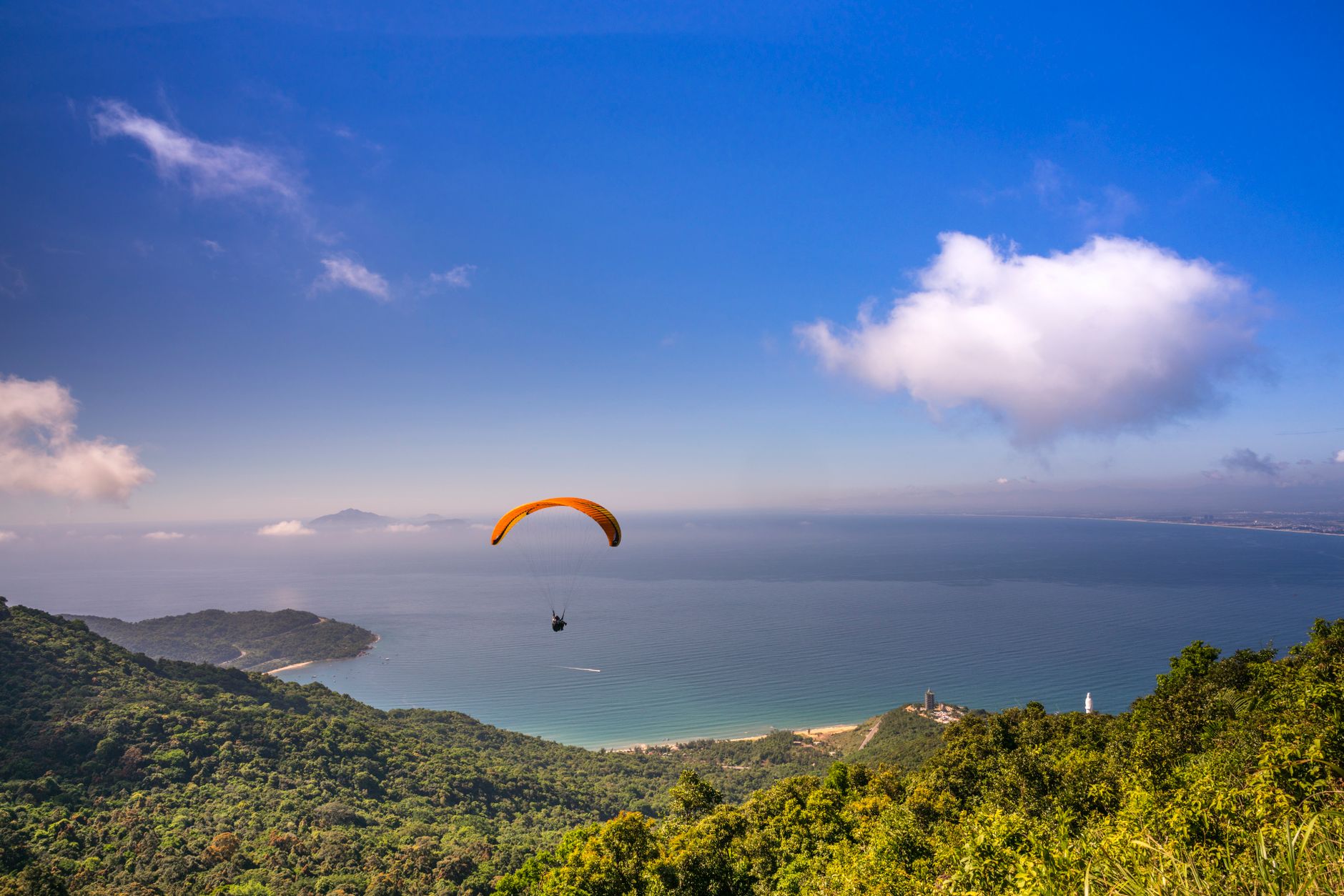
Climb to the base, enter the ground-level shrine if it is open, and walk the full circumference. Then turn around and look back. This is the view most people forget: the full curve of My Khe, the city skyline, the Han River mouth and the bridges. On a clear day it extends south toward the Marble Mountains and, by some accounts, north to the Hai Van Pass.
The classic statue-and-bay frame comes from the edge of the bonsai garden and the lower terrace, not from directly beneath the lotus base.
Viewpoints on the way out
Terraced edges with sea views line the descent. Close the walk here rather than at the car park, where the monkeys and the souvenir stalls pull attention away from the water.
How it compares with other temples nearby
| Site | Age | Entry | Highlights | Best for |
|---|---|---|---|---|
| Linh Ung Bai But (Son Tra) | 2004 to 2010 | Free | 67 m statue, bay views | Scale, views, price |
| Linh Ung Non Nuoc (Marble Mountains) | 19th century | Around 40,000 VND (about 1.50 USD) plus cave fees | Cave shrines, older atmosphere | Age and atmosphere |
| Linh Ung Ba Na | Modern | Inside the Ba Na Hills ticket | Resort setting | Visitors already on the hills |
| Thien Mu (Hue) | Founded 1601 | Small fee | Historic pagoda architecture | History |
Linh Ung Bai But wins on scale, views and price. Linh Ung Non Nuoc and the Marble Mountains caves win on age and atmosphere. Linh Ung Ba Na only makes sense if you are already paying for Ba Na Hills. Thien Mu in Hue remains the reference for historic pagoda architecture in central Vietnam.
For Vietnam's most famous old temples further north, Tran Quoc in Hanoi is traditionally dated to the 6th century, and the One Pillar Pagoda nearby is small but genuinely old. Linh Ung belongs to a different category entirely.
Is it worth the detour? An honest verdict
Who will love it
First-time Da Nang visitors and budget travellers, since it costs nothing. Photographers in clear weather. Families with children, provided the monkeys are supervised. Anyone curious about living Vietnamese Buddhism rather than museum pieces. People pairing it with a Son Tra drive.
Who may be disappointed
Heritage seekers will find everything post-2004 concrete and stone. Crowd-averse visitors should avoid the lunar 1st and 15th, Tet and weekend tour-bus hours. Visitors on hazy or rainy days lose the views entirely. Anyone arriving in beachwear may be refused at the main hall.
The verdict
Worth 90 minutes on any Da Nang stay of two days or more, ideally on a clear morning. It is not worth a special trip from Hoi An on a cloudy day if you have already seen major temples elsewhere.
Tickets, opening hours and rules
Entry and parking
Entry is free as of October 2026, with no photo fee. Parking is where sources disagree: some describe a small fee or customary contribution of about 5,000 to 10,000 VND (about 0.20 to 0.40 USD) for motorbikes, while Grab drop-offs pay nothing. Donation boxes are optional, and incense is available without obligation to buy.
Opening hours
Published ranges conflict between 06:00 to 18:00 and 06:00 to 21:00. The likely explanation is that the outer grounds stay accessible later while the halls and the statue interior keep shorter hours. Arrive before 17:00 to see everything, and expect changes on festival days.
Dress code and etiquette
Shoulders and knees covered for everyone, enforced at the main hall. Shoes and hats off indoors. Do not point feet at altars and do not touch statues. Ask before photographing monks. Speak quietly during chanting.
Photography and drones
Photography is fine outdoors. Flying a drone in Vietnam legally requires a permit, and the peninsula hosts Tien Sa port and restricted areas, so leave the drone in the bag.
Closures
In typhoon season, roughly September to December with a peak in October and November, roads on Son Tra can close after storms or landslides. Check local news or ask the hotel before setting out.
How to get there
| Mode | Time from centre / My Khe | Last known cost | Watch out |
|---|---|---|---|
| GrabBike | 15 to 25 min | 50,000 to 70,000 VND (2 to 3 USD) | Return pickups can be slow |
| GrabCar | 15 to 25 min | 90,000 to 130,000 VND (3.50 to 5 USD) | Surge pricing in rain |
| Xanh SM | Similar | Comparable | Electric fleet |
| Metered taxi | 20 to 25 min | Slightly higher | Agree the meter |
| Rented scooter | 15 to 20 min | Fuel only | Licence and insurance issues |
| Walking from My Khe | 60 to 90 min | Free | Partial shade only |
From the centre, cross the Han River via the Dragon Bridge or Thuan Phuoc bridge, head to the coast, then follow Hoang Sa north past the Man Thai fishing area. The turn-off is signposted. From My Khe, follow Vo Nguyen Giap north into Hoang Sa. Allow about 20 to 25 minutes from the centre and 15 to 20 from My Khe.
For the return leg, pick-ups at the pagoda can be slow on quiet afternoons. Ask the driver to wait and agree a price, or book a return before your phone loses signal.
If you rent a scooter, note that the road to the pagoda is the lower Hoang Sa route, open to all vehicles. The steep upper loop toward Ban Co Peak has a checkpoint restricting automatic scooters, and current rules should be confirmed locally. Riding legally requires a valid licence or an International Driving Permit recognised by Vietnam under the 1968 Convention. Without one, travel insurance is typically void if there is an accident, and the descents are winding with occasional sand on the bends.
Walking or cycling from the north end of My Khe and Man Thai is feasible at about 5 to 6 km with a final uphill stretch. Go before 08:00 and carry water. As of October 2026, no regular city bus route serves the pagoda, so do not rely on public transport.
From Hoi An the distance is about 35 to 40 km, or 50 to 70 minutes by car, with a last known GrabCar fare of roughly 300,000 to 450,000 VND (about 11.50 to 17 USD) one way. A shared day with a driver often makes more sense. From Da Nang airport it is about 12 km.
When to go
Time of day and light
She faces the sea with the mountain behind her, so her face is front-lit in the morning. Late afternoon gives softer light over the bay and the city, but the statue can be partly backlit. Opening at 06:00 means sunrise from the grounds is possible only in winter months, when the sun rises around 06:00. In summer the sun comes up around 05:15, before the gates open, so the "sunrise at the temple" advice found online does not hold for much of the year.
Before 08:00 is coolest and quietest, ahead of the tour buses that typically arrive mid-morning.
Season
| Months | Weather | Visibility | Crowds | Verdict |
|---|---|---|---|---|
| February to May | Warm, mostly dry | Good | Moderate | Best overall |
| June to August | 35°C or more | Good | Heavy | Go early, carry water |
| September to December | Rain, mist, typhoons | Poor | Light | Atmospheric but risky |
Lunar calendar: busy days ahead
The 1st and 15th of each lunar month bring large numbers of local worshippers. Interesting to witness, not ideal for a quiet visit. Approximate upcoming dates, to be checked against a Vietnamese lunar calendar:
| Occasion | Lunar date | Expected date |
|---|---|---|
| Quan Am renunciation day | 19th day, 9th month | Around 28 to 29 October 2026 |
| 1st day, 10th month | 1st day, 10th month | Around 9 November 2026 |
| Tet Ha Nguyen | 15th day, 10th month | Around 23 to 24 November 2026 |
| Tet | New Year's Eve and first 3 days | 6 February 2027, very crowded |
| Quan Am birth festival | 19th day, 2nd month | Around 26 March 2027 |
| Vesak | 15th day, 4th month | Around 20 May 2027 |
Insider tips
- Visit the Xa Loi tower first, while everyone else heads straight for the statue.
- Spend five minutes on the Arhats' faces. They are the most under-photographed detail on site.
- Carry a sarong or light scarf so you are never turned away at the main hall.
- Keep phone and water bottle inside a zipped bag before leaving the car park.
- Plan a seafood meal at Man Thai at the foot of the road, since food on site is limited.
- See the statue from below too, from the Hoang Sa road bends and from My Khe at dusk.
Monkeys, langurs and safety
The macaques are habituated and fast. They grab bottles and plastic bags. Never feed them, keep food out of sight, and supervise children.
Vietnam has rabies. Any bite or scratch means washing the wound for 15 minutes and seeking post-exposure treatment the same day at a Da Nang hospital or vaccination centre. Pre-trip vaccination is worth discussing with a travel clinic.
Son Tra hosts a significant share of the endangered red-shanked douc langur population, with Wikipedia citing over 60%. They are rarely seen at the pagoda itself, more often along forested roads. Watch quietly, never feed them, and do not stop on bends.
Heat exhaustion is a real risk on the lotus base in summer. Avoid riding the peninsula after dark.
Combining it with the rest of Son Tra
Nearby options include Man Thai fishing village with its basket boats and seafood restaurants, the ancient banyan tree, Ban Co Peak at almost 600 m, Tien Sa beach, Son Tra night market and My Khe for the evening. The Dragon Bridge fire and water show usually runs on weekend nights around 21:00, though the current schedule should be checked. The Marble Mountains are about 20 to 25 minutes south and make the natural pairing, since they hold the older Linh Ung pagoda.
A sample half-day: pagoda at 07:00, banyan tree and a viewpoint, Man Thai lunch, Marble Mountains in the afternoon.
FAQ
Q: Where is the Lady Buddha in Da Nang? In the grounds of Linh Ung Bai But Pagoda, on the southern seaward slope of the Son Tra Peninsula off Hoang Sa road, about 10 km northeast of the Dragon Bridge. She is visible from most of My Khe Beach. Post-July 2025 addresses no longer use "Son Tra district".
Q: Is Linh Ung Pagoda free, and what are the opening hours? As of October 2026, entry is free, with optional donations and possibly a small motorbike parking charge. Published hours vary between 06:00 to 18:00 and 06:00 to 21:00. The halls are safest before 17:00, and the quietest window is before 08:00.
Q: Can you go inside the Lady Buddha statue? Visitors can usually enter the ground-level shrine at the base. The 17 upper levels are generally reserved for monks and ceremonies, so do not expect to climb to the top or reach a viewing platform.
Q: How long do you need at Linh Ung Pagoda? 60 to 90 minutes covers the gate, the Arhat courtyard, the main hall, the bonsai garden and the statue. Allow two hours with photography, or half a day if combining it with Man Thai and the banyan tree.
Q: Are the monkeys at Linh Ung Pagoda dangerous? They are habituated macaques that snatch food, bottles and bags. Bites are uncommon but do happen. Wash any wound for 15 minutes and seek same-day post-exposure treatment in Da Nang.
Q: Is Linh Ung Pagoda an old temple? No. The Son Tra complex dates from 2004 to 2010, built where a 19th-century fishermen's shrine is said to have stood. For age, look to Thien Mu in Hue, founded in 1601, Tran Quoc in Hanoi, traditionally dated to the 6th century, or the older Linh Ung pagoda on the Marble Mountains.
Q: Can I visit the Lady Buddha by scooter and continue to Ban Co Peak? The pagoda is on the lower Hoang Sa road, accessible to all vehicles. The upper loop to Ban Co Peak has a checkpoint restricting automatic scooters, so use a manual bike, a car or a jeep. Riding without a valid licence or recognised IDP typically voids travel insurance.