What this article is (and isn't)
This article provides a balanced assessment of tourist development in Cao Bang province. It does not sell a fantasy of untouched remoteness, nor does it dismiss the area as overrun. The goal is practical: help you decide if Cao Bang fits your travel style and how to plan around the crowds that do exist.
The assessment uses concrete metrics: visitor numbers, infrastructure changes, seasonal patterns, and comparisons to other northern destinations. Vague impressions like "it feels authentic" do not help you book a bus or choose a homestay. Facts do.
How touristy is Cao Bang compared to other northern destinations?
To give context, here is a comparative scale. These scores reflect overall tourist development, not just visitor numbers. They account for infrastructure, English prevalence, souvenir shops, and organized tour presence.
| Destination | Tourist score (1-10) | Main crowd sources | Best for |
|---|---|---|---|
| Sapa | 9/10 | International trekkers, domestic tourists, group tours | Rice terraces, hill tribe markets |
| Ha Long Bay | 8/10 | Cruise passengers, domestic tourists, Chinese groups | Limestone karst scenery |
| Ha Giang Loop | 7/10 | International backpackers, motorbike riders | Mountain passes, ethnic minority culture |
| Cao Bang | 4/10 | Domestic tourists at Ban Gioc, few internationals | Waterfalls, caves, quiet countryside |
| Mai Chau | 3/10 | Domestic weekenders, cyclists | Rural valleys, homestay experience |
Cao Bang sits at a 4/10. This is lower than Ha Giang, which sees roughly double the foreign visitors. Ban Gioc Waterfall alone accounts for about 70% of all tourist traffic in the province. The rest of Cao Bang sees very few travelers.
During peak season (December to February), Ban Gioc can feel crowded. Outside that window, and away from the waterfall, you can go hours without seeing another foreigner.
The two Cao Bangs: city versus countryside
This distinction matters more than any other single factor. Most articles treat Cao Bang as one destination. In reality, it splits into two entirely different experiences.
Cao Bang city is a working provincial capital. It has no backpacker street, no souvenir shops targeting foreigners, and almost no English menus. The main street has a few basic hotels, some pho shops, and a market selling vegetables and motorbike parts. Foreign tourists are rare enough that locals sometimes stare. If you stay only in the city, you will think Cao Bang is "not touristy at all."
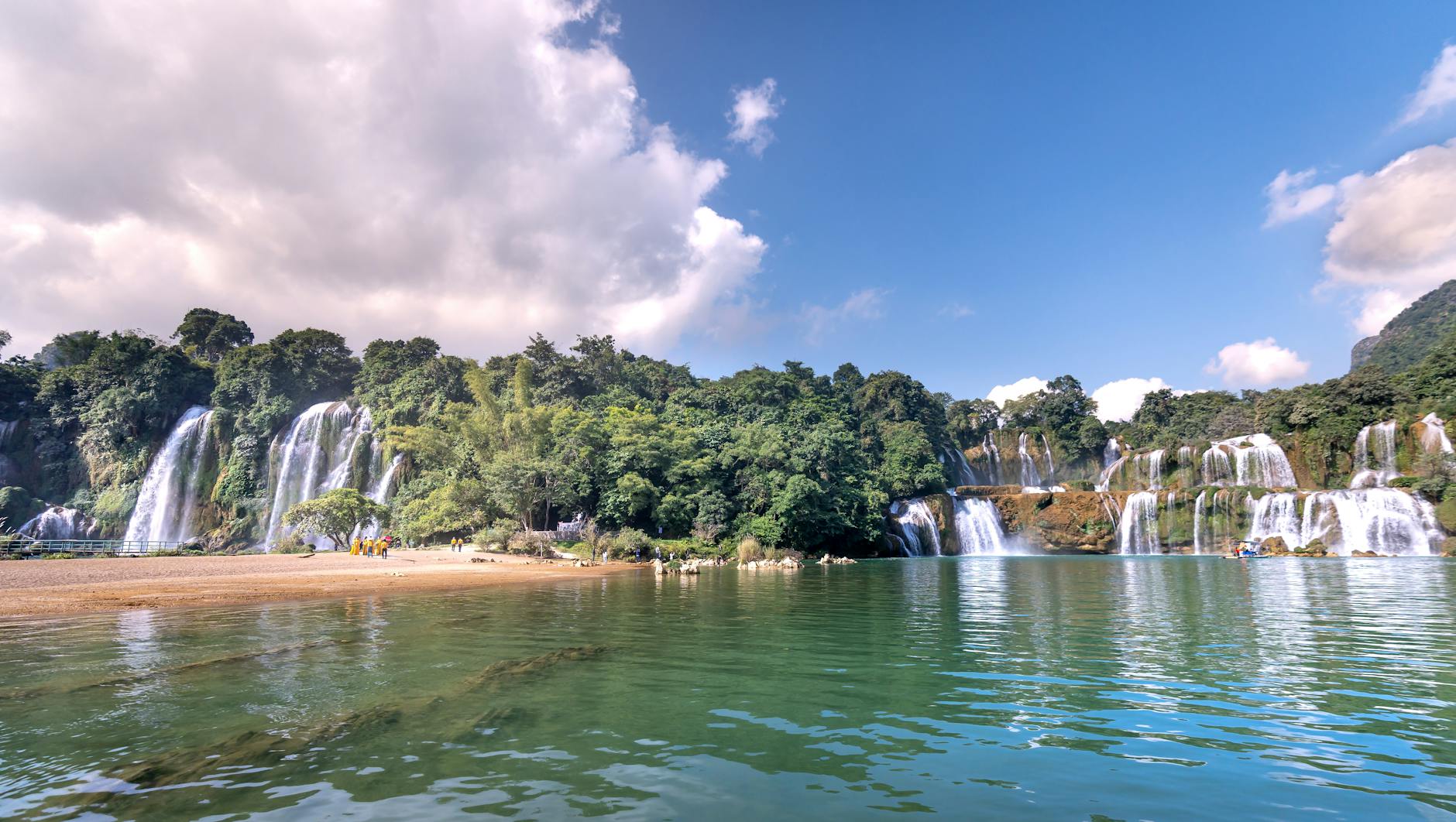
The Ban Gioc area (around 90 kilometers north of the city) is where tourist development concentrates. Here you find homestays with English signs, restaurants with picture menus, and souvenir stalls selling waterfall keychains. During peak season, the viewing platforms at Ban Gioc can hold 200-300 people at once.
This split explains contradictory reports. Travelers who base themselves in the city and visit Ban Gioc as a day trip experience both extremes. Those who stay in a Ban Gioc homestay for three days see mostly the developed side.
Ban Gioc Waterfall: the main draw, and the main crowds
Ban Gioc is Vietnam's largest waterfall and the primary reason people visit Cao Bang. It spans 300 meters across the border with China. The Chinese side has built a full tourist complex with cable cars, hotels, and paved walkways. The Vietnamese side remains relatively basic, with a concrete viewing platform and a short walking path.
Crowd levels by season:
- High season (October-April): 500-800 visitors per day on weekdays, 1,200-2,000 on weekends
- Low season (May-September): 100-300 visitors per day, with some days seeing fewer than 50
- Vietnamese public holidays (Tet, Reunification Day, National Day): 3,000-5,000 visitors per day
The waterfall releases water from the upstream dam between 10:30am and 1:00pm. This creates predictable peak crowds. Before 10:00am, the waterfall has less water but also fewer people. After 1:30pm, the flow decreases and visitors thin out.
Weekends bring a different crowd. Vietnamese families drive up from Hanoi (now 5-6 hours on the improved highway) for a quick overnight trip. They arrive Saturday morning, visit Ban Gioc around noon, and leave Sunday afternoon. If you want solitude, visit on a Tuesday or Wednesday.
What has changed in Cao Bang since 2020
The province has developed noticeably in the last six years. Here is what changed:
Road improvements. The highway from Hanoi to Cao Bang city reduced travel time from 8-9 hours to 6-7 hours. The road to Ban Gioc was paved and widened in 2022. Landslides still happen during heavy rain, but the main routes are now reliable year-round.
Accommodation growth. In 2020, booking platforms listed roughly 40 properties in Cao Bang province. By 2025, that number exceeded 150. Most new builds are homestays near Ban Gioc, ranging from basic rooms (200,000 VND / $8 per night) to mid-range guesthouses (500,000 VND / $20 per night). Cao Bang city has added two hotels with elevators, a novelty for the area.
Tour bus frequency. In 2020, two or three sleeper buses ran daily from Hanoi to Cao Bang. Now at least eight companies operate the route, with departures every 2-3 hours from My Dinh and Giap Bat bus stations. Organized tours from Hanoi to Ban Gioc have also multiplied, with companies like Sinh Tourist and local operators offering 2-day packages.
UNESCO Geopark designation. Cao Bang received UNESCO Global Geopark status in 2018. This boosted official tourism marketing. Signage improved at major sights. The provincial government began promoting Cao Bang as a destination for domestic tourists, with billboards on the highway and ads on Vietnamese television.
None of this makes Cao Bang "touristy" by international standards. But the trajectory is clear. The province is no longer the forgotten corner it was a decade ago.
Where you will see tourists (and where you won't)
High-traffic areas (avoid peak times):
- Ban Gioc Waterfall viewing platforms: 10:30am-1:00pm, especially weekends
- Nguom Ngao Cave entrance: tour groups arrive between 11:00am and 2:00pm
- Truc Lam Pagoda viewpoint: busiest during morning hours
- Main Cao Bang-Ha Giang road: frequent motorbike groups in dry season
Low-traffic areas (quiet year-round):
- Phong Nam Valley: outside the main viewpoint, the valley has few visitors
- Phuc Sen blacksmith village: almost no tourists, mostly locals going about their day
- Phia Thap weaving village: a handful of visitors per week
- Lenin Stream and Pac Bo: historically significant but lightly visited
- Angel Eye Mountain (Nui Mat Than): requires a short hike, sees fewer visitors than Ban Gioc
- Lesser-known passes: routes like Ma Phuc Pass and Khau Coc Cha have minimal traffic
The pattern is simple. Any location with a paved road and a sign attracts visitors. Any location requiring a dirt road, a hike, or local knowledge stays quiet.
The infrastructure reality: what tourist development actually looks like
Here is a practical checklist for what works and what does not in Cao Bang:
| Feature | Status | Details |
|---|---|---|
| Chain hotels | Does not exist | No international brands. Local guesthouses and homestays only. |
| Nightlife | Minimal | A few bia hoi joints in Cao Bang city. Nothing after 10pm. |
| English prevalence | Low | Staff at Ban Gioc homestays speak basic English. Elsewhere, Google Translate is essential. |
| ATMs | Limited | 3 ATMs in Cao Bang city, 1 near Ban Gioc. Bring cash from Hanoi. |
| Grab/ride-hailing | Does not work | No Grab coverage. Local taxis available in Cao Bang city (call only). |
| Road quality | Good on main routes | Paved roads to all major sights. Rural roads are unpaved and rough. |
| Signage | Adequate | Brown tourist signs in Vietnamese and English at major sights. Minor roads lack signs. |
| Mobile data | Works | 4G coverage in Cao Bang city and Ban Gioc. Spotty in mountain passes. |
The lack of infrastructure is the main reason Cao Bang is not touristy. Even with increased visitor numbers, you cannot buy a cappuccino, find a hostel dorm, or use a ride-hailing app. The experience remains rough around the edges.
Seasonal crowds: when to visit for solitude, when to accept company
| Month | Weather | Crowd level | Pros | Cons |
|---|---|---|---|---|
| January | Cool, 10-18°C, clear | High | Best waterfall views | Cold mornings, crowded Ban Gioc |
| February | Cool, 12-20°C, Tet holiday | Very high | Festive atmosphere | Tet closures, peak domestic travel |
| March | Mild, 15-25°C, clear | High | Good hiking weather | Busy weekends |
| April | Warm, 18-28°C, Reunification Day | High | Rice planting season | Holiday crowds April 30-May 1 |
| May | Warm, 22-30°C, rain starts | Moderate | Green landscapes | Afternoon showers |
| June | Hot, 25-32°C, rainy | Low | Few tourists | Landslide risk, humid |
| July | Hot, 25-33°C, rainy | Low | Lowest prices | Heavy rain, poor visibility |
| August | Hot, 24-32°C, rainy | Low | Quiet roads | Typhoon risk |
| September | Warm, 20-28°C, rain easing | Moderate | Rice harvest, clear skies | Shoulder season crowds increasing |
| October | Mild, 15-25°C, dry | Moderate | Best weather overall | Growing visitor numbers |
| November | Cool, 12-22°C, dry | High | Golden rice fields | Busy at Ban Gioc |
| December | Cold, 8-18°C, dry | High | Dramatic skies | Coldest month, busy |
For the best balance of good weather and few people, visit in late September or early October. For absolute solitude, come in June or July and accept the rain. For guaranteed clear skies and manageable crowds, visit on a weekday in November.
The domestic tourism factor
International coverage of Cao Bang focuses on backpackers. The growing wave of Vietnamese tourists is largely absent from English-language articles.
Domestic travel patterns differ from international ones:
- Weekend trips. Vietnamese tourists visit Ban Gioc on Saturday-Sunday trips from Hanoi. They arrive by private car or organized bus. They spend one night, visit the waterfall, and leave.
- Family groups. Extended families travel together, often with elderly members and children. They prefer paved walkways and clean restrooms.
- Different expectations. Vietnamese tourists expect basic services: parking, ticket booths, trash bins, and concrete paths. They do not look for "authenticity" or "off the beaten path" experiences.
- Concentration at Ban Gioc. Domestic tourists rarely visit Phong Nam Valley, the craft villages, or the mountain passes. They go to the waterfall, take photos, and leave.
This means the "touristy" feeling at Ban Gioc comes mostly from Vietnamese families, not international backpackers. The rest of the province remains quiet because domestic tourists do not venture beyond the main sight.
Is Cao Bang still worth visiting if you want to avoid crowds?
The answer depends on your tolerance for other people.
For the "true off the beaten path" seeker: Cao Bang still offers remote areas, but requires effort to reach them. Skip Ban Gioc entirely. Head to Phong Nam Valley, stay in a rural homestay, and explore the craft villages. You will see almost no other tourists. The trade-off is less dramatic scenery and fewer services.
For the "moderate crowds are fine" traveler: Visit Ban Gioc at 8:00am on a weekday. The waterfall will have 20-30 people instead of 200. Spend the rest of your time in the quiet areas. This is the sweet spot for most travelers.
For the "I want zero tourists" traveler: Cao Bang is not the right destination. Consider Mai Chau & Pu Luong: Northern Vietnam's Quieter Alternative to Sapa or 10 Vietnam Towns That Quietly Outshine Halong and Hanoi for more remote options.
How to experience Cao Bang without feeling like a tourist
These strategies minimize the "touristy" experience:
Visit Ban Gioc at opening time. The waterfall opens at 7:00am. Arrive then. You get an hour of near-solitude before the buses arrive. The water flow is lower, but the experience is better.
Stay in a rural homestay, not Cao Bang city. Homestays in Phong Nam Valley or near the craft villages offer a completely different experience than hotels in the city. You eat with the family, sleep in a stilt house, and wake up to roosters instead of traffic.
Hire a local guide. A guide from Cao Bang city or a homestay owner can take you to spots not marked on Google Maps. These include hidden waterfalls, remote viewpoints, and villages where tourists never go. Expect to pay 300,000-500,000 VND ($12-20) per day for a guide with a motorbike.
Travel by motorbike, not organized tour. Renting a Motorbike in Vietnam: The Legal Truth Nobody Tells Tourists covers the requirements. A motorbike lets you stop anywhere, take side roads, and avoid the bus schedule. Organized tours rush through the sights and concentrate at peak times.
Visit during shoulder season. Late September and early October offer good weather with lower crowds than the December-February peak. You trade some waterfall volume for a quieter experience.
Spend extra days. Most visitors rush through Cao Bang in 2 days. Spend 4-5 days. The extra time lets you explore beyond the highlights and find the quiet corners.
The honest verdict: is Cao Bang touristy in 2026?
No. But the answer comes with caveats.
Cao Bang is moderately touristy at Ban Gioc Waterfall during peak season and on weekends. It is not touristy in the city, in the countryside, or during the rainy season. The province lacks the infrastructure, the English prevalence, and the sheer volume of visitors that define truly touristy destinations like Sapa or Ha Long Bay.
The experience depends entirely on where you go and when. If you visit Ban Gioc at noon on a Saturday in December, you will think Cao Bang is crowded. If you visit Phong Nam Valley on a Tuesday in June, you will think you discovered a secret.
The journey from Hanoi still takes 6-7 hours. The roads are winding. The services are basic. But the scenery is dramatic, the people are welcoming, and the province still rewards those who make the trip. For travelers willing to plan around the crowds, Cao Bang remains one of northern Vietnam's most worthwhile destinations.
FAQ
Q: Is Cao Bang worth visiting? Yes, for travelers interested in dramatic mountain scenery, waterfalls, caves, and ethnic minority culture. The main drawback is the long travel time from Hanoi (6-7 hours). Worth visiting if you have at least 3-4 days to dedicate to the area.
Q: Is Cao Bang more touristy than Ha Giang? No. Ha Giang's famous loop attracts significantly more international backpackers, especially during peak season (October-April). Cao Bang sees roughly half the foreign visitors of Ha Giang, though Ban Gioc Waterfall draws more domestic tourists than any single sight in Ha Giang.
Q: When is the best time to visit Cao Bang to avoid crowds? Late September to early October offers good weather (rice harvest, clear skies) with fewer tourists than the peak December-February period. Weekdays throughout the year are significantly quieter than weekends, especially at Ban Gioc Waterfall.
Q: How many days should I spend in Cao Bang? Minimum 3 days (2 nights) to see the main sights without rushing. 4-5 days allows exploration of lesser-visited areas like Phong Nam Valley, craft villages, and the mountain passes. The long travel time from Hanoi makes shorter visits inefficient.
Q: Is Cao Bang safe for solo travelers? Yes, with standard precautions. Roads are well-paved but winding and steep in places. Grab does not operate in Cao Bang, so solo travelers need to arrange transport through homestays or local taxis. Petty crime is rare. English is limited outside tour operators.
Q: Can I visit Ban Gioc Waterfall without a tour? Yes. Public buses run from Cao Bang city to Ban Gioc (about 2 hours, 80,000 VND / $3). Motorbike rental is also available in Cao Bang city (180,000-250,000 VND / $7-10 per day). The entrance fee is 45,000 VND ($2). No guide is required.
Q: Has Cao Bang changed a lot in the last 5 years? Moderately. Road improvements have reduced travel time from Hanoi by about 1-2 hours. More homestays and small hotels have opened, especially near Ban Gioc. However, Cao Bang city remains largely unchanged, and the province still lacks the tourist infrastructure of Sapa or Ha Giang.