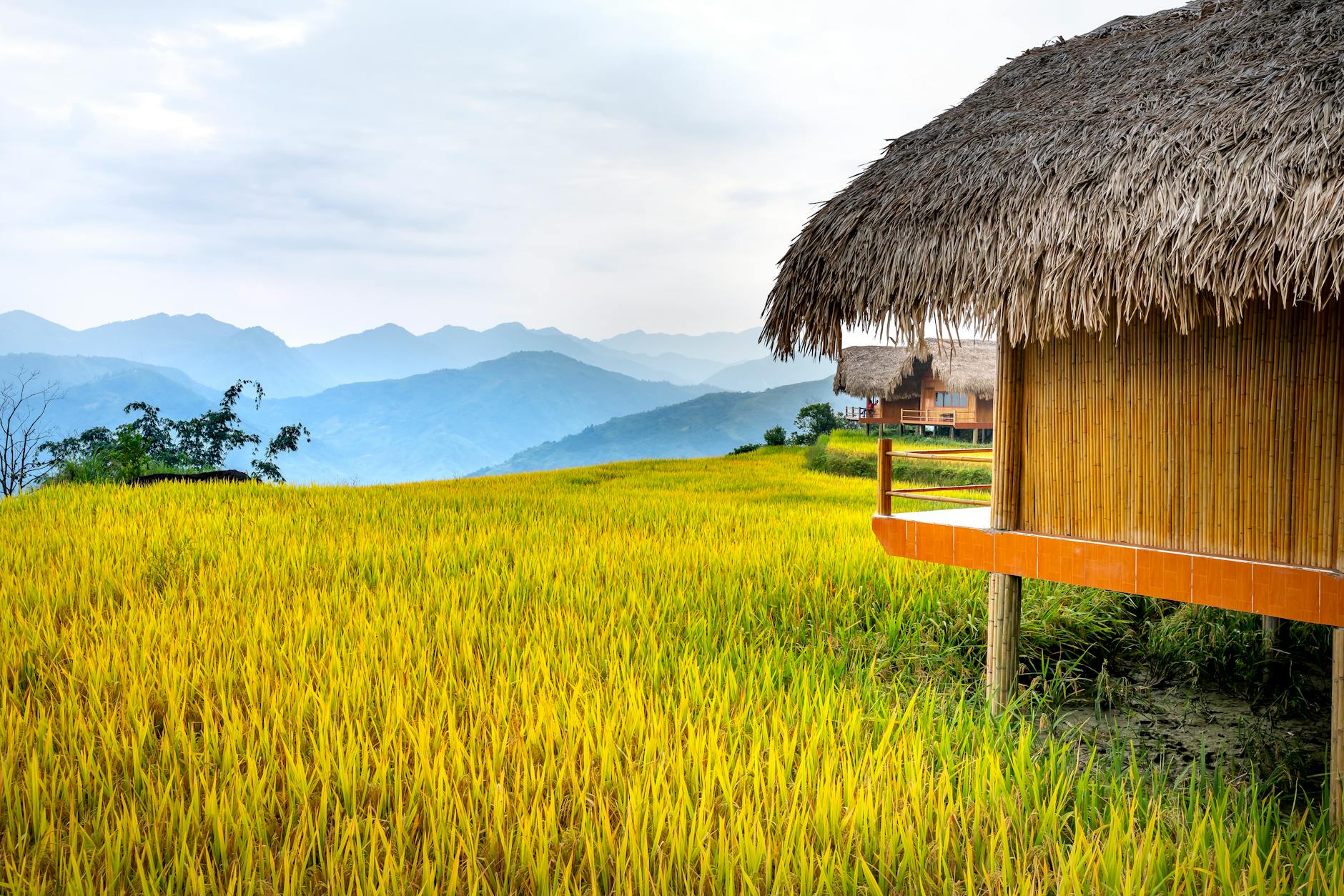
This guide covers how to get there independently, where to base yourself, when to go, and what realistically makes these valleys different from their famous northern cousin.
Why Choose Mai Chau and Pu Luong Over Sapa
Sapa earned its reputation honestly — the Muong Hoa Valley is genuinely spectacular — but mass tourism has reshaped the town. Mai Chau and Pu Luong remain agricultural communities where tourism supplements rice farming rather than replacing it. Expect water buffalo on the road, looms clattering inside stilt houses, and homestay hosts who also tend their own paddies.
The landscapes differ too. Sapa's terraces climb steep mountainsides at high altitude. Mai Chau is a flat valley floor ringed by karst cliffs, ideal for cycling. Pu Luong sits between the two: rolling hills, terraced rice paddies cascading down moderate slopes, bamboo waterwheels turning in streams, and a nature reserve protecting primary forest.
| Feature | Sapa | Mai Chau | Pu Luong |
|---|---|---|---|
| Distance from Hanoi | 315 km | 135 km | 165 km |
| Travel time | 5–6 hrs | 3–3.5 hrs | 4.5–5 hrs |
| Elevation | 1,500 m | 250 m | 300–1,700 m |
| Best for | Dramatic terraces, ethnic markets | Cycling, easy walking, families | Trekking, remote villages |
| Crowds (2026) | Heavy year-round | Moderate weekends | Light |
| Avg homestay cost | 400,000–900,000 VND | 250,000–500,000 VND | 300,000–700,000 VND |
| English spoken | Widely | Common in homestays | Limited outside main lodges |
Getting There Independently from Hanoi
You do not need a tour. Both destinations are accessible by public bus, and onward transport is straightforward once you arrive.
To Mai Chau
The easiest option is a sleeper or seat bus from My Dinh Bus Station in Hanoi. Operators including Hoa Binh Tourist, Xuan Long, and Hung Thanh run several departures daily between 06:00 and 14:00. The ride takes around 3.5 hours and costs 130,000–180,000 VND (USD 5.20–7.20) as of early 2026. Ask the driver to drop you at the Tong Dau junction, then take a xe om (motorbike taxi) for around 40,000 VND into Mai Chau town or directly to Lac or Pom Coong villages.
Limousine vans (9-seat minibuses with door-to-door pickup in Hanoi) cost 240,000–290,000 VND (USD 9.50–11.50) and are worth the modest premium for comfort.
To Pu Luong
There is no direct public bus to the reserve. The standard route is:
- Bus from Giap Bat or My Dinh station to Canh Nang or Pho Doan in Thanh Hoa province (around 4 hours, 170,000 VND / USD 6.80).
- Xe om or pre-arranged homestay pickup from Pho Doan to your accommodation (30–60 minutes, 150,000–250,000 VND).
A simpler alternative is the daily tourist shuttle run by several Pu Luong lodges, which leaves Hanoi's Old Quarter around 08:00 and reaches the reserve by 13:00. Expect to pay 350,000–450,000 VND (USD 14–18) one way.
Tip: Many travellers visit Mai Chau and Pu Luong as a combined loop. A private car between the two takes about 2 hours and costs around 1,200,000 VND (USD 48), split between up to four passengers. Motorbiking the back roads via Co Luong is one of northern Vietnam's most scenic rides for confident riders.
Mai Chau: The Valley of White Thai Stilt Houses
Mai Chau is a broad green basin populated mainly by the White Thai ethnic group, whose stilt houses cluster in tidy villages amid the paddies. The two best-known are Lac and Pom Coong, both walkable and bicycle-friendly. For more solitude, push on to Pa Co, Hang Kia, or Ban Buoc.
What to do
- Cycling the valley. Most homestays lend bicycles free or for 50,000 VND per day. A flat 15–20 km loop takes in working paddies, small temples, and the Chieu Cave viewpoint above Mai Chau town.
- Hang Kia and Pa Co. These higher Hmong villages sit 25 km north on Highway 6, accessible by motorbike or hired car. The Sunday morning market at Pa Co (07:00–11:00) is the area's best for textiles and produce.
- Evening cultural shows. Lac and Pom Coong host nightly Thai dance performances with bamboo-pole dancing and rice wine. They are touristy but genuinely performed by villagers; tickets cost around 100,000 VND (USD 4).
- Weaving and textiles. Many stilt houses double as workshops. Brocade scarves run 150,000–400,000 VND, and prices are fair without aggressive haggling.
Where to stay
Mai Chau Ecolodge and Mai Chau Hideaway are the boutique options at 2,200,000–4,500,000 VND (USD 88–180) per night. For the authentic experience, family-run stilt-house homestays in Lac and Pom Coong charge 250,000–500,000 VND (USD 10–20) per person including breakfast and dinner, with shared sleeping mats on the upper floor.
Pu Luong: Trekking, Waterwheels, and Limestone
Pu Luong Nature Reserve covers 17,600 hectares of karst forest, terraced farmland, and Thai and Muong villages. The landscape is steeper than Mai Chau and the tourism infrastructure newer — most lodges have opened since 2018 — so the trail network still feels genuinely rural.
Core trekking routes
- Ban Hieu to Kho Muong (full day, ~14 km). Probably the classic Pu Luong walk. The trail descends from Ban Hieu's waterwheels through paddies, climbs over a low pass, and drops into Kho Muong, a remote valley with a large bat cave at its edge. Moderate difficulty.
- Don village circuit (half day, ~7 km). Easier loop linking riverside hamlets and bamboo waterwheels. Good for first-day acclimatisation.
- Pu Luong Peak (1,700 m, full day). A serious climb of 6–8 hours return, best done with a local guide (around 600,000 VND / USD 24). Summit views span into Laos on clear days.
- Hieu Waterfall. A series of cascades with natural pools above Ban Hieu village. Free to enter; reachable on foot or by motorbike.
Warning: Trails are unmarked and split frequently through farmland. Even short routes are easier with a local guide (350,000–500,000 VND for half a day). Offline maps such as Maps.me show most paths but not all.
Where to stay
Pu Luong's accommodation runs from simple homestays to mid-range eco-lodges with infinity pools overlooking the valleys.
| Property type | Price (per night, 2026) | What you get |
|---|---|---|
| Village homestay | 300,000–500,000 VND (USD 12–20) | Shared stilt-house dorm, family meals |
| Mid-range lodge | 1,400,000–2,500,000 VND (USD 56–100) | Private bungalow, restaurant |
| Higher-end retreat | 3,500,000–6,500,000 VND (USD 140–260) | Pool, full board, guided activities |
The lodges cluster around Ban Don, Ban Hieu, and Kho Muong. Ban Don is the most established and easiest to reach; Kho Muong is the most remote and requires the final stretch on motorbike or on foot.
Best Time to Visit
Both areas share a climate, but the visual experience changes dramatically by month.
| Season | Months | What to expect |
|---|---|---|
| Dry spring | Feb–Apr | Mild temperatures (18–26°C), green young rice, plum blossoms in Hang Kia |
| Pre-harvest | May–Jun | Flooded paddies reflecting the sky, warm but humid |
| Wet summer | Jul–Aug | Heavy rains, leeches on trails, lush forest, fewer visitors |
| Harvest gold | Late Sep–Oct | Terraces turn brilliant yellow; the iconic photo season |
| Cool dry | Nov–Jan | Crisp days (10–20°C), brown stubble fields, clear skies, occasional cold snaps |
Late September into mid-October is the peak window — book homestays two to three weeks ahead for weekends. June, with mirror-like flooded paddies, is the underrated runner-up.
Tip: Avoid the Vietnamese public holidays of Tet (mid-Feb 2026), Reunification Day (30 April), and Labour Day (1 May), when domestic tourism spikes and prices double.
Practical Costs and Sample Budget
A realistic daily budget for an independent traveller in 2026:
| Item | Budget | Mid-range |
|---|---|---|
| Accommodation | 350,000 VND | 1,800,000 VND |
| Three meals | 200,000 VND | 400,000 VND |
| Bicycle/motorbike hire | 50,000–200,000 VND | 200,000 VND |
| Guide (half day) | — | 400,000 VND |
| Entrance fees | 30,000 VND | 30,000 VND |
| Daily total | ~650,000 VND (USD 26) | ~2,830,000 VND (USD 113) |
Three nights split between Mai Chau and Pu Luong, including round-trip transport from Hanoi, can be done comfortably for 3,500,000–4,500,000 VND (USD 140–180) per person on a budget plan, or 9,000,000–13,000,000 VND (USD 360–520) at mid-range.
What Makes the Experience Different from Sapa
It is worth being honest: Sapa offers things Mai Chau and Pu Luong cannot. Fansipan's summit, the scale of the Muong Hoa terraces, the diversity of nearby Hmong, Dao, and Tay villages, and the comparatively developed restaurant and bar scene. Travellers who want dramatic alpine scenery and dependable Western amenities will still prefer Sapa.
What Mai Chau and Pu Luong offer instead:
- Shorter, easier travel from Hanoi. No overnight train or long mountain bus required.
- Lower prices across the board. Roughly 30–40% less than equivalent Sapa accommodation.
- Working agricultural valleys. Tourism has not yet outweighed farming as the primary economy.
- Easy, flat cycling (Mai Chau) that suits families and casual riders.
- Trekking without crowds (Pu Luong). It is genuinely possible to walk for two hours and pass only farmers.
- Less sales pressure. Textile vendors will approach you, but the persistence found in Sapa town is largely absent.
The trade-off is fewer English-speaking guides outside lodges, simpler food options, and limited nightlife. For most travellers seeking rural Vietnam, that trade-off is the point.
Frequently Asked Questions
Is it safe to visit independently without a tour? Yes. The route from Hanoi is well-trodden, homestays are accustomed to walk-in guests, and crime targeting tourists is rare. The main risks are road accidents on motorbikes and getting lost on unmarked trails — both manageable with caution.
Can Mai Chau and Pu Luong be done as a day trip from Hanoi? Mai Chau yes, technically, though a 7-hour round trip for 4 hours on the ground is poor value. Pu Luong realistically requires at least one overnight; two is better. The combined loop deserves three to four nights.
Do I need a permit for Pu Luong Nature Reserve? No formal permit is required for the standard trekking villages. A small entrance fee of 30,000 VND is collected at some trailheads. Climbing Pu Luong Peak requires a local guide, which is enforced informally rather than by checkpoint.
Is there ATM access in the valleys? Mai Chau town has two ATMs; reliability varies. Pu Luong has none inside the reserve — the nearest is in Canh Nang or Pho Doan. Bring sufficient cash from Hanoi, and note that most homestays accept VND only.
Can I get vegetarian or special-diet meals at homestays? Yes, with advance notice. Communicate by phone or message the day before so the host can shop accordingly. Vegan diets are harder to accommodate as fish sauce and lard appear in many dishes by default.
Is it suitable for travellers with limited mobility? Mai Chau's flat valley is manageable, and several mid-range hotels offer ground-floor rooms. Pu Luong is steep, with most homestays requiring stairs into stilt houses and uneven walking paths between properties. Travellers with mobility limitations will find Mai Chau the better choice.
How does the weather compare to Sapa? Both Mai Chau and Pu Luong are warmer than Sapa year-round due to lower elevation. Winter nights can drop to 8°C but rarely lower; snow is unknown. Pu Luong's higher slopes are 3–5°C cooler than the valley floor.
Final Thoughts
Mai Chau and Pu Luong are not secrets — Vietnamese weekenders have known about them for years, and international travellers are catching up. But the pace of change here is slower than in Sapa, partly because the terrain does not lend itself to cable cars or convention hotels, and partly because the communities themselves have steered tourism toward homestays and small lodges. Visiting now, in 2026, still means walking into stilt houses where the family eats with you, sharing rice wine after dinner, and waking to roosters rather than tour-bus engines. For travellers willing to swap iconic peaks for genuine quiet, the choice is straightforward.