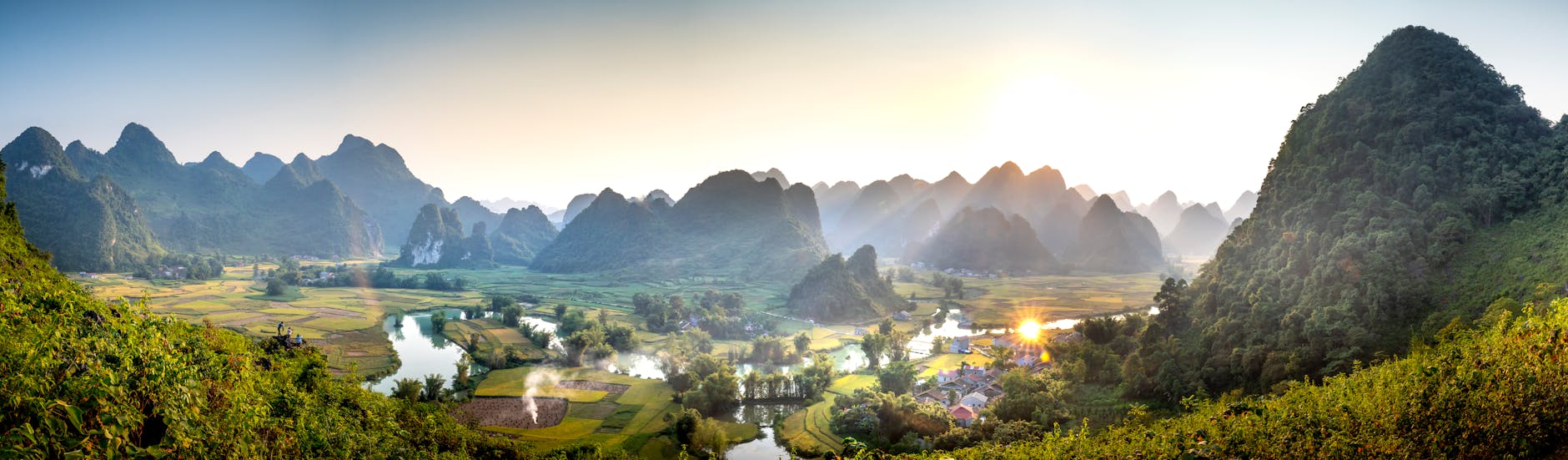
What you need to know before going to Cao Bang
Cao Bang is a mountainous province in northeastern Vietnam, sharing a border with China. It sits roughly 280 km from Hanoi. The main draw is dramatic limestone karst scenery, ethnic minority villages, and Ban Gioc Waterfall, one of Southeast Asia's largest waterfalls.
The honest trade-offs are real. Cao Bang is remote. Infrastructure is basic compared to Sapa or Ha Giang. English is limited outside Cao Bang City. ATMs are scarce. Roads are winding and steep in sections.
The traveler who will enjoy Cao Bang most is someone comfortable with uncertainty. Someone who does not need luxury accommodation or nightlife. Someone who values empty roads and authentic interactions over convenience. If that sounds like you, read on.
How to get to Cao Bang from Hanoi and other cities
The journey from Hanoi takes 6-9 hours depending on your transport choice and road conditions.
| Mode | Duration | Cost (VND/USD) | Comfort Level | Best For |
|---|---|---|---|---|
| Sleeper bus | 7-9 hours | 200,000-350,000 ($8-14) | Low | Budget travelers |
| Limousine van | 6-7 hours | 400,000-600,000 ($16-24) | Medium | Those with more budget |
| Private car | 6-7 hours | 2,500,000-3,500,000 ($100-140) | High | Groups or families |
| Motorbike | 7-9 hours | 100,000-150,000 fuel ($4-6) | Low | Experienced riders only |
Sleeper buses depart from My Dinh or Giap Bat bus stations in Hanoi. Book through your hotel or a travel agency. The ride is bumpy. Motion sickness is common. Bring a mask, snacks, and earplugs.
Limousine vans are a step up. They have fewer seats, more legroom, and air conditioning. Companies like G8 Limousine and Cao Bang Travel offer daily departures.
Private cars cost more but offer flexibility. You can stop at scenic points along the way, including the famous Bac Me Pass.
From Ha Giang, the route takes 4-5 hours by motorbike via Highway 34. From Sapa, expect 8-10 hours. From Hanoi, you can also fly to Na San Airport (Son La) but this is not practical for most travelers.
Pro tip: Avoid traveling at night. The roads have poor lighting, and livestock often crosses without warning.
Getting around Cao Bang: Options compared
Once in Cao Bang, you need a way to reach the attractions. Here are your options.
Motorbike rental is the most popular choice. Costs range from 150,000 to 250,000 VND per day ($6-10). Fuel adds roughly 100,000 VND per day ($4). You need an International Driving Permit (IDP) to ride legally. While enforcement is inconsistent in remote areas, having an IDP protects you if stopped by police or involved in an accident.
Easy riders are experienced local drivers who take you as a passenger on the back of their bike. Costs range from 500,000 to 800,000 VND per day ($20-32). This is a good option for solo travelers or those uncomfortable riding themselves.
Taxis are available in Cao Bang City but expensive for long distances. A trip from the city to Ban Gioc Waterfall (60 km) costs around 600,000-800,000 VND ($24-32) one way.
Public buses connect Cao Bang City to Trung Khanh district (near Ban Gioc) for 50,000-80,000 VND ($2-3). They run infrequently and do not stop at viewpoints.
Warning: Do not ride after dark. Roads have no streetlights, and fog is common in the mountains.
Best time to visit Cao Bang: Month-by-month breakdown
The best time to visit depends on what you want to see. The dry season (October-April) offers clearer skies but weaker waterfalls. The rainy season (May-September) brings powerful waterfalls but more clouds and rain.
| Month | Temp (°C) | Rainfall | Waterfall Volume | Rice Terrace Color | Crowd Level | Events |
|---|---|---|---|---|---|---|
| January | 10-18 | Low | Low | Brown | Low | None |
| February | 12-20 | Low | Low | Brown | Low | Tet (Lunar New Year) |
| March | 15-24 | Low | Medium | Green | Low | None |
| April | 18-28 | Low | Medium | Green | Medium | None |
| May | 22-30 | High | High | Green | Medium | None |
| June | 24-32 | Very high | Very high | Green | Low | None |
| July | 25-33 | Very high | Very high | Green | Low | None |
| August | 24-31 | High | Very high | Green | Low | None |
| September | 22-29 | Medium | High | Yellow (harvest) | High | Mid-Autumn Festival |
| October | 18-26 | Low | Medium | Golden | High | None |
| November | 14-22 | Low | Low | Brown | Medium | None |
| December | 10-18 | Low | Low | Brown | Low | None |
For the best balance of strong waterfall flow and clear skies, visit in September-October or March-April. The waterfall is significantly reduced in December-February. Rice terraces turn golden in September-October.
How many days to spend in Cao Bang
2 days (highlights only): Day 1: travel from Hanoi. Day 2: visit Ban Gioc Waterfall and Nguom Ngao Cave, then return to Hanoi. This is rushed but possible for those with very limited time.
3-4 days (recommended for most travelers): This allows you to complete the Cao Bang Loop at a comfortable pace. You can see Ban Gioc Waterfall, Nguom Ngao Cave, Angel Eye Mountain, and Pac Bo historical site without rushing.
5-7 days (full exploration): Add side trips to Phuc Sen blacksmith village, Khuoi Ky Stone Village, and Phia Thap incense village. You can also combine Cao Bang with a trip to Ha Giang.
Top things to do in Cao Bang province
Ban Gioc Waterfall (Thác Bản Giốc)
Ban Gioc is the main reason most travelers come to Cao Bang. It is a 60-meter-high, 300-meter-wide waterfall straddling the Vietnam-China border. The waterfall is most powerful during rainy season (May-September).
Entrance to the area is free. Crossing the bridge to the island in front of the waterfall costs 2,000 VND ($0.08). Boat rides on the river cost 50,000-100,000 VND ($2-4) per person.
Best time of day to visit is early morning (7:00-9:00 AM) before tour groups arrive. Weekdays are quieter than weekends.
Warning: Do not fly drones. The area is a border zone. Cell service may switch to Chinese networks near the waterfall.
Nguom Ngao Cave (Động Ngườm Ngao)
This cave system is 3 km long with impressive stalactites and stalagmites. Two routes are available: the short route (30 minutes, 45,000 VND/$1.80) and the full guided route (90 minutes to 2 hours, 200,000 VND/$8).
The short route is self-guided and covers the main chamber. The full route requires a guide and goes deeper into the cave. Bring a flashlight or use your phone. The paths are wet and slippery.
Combine Nguom Ngao Cave with Ban Gioc Waterfall. They are only 5 km apart.
Angel Eye Mountain (Núi Mắt Thần) and Thang Hen Lake
Angel Eye Mountain gets its name from a hole through the mountain that resembles an eye. Thang Hen Lake sits at its base.
Honest assessment: the lake is best in rainy season (May-September). In dry months, the water level drops and the lake can look disappointing. The viewpoint requires a 15-minute hike up a steep path. Go early to avoid heat and crowds.
Pac Bo Historical Site (Khu di tích Pác Bó)
This is where Ho Chi Minh lived and worked after returning to Vietnam in 1941. The site includes Lenin Stream, Coc Bo Cave, and walking paths. Entrance is 20,000 VND ($0.80). Allow 1-2 hours.
Important for history travelers but skippable for those short on time. The site is 60 km from Cao Bang City.
Traditional craft villages: Phuc Sen, Phia Thap, Dia Tren
Phuc Sen is a blacksmithing village where locals make knives and agricultural tools. Phia Thap produces incense sticks. Dia Tren makes traditional paper.
These villages are not tourist traps. There is no pushy sales. You can watch craftspeople work and buy souvenirs directly. Costs range from 20,000 to 100,000 VND ($0.80-4) for small items.
Khuoi Ky Stone Village
This 400-year-old Tay village has traditional stilt houses and stone walls. Homestays are available. Traditional music and dance performances can be arranged. The village is less commercialized than other ethnic minority villages in Vietnam.
Cao Bang City itself
The city is small and quiet. The riverside walk along the Bang River is pleasant in the evening. Kim Dong Walking Street comes alive on weekend evenings. The weekend market sells local produce and handicrafts.
Honest assessment: Cao Bang City is not a destination in itself. It is a base for exploring the province. Most travelers spend one night here before heading to the loop or Ban Gioc. If you have limited time, skip the city and head straight to the countryside.
For more details on local markets, read our guide to the Cao Bang Market.
The Cao Bang Loop: Complete route guide
What is the Cao Bang Loop?
The Cao Bang Loop is a circular route starting and ending in Cao Bang City. It covers approximately 300 km over 3-5 days. The loop passes through Trung Khanh (Ban Gioc Waterfall, Nguom Ngao Cave), Quang Uyen (Phuc Sen blacksmith village, Thang Hen Lake), and Pac Bo historical site.
Compared to the Ha Giang Loop, the Cao Bang Loop is less crowded, has easier roads, and offers different scenery. It is a good option for travelers who want the loop experience without the intense difficulty of Ha Giang.
For a detailed map and route description, see our Cao Bang Loop Map.
Detailed day-by-day itinerary
3-day compact loop:
- Day 1: Cao Bang City to Trung Khanh (60 km). Visit Ban Gioc Waterfall and Nguom Ngao Cave. Stay in Trung Khanh.
- Day 2: Trung Khanh to Quang Uyen (80 km). Visit Phuc Sen blacksmith village and Thang Hen Lake. Stay in Quang Uyen.
- Day 3: Quang Uyen to Cao Bang City (60 km). Visit Pac Bo historical site. Return to Cao Bang City.
4-day recommended loop:
- Day 1: Cao Bang City to Trung Khanh. Visit Ban Gioc Waterfall and Nguom Ngao Cave. Stay in Trung Khanh.
- Day 2: Trung Khanh to Quang Uyen. Visit Phuc Sen and Thang Hen Lake. Stay in Quang Uyen.
- Day 3: Quang Uyen to Pac Bo (40 km). Visit Pac Bo historical site. Stay in Pac Bo area.
- Day 4: Pac Bo to Cao Bang City (60 km). Visit Khuoi Ky Stone Village along the way.
5-day relaxed loop:
- Add a day for side trips to Phia Thap incense village or Dia Tren paper village. Or spend an extra night at a homestay in Trung Khanh.
Road conditions and difficulty level
The loop is easier than Ha Giang but still challenging for novice riders. Roads are well-paved but steep, with sharp curves and occasional gravel sections. The Ma Phuc Pass and Khau Coc Cha Pass are the most challenging sections. Both have tight switchbacks and steep gradients.
Experienced riders can manage independently. Novices should consider hiring an easy rider or joining a guided tour.
For a full safety assessment, read Is the Cao Bang Loop safe to drive?
Safety advice for motorbike riders
- Wear a helmet at all times. Vietnam requires it by law.
- Bring rain gear. Weather changes quickly in the mountains.
- Check your brakes and tires before starting the loop.
- Do not ride after dark. Roads have no streetlights.
- Carry a basic first aid kit.
- Have travel insurance that covers motorbike accidents.
- Download offline maps. Cell service is unreliable in remote areas.
For legal requirements, read Renting a Motorbike in Vietnam: The Legal Truth Nobody Tells Tourists.
Where to stay in Cao Bang: Accommodation guide
| Area | Price Range (VND/USD) | Type | What to Expect |
|---|---|---|---|
| Cao Bang City | 200,000-500,000 ($8-20) | Hotel | Basic amenities, some English spoken |
| Near Ban Gioc | 100,000-300,000 ($4-12) | Homestay | Local experience, limited English |
| Along the loop | 150,000-400,000 ($6-16) | Homestay | Remote, basic facilities |
Budget homestays cost 100,000-200,000 VND ($4-8) per night. They offer a mattress, mosquito net, and shared bathroom. Hot water is not always reliable. WiFi is available but slow.
Mid-range hotels cost 300,000-500,000 VND ($12-20) per night. They have private bathrooms, air conditioning, and hot water. Some English is spoken.
Book in advance during peak season (September-October and March-April). Walk-in rates are negotiable in low season.
What to eat in Cao Bang: Local specialties
Pho chua (sour noodle salad): A cold noodle dish with pork, herbs, peanuts, and a tangy fish sauce dressing. Found at street stalls in Cao Bang City. 20,000-30,000 VND ($0.80-1.20).
Ap chao (crispy pork belly): Pork belly fried until crispy, served with rice and vegetables. 30,000-50,000 VND ($1.20-2).
Banh cuon Cao Bang (steamed rice rolls with broth): Similar to banh cuon elsewhere but served with a warm broth. 20,000-30,000 VND ($0.80-1.20).
Pho vit quay (roast duck noodle soup): Roast duck in a rich broth with rice noodles. 40,000-60,000 VND ($1.60-2.40).
Trung Khanh chestnuts: Seasonal from September to November. Roasted and sold by street vendors. 20,000-30,000 VND per bag ($0.80-1.20).
Costs and budgeting for Cao Bang
Budget (under 500,000 VND/$20 per day):
- Dorm bed or basic homestay: 100,000-150,000 VND
- Street food: 50,000-80,000 VND per meal
- Motorbike rental and fuel: 200,000-250,000 VND
- Entrance fees: 20,000-50,000 VND
Mid-range (500,000-1,000,000 VND/$20-40 per day):
- Private room in homestay or budget hotel: 200,000-300,000 VND
- Restaurant meals: 80,000-150,000 VND per meal
- Motorbike rental and fuel: 250,000-300,000 VND
- Entrance fees and activities: 50,000-100,000 VND
Comfortable (1,000,000+ VND/$40+ per day):
- Mid-range hotel: 400,000-500,000 VND
- Restaurant meals: 150,000-250,000 VND per meal
- Private driver or easy rider: 500,000-800,000 VND
- Entrance fees and activities: 100,000-200,000 VND
The 3-day loop costs approximately 2,000,000-3,500,000 VND ($80-140) total including bike rental, fuel, accommodation, food, and entrance fees. For a detailed breakdown, see How much does a Cao Bang loop cost?
Warning: ATMs are limited outside Cao Bang City. Carry enough cash for the loop. Most homestays and restaurants do not accept cards.
Is Cao Bang worth visiting? An honest assessment
Who will love it:
- Adventurous travelers who enjoy motorbike riding
- Those seeking fewer crowds than Ha Giang or Sapa
- Travelers interested in ethnic minority cultures
- Photographers looking for dramatic mountain scenery
- Budget travelers comfortable with basic accommodation
Who might skip it:
- Travelers with limited time (less than 3 days)
- Those uncomfortable on motorbikes or winding roads
- Travelers seeking nightlife or luxury accommodation
- Families with young children (long drives, limited facilities)
- Those who prefer guided tours with English-speaking guides
For a direct answer to this question, read Is it worth going to Cao Bang?
Practical tips for a smooth trip
Packing checklist:
- Rain jacket or poncho
- Warm layer (temperatures drop at night)
- Sunscreen and insect repellent
- Flashlight or headlamp
- Power bank (electricity can be unreliable)
- Cash in small denominations
- Motion sickness medication
- First aid kit
Health considerations:
- Motion sickness is common on winding roads. Bring medication.
- Altitude is not a concern (maximum elevation is around 1,000 meters).
- Food safety is generally good at homestays and local restaurants.
- Tap water is not safe to drink. Buy bottled water.
Communication:
- English is limited outside Cao Bang City.
- Download Google Translate with offline Vietnamese.
- Learn a few basic phrases: "xin chao" (hello), "cam on" (thank you), "bao nhieu?" (how much?).
Cash requirements:
- ATMs are available in Cao Bang City but not along the loop.
- Bring enough cash for accommodation, food, and fuel.
- Some homestays accept bank transfers but this is rare.
Emergency:
- Police: 113
- Ambulance: 115
- Fire: 114
- Nearest hospital: Cao Bang General Hospital, 02 Phai Khat Street, Cao Bang City
FAQ
Q: Is Cao Bang worth visiting? A: Yes, for travelers seeking dramatic mountain scenery, fewer crowds than Ha Giang or Sapa, and authentic cultural experiences. It is less touristy than other northern destinations, but requires more planning and comfort with limited infrastructure.
Q: How difficult is the Cao Bang Loop to navigate? A: The loop is easier than Ha Giang but still challenging for novice riders. Roads are well-paved but steep, with sharp curves and occasional gravel sections. Experienced riders can manage independently; novices should consider hiring an easy rider or joining a guided tour.
Q: How many days to stay in Cao Bang? A: Minimum 2 days for Ban Gioc Waterfall and one other attraction. Recommended 3-4 days to complete the Cao Bang Loop at a comfortable pace. Allow 5-7 days if combining with Ha Giang or exploring side routes.
Q: Where does the Cao Bang loop go? A: The loop starts and ends in Cao Bang City, typically passing through Trung Khanh (Ban Gioc Waterfall, Nguom Ngao Cave), Quang Uyen (Phuc Sen blacksmith village, Thang Hen Lake), and Pac Bo historical site. The full loop covers approximately 300 km over 3-5 days.
Q: What is the best time to visit Ban Gioc Waterfall? A: The waterfall is most powerful during rainy season (May-September), but can be muddy and cloudy. For the best balance of strong flow and clear skies, visit in September-October or March-April. The waterfall is significantly reduced in December-February.
Q: Do I need an International Driving Permit to ride in Cao Bang? A: Yes, technically. Vietnam requires an IDP for legal motorcycle operation. While enforcement is inconsistent in remote areas, having an IDP protects you if stopped by police or involved in an accident. Rental shops may rent without one, but this does not make it legal.
Q: Can I visit Cao Bang without a motorbike? A: Yes, but with limitations. Public buses connect Cao Bang City to Ban Gioc Waterfall. Taxis and private drivers are available for day trips. However, many viewpoints and remote villages are only accessible by motorbike. Budget 500,000-1,000,000 VND per day for a private driver.
Q: How much does a trip to Cao Bang cost? A: Budget travelers can manage 400,000-600,000 VND per day (accommodation, food, transport). Mid-range travelers should budget 800,000-1,200,000 VND per day. The 3-day loop costs approximately 2,000,000-3,500,000 VND total including bike rental, fuel, accommodation, food, and entrance fees.