What is bánh da lợn?
Bánh da lợn is a steamed layered cake made from tapioca starch, rice flour, coconut milk, sugar, pandan leaf juice and skinned mung beans. The batter is divided into a green pandan portion and a yellow mung bean portion, then poured into a mould one thin layer at a time and steamed until set. The result is a firm, glossy cake with alternating stripes that hold their shape when sliced.
The cake contains no pork, no meat and no animal fat of any kind. The classic version is vegetarian, and often vegan.
It is a snack rather than a meal, sold by the slice or by the tray at wet markets, roadside cake stalls and dessert counters. Vendors usually sell it alongside bánh bò, bánh tét and other steamed Vietnamese cakes.
Meaning of the name and pronunciation
"Bánh da lợn" translates to "pig skin cake". The name describes the look of a cut slice: translucent green layers alternating with opaque yellow ones, resembling pork skin with its layers of fat and rind. It says nothing about what is inside.
A rough phonetic guide is "bahn zah lun", with a soft "z" sound. Southern Vietnamese speakers say "bánh da heo", since "heo" is the southern word for pig. Both names refer to the same cake. Unaccented search spellings such as "banh da lon" and "banh da heo" are common.
What it looks and feels like
A good slice shows clean, even stripes: translucent green and opaque yellow, with a smooth, slightly shiny surface. Most cooks build somewhere between 7 and 13 layers, and some go higher. The cake is steamed in a round or square tray, then cut into diamonds or rectangles for sale.
What does it taste like? Flavour and texture
Most descriptions stop at "chewy and fragrant". Here is what to actually expect.
Flavour profile
Pandan gives a soft aroma often compared to vanilla mixed with fresh cut grass. The green layers taste mainly of coconut milk and sugar, lightly sweet rather than heavy. The yellow mung bean layers are denser and slightly savoury, with a mild bean flavour and usually a pinch of salt to balance the sugar.
Texture
Tapioca starch delivers a springy, elastic chew. Rice flour gives the slice enough structure to hold together. The closest Western reference points are mochi, firm jelly and flan, not sponge cake. Readers who expect a light, airy bake will be surprised by the density.
Who will like it and who may not
Anyone who enjoys pandan, coconut or chewy Asian desserts will likely finish the slice and buy a second. People who dislike dense textures, or who want a strongly sweet dessert, may find it bland or heavy. It is noticeably less sugary than most Western cakes.
Where bánh da lợn comes from and why it matters at Tet
No recipe page explains why this cake shows up on altars and in gift boxes. The cultural context is worth knowing before buying one.
Origins and the southern link
Bánh da lợn is most strongly associated with southern Vietnam and the Mekong Delta, though it is sold nationwide. Documented history is thin, and no reliable source pins down a specific origin, so claims of an exact birthplace should be treated with caution. What is clear is that the cake belongs to a broader Southeast Asian family of steamed, starch-based, coconut-scented layer cakes.
Offerings and celebrations
The cake appears on ancestral altars during Tet and on the lunar 1st and 15th days of each month, when many Vietnamese families make offerings. It also shows up at weddings, birthdays and family gatherings. The stacked layers are popularly read as a symbol of abundance and togetherness, though this is interpretation rather than documented fact.
Tet, the Lunar New Year, next falls on Saturday 6 February 2027. Markets fill with offering cakes in the days before, and the busiest stalls sell out early.
Cultural cousins
Thai khanom chan, Indonesian kue lapis and Malaysian kuih lapis all use the same steamed-starch, coconut-milk approach with different flavourings. Vietnamese bánh bò and bánh lọt share ingredients but differ in texture and shape. The comparison table further down sorts out the differences.
How bánh da lợn is made: what the ingredients mean for the finished cake
This is not a recipe. It is a guide to what the ingredients and technique tell you about the slice in your hand.
Core ingredients
The standard list is tapioca starch (bột năng), rice flour (bột gạo), coconut milk (nước cốt dừa), sugar, pandan juice (lá dứa) and skinned mung beans (đậu xanh). One widely shared reference ratio uses 300 g tapioca starch, 100 g rice flour, 370 g sugar, 110 g mung beans, 650 ml coconut milk and 10 pandan leaves. Ratios vary by vendor, and the balance of tapioca to rice flour decides how chewy or firm the cake turns out.
Layer-by-layer steaming
Each layer is poured into an oiled mould, steamed until partly set, then topped with the next. One common method steams the first layer for about 5 minutes, adds roughly a minute per subsequent layer, then gives the finished cake a final 20 to 25 minutes. The pause between layers is what keeps the stripes crisp. Pour the next layer onto a wet surface and the colours blur into a muddy swirl.
Cooks also tilt the lid slightly during steaming so condensation runs off instead of dripping onto the surface and pocking it.
What good and bad cakes look like
| What to check | Good sign | Warning sign |
|---|---|---|
| Layers | Even thickness, clean stripes | Blurred or uneven bands |
| Surface | Smooth and glossy | Watery pockets, dents |
| Colour | Natural green from pandan | Bright, uniform neon green |
| Smell | Fresh pandan and coconut | Sour, stale or chemical |
| Texture | Springy, holds shape | Hard, stiff or slimy |
| Cut | Clean edges | Crumbling or weeping |
Very bright, uniform green usually means artificial colouring or flavouring rather than real pandan juice. A hard, stiff slice often means too much starch or a spell in the fridge. Slimy surfaces and sour smells mean spoilage.
If a vendor's tray looks wet and the slices are sweating in direct sun, walk to the next stall. Steamed coconut cakes turn quickly in tropical heat.
Short note for home cooks
The process is manageable at home with four steps: prepare the mung bean paste and pandan juice, mix and split the batter, steam layer by layer, then cool completely before cutting. A dedicated recipe article covers the full method.
Regional and modern variants
Recipe sites list dozens of versions with no explanation of which are traditional. Here is the sorting.
The classic: pandan and mung bean
Green pandan layers alternating with yellow mung bean layers. This is the baseline and what most market stalls sell.
Colour variations
Butterfly pea flower (hoa đậu biếc) gives blue layers. Lá cẩm, the plant also used for magenta sticky rice, gives purple. Purple sweet potato (khoai lang tím), matcha or green tea, and green young rice flakes (cốm) all appear in modern versions.
Shape variations
Beyond the standard tray cut, cooks make rolled cakes (cuộn), rose-shaped cakes (cuộn hoa hồng), marbled "vân thủy" cakes and small individual cakes set in silicone moulds.
Fusion and non-traditional versions
A baked egg-and-milk "bánh da lợn nướng" circulates on recipe platforms. It is a different dessert borrowing the name, closer to a custard cake. Do not expect it at a traditional stall.
North, centre and south
The southern version tends to be coconut-rich and sweeter. Beyond that, verifiable regional differences are hard to pin down. In practice the main variation is by vendor, not by province: two stalls on the same street can produce very different cakes. Treat claims of a distinct northern or central style with caution.
| Variant | Colour or ingredient | Traditional or modern | Where likely to be found |
|---|---|---|---|
| Classic | Green pandan, yellow mung bean | Traditional | Markets nationwide |
| Butterfly pea | Blue | Modern | Bakeries, specialty stalls |
| Lá cẩm | Magenta purple | Modern | Northern markets, bakeries |
| Purple sweet potato | Purple | Modern | Home cooks, bakeries |
| Matcha | Green | Modern | Cafes, bakeries |
| Cốm | Pale green | Modern | Hanoi, seasonal stalls |
| Rolled or rose-shaped | Any | Modern | Bakeries, gift orders |
| Baked (nướng) | Egg and milk | Non-traditional | Recipe platforms, fusion bakeries |
How to eat it: etiquette, timing and pairings
Street-snack format
Vendors sell it as a single slice or piece, wrapped in banana leaf, paper or a plastic bag. It is eaten by hand or with a toothpick. It is a mid-morning or mid-afternoon snack, not a meal.
Serving temperature
The cake is best at room temperature on the day it is made. A refrigerated slice goes hard and rubbery, which is why vendors and home cooks re-steam it for a few minutes to bring back the chew. To cut cleanly, heat the knife first or use a length of string pulled tight through the cake.
Pairings
Vietnamese iced tea (trà đá), hot jasmine tea or cà phê sữa all work. It also fits alongside chè and other sweet snacks, and it is often sold at the same stall as bánh bò, bánh tét and bánh lá dứa.
Where to try bánh da lợn
Every top search result is a recipe. None tells a visitor where to actually buy the cake. This section fills that gap.
Best places by type of venue
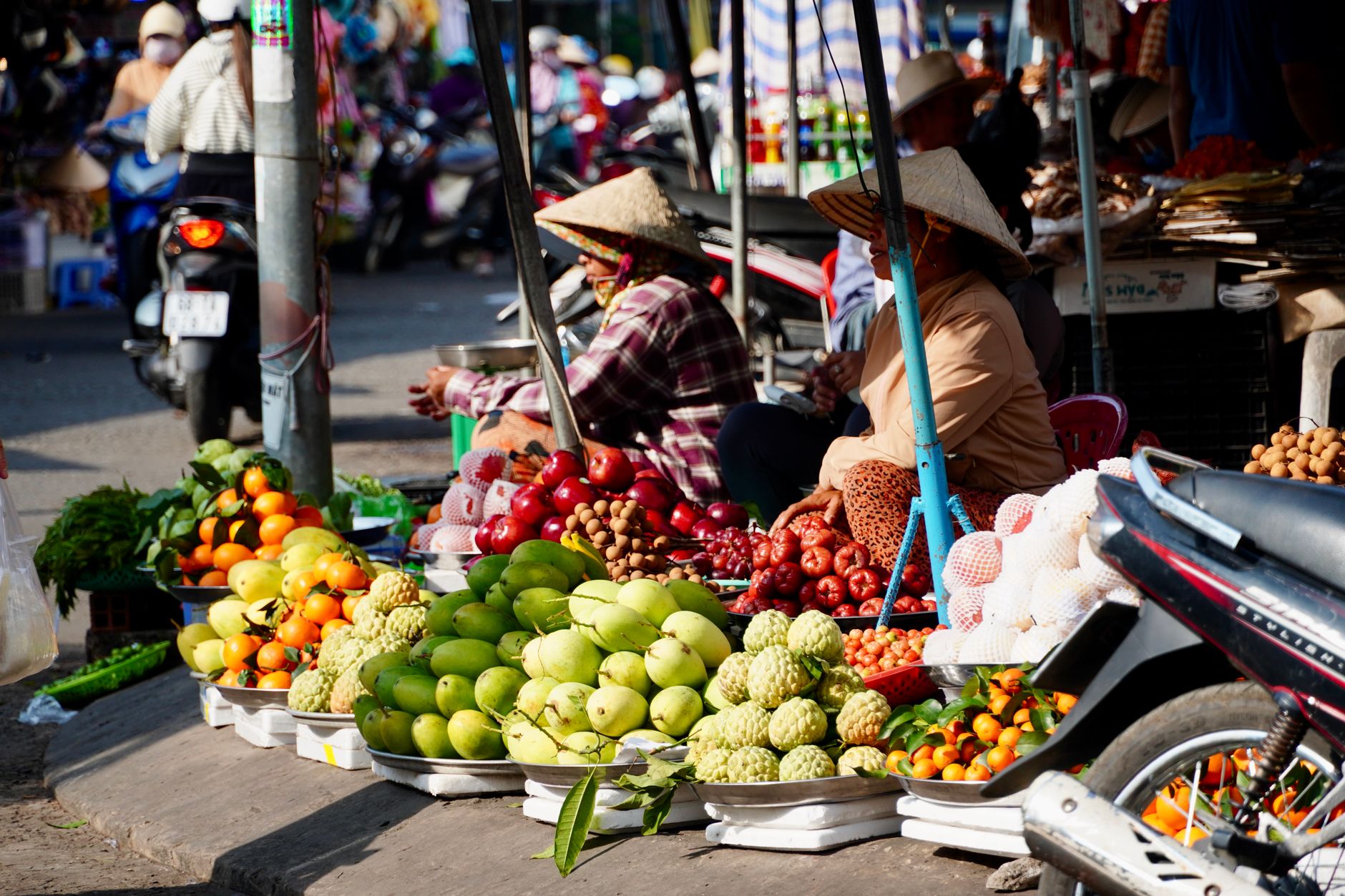
Traditional wet markets are the first stop, and morning is the best time, when the day's cakes are freshest. Cake stalls and dessert counters in busy neighbourhoods are reliable. Chè shops often carry it. Small family workshops and bakeries that specialise in Vietnamese cakes sell it by the tray.
In Ho Chi Minh City, Bến Thành and Bình Tây markets in Cholon are the obvious starting points, though tourist-zone pricing applies at Bến Thành. In Hanoi, the Old Quarter and neighbourhood markets carry it, but availability varies by stall and day. Check locally before making a special trip.
Mekong Delta
The delta is the most atmospheric setting for the cake, and provincial markets in Cần Thơ, Mỹ Tho and Bến Tre are the places to look. Specific vendors change frequently, so verify on the ground rather than relying on an old list.
Tet and festival periods
Selection and demand rise sharply before Tet, next on Saturday 6 February 2027. The next Mid-Autumn Festival falls in mid-September 2027, since the 2026 date has passed. During the busiest days, offering cakes sell out early in the morning.
How to ask for it
- "Cho tôi một miếng bánh da lợn" (one slice, please)
- "Bánh da lợn bao nhiêu một cái?" (how much for one?)
- "Có đậu xanh không?" (does it have mung bean?)
In the south, "bánh da heo" works just as well.
Finding a good vendor
Look for high turnover, covered trays, and cut cakes that are clean rather than sweating. A natural pandan scent is a good sign. Neon green is not.
What bánh da lợn costs in 2026
Pricing is not widely covered. The figures below are estimates and should be verified against current market checks before relying on them.
| Format | Venue | Price in VND | Price in USD |
|---|---|---|---|
| Single slice | Wet market | 5,000 to 15,000 | 0.20 to 0.60 |
| Whole tray | Market or bakery | 60,000 to 200,000 | 2.40 to 8 |
| Rolled or rose-shaped | Modern bakery | Higher, varies | Varies |
Why prices vary
City prices run above provincial ones. Real coconut milk costs more than cheaper substitutes, and tourist-zone stalls add a mark-up. Tet brings a festival premium. Home cooks can buy pre-mixed flour (bột bánh da lợn) at supermarkets and online.
Tips for avoiding overpayment
Ask the price before the vendor wraps the cake. Carry small notes, since change for a 500,000 VND note can be a problem at a market stall. Compare with a neighbouring stall before committing.
Food safety, allergies and dietary notes
Spoilage and the heat
Steamed coconut cakes spoil quickly in tropical heat. Buy from covered trays, eat the same day, and avoid slices that have been sitting in direct sun. Vietnamese recipe pages themselves warn that the cake turns in hot weather.
Allergens and diets
The cake contains coconut and mung beans, which are legumes. The classic version has no pork, no dairy and no wheat, which makes it vegetarian and often vegan. Some recipes add wheat flour (bột mì), so gluten-free is not guaranteed. Some modern variants add milk or eggs. Ask before buying if either matters.
Colouring and sugar
Artificial colour and pandan essence are common at cheaper stalls. The cake is high in sugar and starch, so it is not ideal for anyone managing diabetes. As a rough estimate, allow around 150 to 220 kcal per 100 g, though this figure should be verified.
Storage and travelling with it
Fridge storage hardens the texture, and re-steaming restores some softness. Carrying a cake home on a long flight is not recommended, and customs rules on fresh food vary by country.
Bánh da lợn compared with similar desserts
| Cake | Country or region | Main starch | Flavour base | Texture |
|---|---|---|---|---|
| Bánh da lợn | Vietnam | Tapioca, rice flour | Pandan, coconut, mung bean | Chewy, springy |
| Khanom chan | Thailand | Tapioca, rice flour | Pandan, coconut | Chewy, layered |
| Kue lapis | Indonesia | Rice flour, tapioca | Coconut, pandan | Firm, dense |
| Kuih lapis | Malaysia | Rice flour, tapioca | Coconut, pandan | Soft, layered |
| Bánh bò | Vietnam | Rice flour | Coconut, sugar | Spongy, honeycomb |
| Bánh phu thê | Vietnam | Rice flour, tapioca | Pandan, mung bean | Soft, sticky |
Other Vietnamese steamed cakes
Bánh bò is spongy with a honeycomb crumb, nothing like the dense chew of bánh da lợn. Bánh lá dứa is a pandan-scented steamed cake, often baked rather than layered. Bánh lọt is served as noodles in coconut milk, not as a slice. Bánh tét is a savoury or sweet sticky rice log wrapped in leaf. Bánh phu thê, the "husband and wife" cake, shares the pandan and mung bean pairing but is softer and served in small parcels.
Quick ordering guide
If a stall has several cakes and the names mean nothing, describe what you want: "the green and yellow striped chewy one". It works.
Making it at home or taking a class
Quick overview of the process
Four steps cover the whole cake: prepare the mung bean paste and pandan juice, mix the batter and split it into two coloured portions, steam it layer by layer in an oiled mould, then cool completely and cut. The cooling step matters. Cut too early and the layers smear.
Cooking classes
Some cooking classes in Vietnam include steamed cakes, but the layered cake is not always part of a standard menu. Ask what the class actually covers before booking, and check whether the session is hands-on or a demonstration.
Where to buy ingredients abroad
Asian grocery stores stock tapioca starch, pandan leaves or extract, and canned coconut milk. Frozen pandan leaves give a far better result than extract. Canned coconut cream works as a substitute for fresh coconut milk.
FAQ
Q: Does bánh da lợn contain pork? No. The name means "pig skin cake" because the striped layers resemble pork skin. The classic cake is made from tapioca starch, rice flour, coconut milk, sugar, pandan and mung beans, and is usually vegetarian.
Q: What does bánh da lợn taste like? Fragrant with pandan and coconut, lightly sweet, with a chewy, springy texture and a softer, slightly savoury mung bean layer. Think mochi or firm jelly rather than sponge cake.
Q: Is bánh da lợn the same as bánh da heo? Yes. "Da heo" is the southern word for pork skin, and both names refer to the same cake. "Banh da lon" is the common accent-free spelling.
Q: How much does bánh da lợn cost in Vietnam? A market slice typically runs 5,000 to 15,000 VND (USD 0.20 to 0.60), and a whole tray 60,000 to 200,000 VND (USD 2.40 to 8). Tourist areas and the Tet period push prices higher.
Q: Is bánh da lợn gluten-free and vegan? The classic version uses tapioca and rice flour with no dairy or eggs, so it is often both. Some recipes add wheat flour, milk or eggs, so ask the vendor if either matters to you.
Q: How long does bánh da lợn last, and can it go in the fridge? It is best eaten the same day at room temperature, and it spoils quickly in tropical heat. Refrigeration hardens it, though a few minutes of re-steaming softens it again.
Q: When is bánh da lợn most popular? All year, but especially in the days before Tet, next on Saturday 6 February 2027, and for family offerings on the lunar 1st and 15th days of each month.
Q: Where can travellers buy bánh da lợn? Traditional markets, cake stalls and chè shops, particularly in southern Vietnam and the Mekong Delta. Morning is the best time for freshly made cakes.