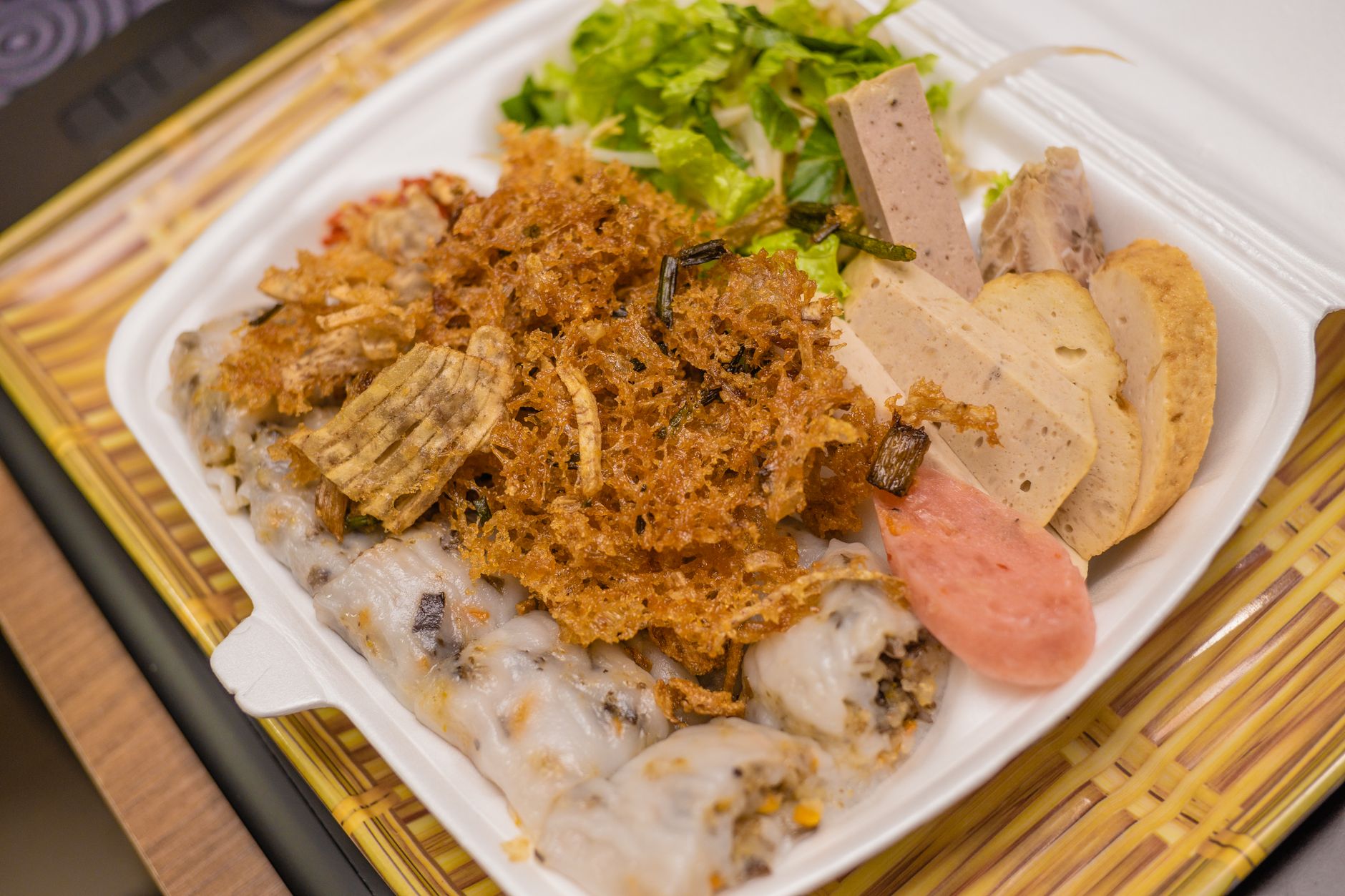
This is banh cuon, Vietnam's delicate steamed rice rolls, and it happens thousands of times every morning across the country. Unlike pho or bun cha, which have achieved international fame, banh cuon remains mostly a local breakfast ritual. That is changing, but slowly. For travelers willing to seek it out, banh cuon offers one of the most refined, subtle dishes in Vietnamese cuisine.
What exactly is banh cuon?
Banh cuon starts with rice batter made from soaked rice grains ground with water. The batter is poured in a thin layer onto a cloth stretched over a pot of boiling water. Steam cooks the batter in seconds, producing a sheet of rice paper that is impossibly thin, slightly translucent, and silky.
The classic filling is a mixture of minced pork, finely chopped wood ear mushroom, shallots, and sometimes black pepper. The filling is cooked, placed along the center of the rice sheet, and the whole thing is rolled into a cylinder. The result is a soft, slightly chewy roll about the size of a finger.
Banh cuon is served with a handful of accompaniments. The plate typically includes:
- The rolls themselves, cut into bite-sized pieces
- Cha lua (Vietnamese pork sausage) or cha que (cinnamon-scented pork sausage)
- Fresh herbs: rau thom, mint, and sometimes perilla
- Bean sprouts, briefly blanched
- Thinly sliced cucumber and pickled carrots
- Fried shallots sprinkled on top
- A small bowl of nuoc cham, the fish sauce-based dipping sauce
The dish is eaten with chopsticks, each piece dipped generously into the sauce. Some people add a slice of sausage and a herb leaf to each bite. The texture contrast matters: the soft roll, the firm sausage, the crunch of cucumber, the sharpness of herbs.
The birthplace: Hanoi and Thanh Tri village
Banh cuon originated in the north, specifically in the villages around Hanoi. The most famous is Thanh Tri, a village on the southern edge of the city that has been making banh cuon for generations. Families here wake before dawn to grind rice, prepare batter, and set up their steaming stations.
In Hanoi proper, banh cuon is a morning food. Stalls open around 6 AM and often sell out by 10 AM. The best ones are small operations with a single woman working the steam drum, a stack of plates beside her, and a queue of locals on plastic stools waiting for their order.
The Hanoi style is minimalist. The rolls are plain, filled only with pork and mushroom. The sausage is cha luc, a simple boiled pork roll. The herbs are limited to what is fresh that morning. The focus is entirely on the texture of the rice sheet and the balance of the nuoc cham.
A proper Hanoi nuoc cham for banh cuon is lighter than the version used for fried spring rolls. It combines fish sauce, water, lime juice, sugar, garlic, and chili, but the proportions lean toward sweet and sour rather than salty. Some stalls add a few slices of fresh chili and a sprinkle of ground pepper on top of the rolls.
For the best experience in Hanoi, look for stalls near markets or residential streets in the Old Quarter and surrounding districts. The district of Thanh Xuan, home to many Thanh Tri families who moved to the city, has a high concentration of good banh cuon shops.
Regional variations across Vietnam
Banh cuon changes as you travel south. The basic technique remains the same, but the fillings, accompaniments, and serving style shift.
Northern style (Hanoi and surrounding provinces)
The northern version is the benchmark. Plain rice rolls, pork and mushroom filling, cha luc sausage, minimal herbs. The dipping sauce is light and balanced. This is the version that purists defend.
Central style (Hue, Da Nang, Hoi An)
Central Vietnam adds more drama. In Hue, banh cuon is often served with a richer filling that includes shrimp and pork. The rolls might be topped with crushed peanuts and fried shallots. The nuoc cham is thicker and more pungent, reflecting central Vietnam's preference for bold flavors. Some versions add a drizzle of scallion oil over the rolls before serving.
In Hoi An, banh cuon appears on breakfast menus alongside cao lau and mi quang. The local version includes a slightly thicker rice sheet and often comes with a side of fresh herbs that includes the peppery rau ram (Vietnamese coriander).
Southern style (Ho Chi Minh City and the Mekong Delta)
The south goes bigger. Banh cuon in Ho Chi Minh City is often served with a more substantial filling: ground pork, shrimp, and sometimes egg. The accompaniments multiply: more herbs, more pickles, more sausage. Some stalls offer banh cuon topped with a fried egg or served with a bowl of clear broth.
The Mekong Delta has its own variation called banh cuon long, where the rolls are served in a pork bone broth with herbs, similar to how some noodle soups are served. This version is harder to find outside the delta, but worth seeking out if traveling through Can Tho or Vinh Long.
The filling that changes everything: banh cuon tom
A notable variation is banh cuon tom, where the rice sheet is wrapped around a whole steamed shrimp. The shrimp is placed at one end of the sheet, then rolled so the pink tail protrudes from the roll. This version is popular in central Vietnam and at higher-end restaurants in Hanoi. The sweetness of the shrimp contrasts with the neutral rice sheet and the salty fish sauce.
How to eat banh cuon properly
Eating banh cuon is not complicated, but there is a method. The key is to build each bite with the right combination of textures.
- Use your chopsticks to pick up one piece of roll.
- Dip it into the nuoc cham, making sure it is fully coated.
- Optionally, add a slice of cha lua or a herb leaf on top of the roll before eating.
- Chew slowly. The roll should be soft, almost dissolving, with the filling providing a slight chew.
- Alternate bites of roll with bites of pickled carrot and cucumber to cleanse the palate.
- Drink the leftover nuoc cham at the end if you want. Many locals do.
Some people add a few drops of chili garlic sauce to their nuoc cham for extra heat. Others squeeze lime into the sauce before starting. The stall owner will usually provide a small plate of fresh chili and lime wedges. Use them according to taste.
One thing to avoid: don't ask for the rolls to be reheated. Banh cuon is meant to be eaten fresh, at the temperature it comes off the steam drum. Reheating makes the rice sheet tough and ruins the texture.
Pro tip: Order "banh cuon nong" (hot banh cuon) at a stall where you can watch the steam. The rolls are made to order, so they arrive at the table still warm. This is the only way to experience the dish at its best.
Banh cuon vs. other Vietnamese rice dishes
Banh cuon is often confused with other rice-based dishes. Here is a quick comparison:
| Dish | Rice form | Filling | How served | Region |
|---|---|---|---|---|
| Banh cuon | Steamed thin sheets, rolled | Pork, mushroom | With sausage, herbs, nuoc cham | North, all regions |
| Banh uot | Steamed sheets, not rolled | None or minimal | With grilled pork or chicken | Central, South |
| Banh xeo | Fried crispy pancake | Pork, shrimp, bean sprouts | Wrapped in lettuce with herbs | Central, South |
| Banh khot | Mini fried pancake | Shrimp | Eaten with herbs and fish sauce | South |
| Goi cuon | Raw rice paper roll | Shrimp, pork, herbs | With peanut hoisin sauce | South |
Banh uot is the closest relative. It is the same steamed rice sheet, but served flat instead of rolled, often underneath grilled pork or chicken. If you like banh cuon, banh uot is worth trying as a variation.
Where to find the best banh cuon
Hanoi
The capital remains the best city for banh cuon. The most famous stall is Banh Cuon Ba Xuan on Hang Ga Street, which has been operating for decades. Expect a queue at peak hours. The rolls are consistently excellent, the nuoc cham is perfectly balanced, and the cha lua is freshly made.
Another reliable option is Banh Cuon Thanh Tri on Nguyen Trai Street, run by a family that moved from the village to the city. The rice sheet here is slightly thinner than average, which is a sign of skill.
For a sit-down experience, try Banh Cuon Gia Truyen on Cau Go Street. It is more expensive than street stalls but offers a cleaner environment and the same quality of rolls.
Ho Chi Minh City
The best banh cuon in Saigon tends to be in District 5 (Chinatown) and District 10. Banh Cuon Hoa Mai on Nguyen Trai Street in District 5 is a local favorite. The southern style here includes shrimp in the filling and a broader range of herbs.
Hue
In Hue, look for banh cuon stalls near the Dong Ba Market. The central version with shrimp and a thicker nuoc cham is worth trying, especially if you have already eaten the northern style and want to compare.
Cooking classes
For travelers who want to learn the technique, several cooking classes in Hanoi and Hoi An include banh cuon in their curriculum. The challenge is the steaming equipment, which is hard to replicate at home. Most classes use a flat pan with a lid instead of the traditional drum. The results are acceptable but not identical. See our guide to cooking classes in Vietnam for recommendations.
The role of banh cuon in Vietnamese food culture
Banh cuon occupies a specific place in the Vietnamese breakfast hierarchy. It is lighter than pho or bun bo Hue, but more substantial than banh mi. It is also one of the few dishes where the texture of the rice sheet is the star, not the filling or the broth.
The dish has a reputation as a "gentle" food, suitable for people with delicate stomachs. Elderly people and young children eat banh cuon because it is easy to digest. It is also commonly given to people recovering from illness, for the same reason.
In recent years, banh cuon has gained popularity as a late-night snack in Hanoi. Some stalls now open in the evening and serve smaller portions. This is a departure from tradition, but it means travelers who miss the morning window can still try the dish.
Practical tips for eating banh cuon
- Go early: The best rolls are made in the first hours of operation, when the batter is fresh and the steam drum is at the right temperature.
- Watch the stall: If you can see the cook making the rolls, you can judge the thickness of the rice sheet. A good sheet is almost transparent but doesn't tear.
- Check the nuoc cham: Taste the dipping sauce before adding anything. A good banh cuon stall has a balanced sauce that doesn't need adjustment.
- Bring cash: Most banh cuon stalls are cash-only. Small bills are appreciated.
- Sit on the small stools: The plastic stools are part of the experience. They are low to the ground, so wear clothes that allow you to bend comfortably.
Pairing banh cuon with other foods
Banh cuon is often eaten as a standalone breakfast, but it pairs well with other dishes. In Hanoi, it is common to order a bowl of cha lua (pork sausage) on the side, or a plate of banh ran (fried glutinous rice balls) for contrast.
For drinks, a hot cup of tra da (iced tea) is the standard accompaniment. The cold tea cuts through the richness of the rolls and cleanses the palate. A glass of fresh soy milk also works well, especially in the cooler months.
If you are planning a food-focused trip, banh cuon should be part of a broader Vietnam food itinerary. It pairs naturally with other northern breakfast dishes like bun cha and pho, and provides a lighter alternative to the heavier noodle soups.
Warning: Banh cuon is addictive. The combination of soft rice sheet, savory filling, and tangy sauce is easy to eat in large quantities. A single portion is usually 8-10 rolls, which is enough for one person. If you are very hungry, order two portions.
Seasonal considerations
Banh cuon is available year-round, but it is most satisfying in cooler weather. The hot rolls and warm broth are comforting on a chilly Hanoi morning. In summer, the dish is less appealing, though the light texture makes it easier to eat than hot noodle soups.
In the rainy season, banh cuon stalls are often busier, as people seek warm food during the downpours. The steam from the cooking drums also provides a natural shelter from the drizzle. If you are traveling during the monsoon, a plate of banh cuon is a practical choice. See our guide to visiting Vietnam in the rainy season for more tips.
The future of banh cuon
Banh cuon remains a street food first and foremost. It has not made the leap to fine dining that pho has, and there are no high-end banh cuon restaurants in Hanoi or Saigon. This is partly because the dish depends on the steam drum and the skill of the cook, which are hard to replicate in a commercial kitchen.
But the dish is spreading. Banh cuon stalls now appear in Da Nang, Nha Trang, and even in Vietnamese communities abroad. The version served overseas tends to be the southern style, with more filling and more accompaniments, as it travels better and is more visually impressive.
For travelers, the message is simple: eat banh cuon where it is made, in the morning, at a stall with a steam drum and a queue of locals. The dish will not change your life, but it will show you a side of Vietnamese cuisine that many visitors miss entirely.
Frequently asked questions
Q: Is banh cuon gluten-free? Yes. The rice sheets are made from rice flour and water, with no wheat. The filling is pork and mushroom. The nuoc cham is fish sauce based. The only potential issue is the cha lua, which sometimes contains a small amount of wheat starch as a binder. Ask the stall owner if you have a gluten sensitivity.
Q: What is the difference between banh cuon and banh uot? Banh cuon is rolled with a filling inside. Banh uot is served flat, without a filling, usually as a base for grilled meat or chicken. The rice sheet is the same.
Q: Can vegetarians eat banh cuon? The classic filling is pork, but some stalls offer a mushroom-only version. Ask for "banh cuon nam" (mushroom banh cuon). The dipping sauce is fish sauce, so strict vegetarians should ask for soy sauce instead.
Q: How much does banh cuon cost in 2026? Street stalls charge 30,000-50,000 VND ($1.20-2.00) per plate. Restaurants charge 60,000-80,000 VND ($2.40-3.20). The price difference reflects the quality of the filling and the environment.
Q: Why is banh cuon only served in the morning? The rice batter is made fresh each day and does not keep well. Stalls prepare a limited amount and sell until it runs out. Some stalls in Hanoi now open in the evening, but the quality is usually lower.
Q: Is banh cuon healthy? It is one of the lighter Vietnamese dishes. The rice sheet is steamed, not fried. The filling is lean pork and mushrooms. A plate has roughly 300-400 calories. The main concerns are the sodium in the fish sauce and the sugar in the nuoc cham.
Q: What is the best way to find a good banh cuon stall? Look for a stall with a queue of locals, a single cook working a steam drum, and a plate of cha lua on display. If the cook is making rolls continuously, the stall is busy and the rolls are fresh. Avoid stalls that have pre-made rolls sitting on a tray.