Truc Lam Zen Monastery at a glance
| Item | Detail | Last known as of |
|---|---|---|
| Vietnamese name | Thiền viện Trúc Lâm Đà Lạt | October 2026 |
| Location | Phụng Hoàng (Phoenix) Hill, above Tuyền Lâm Lake, 5 to 7 km south of Xuan Huong Lake | October 2026 |
| Built | 1993 to 1994 | October 2026 |
| Founder | Zen Master Thích Thanh Từ | October 2026 |
| Size | About 24 to 25 ha | October 2026 |
| Entry | Free | October 2026 |
| Usual hours | Around 07:00 to 17:00 daily | October 2026 |
| Time to allow | 1 to 1.5 hours for the monastery alone; 2.5 to 3 hours with the cable car and the walk to the lake | October 2026 |
| Best hour | Opening time | October 2026 |
Which Truc Lam? A name shared across Vietnam
Search results for "Truc Lam" mix up half a dozen unrelated places: Yen Tu in Quang Ninh, Bach Ma in Hue, Phuong Nam in Can Tho, and monasteries in Sapa and Phu Yen. The confusion is understandable, because Truc Lam is not one building. It is the name of a Zen lineage, and dozens of monasteries across the country carry it.
This page is about the Da Lat monastery, one of the first large Truc Lam houses of the modern revival. If you are looking for the 13th-century origin site, that is Yen Tu in the north. If you want the lakeside garden monastery most Da Lat itineraries include, you are in the right place.
The story of the place
The story connects a 13th-century king to a 1990s concrete monastery, and it explains why the site carries weight far beyond its age.
Tran Nhan Tong, the king who became a monk
Tran Nhan Tong (1258-1308) ruled Dai Viet through the Mongol-Yuan invasions of 1285 and 1287-1288, both of which his armies repelled. He abdicated in 1293 and later withdrew to Yen Tu Mountain in what is now Quang Ninh province.
There he founded the Truc Lam ("Bamboo Grove") school, the first Zen lineage of fully Vietnamese origin. The school's three patriarchs were Tran Nhan Tong, Phap Loa and Huyen Quang. Its core idea was practising Zen while living in the world, not fleeing it. A king who gave up the throne to meditate is the founding image, and it shapes how Vietnamese Buddhists read every Truc Lam monastery.
A lineage that faded, and the monk who revived it
After the 14th century the Truc Lam school declined and merged into other traditions. It survived as a historical memory more than a living institution.
Thích Thanh Từ revived it in the second half of the 20th century, through monasteries in the south such as Chân Không in Vung Tau and Thường Chiếu in Dong Nai. He stripped back ritual and emphasised meditation over devotional practice, which is why the buildings feel spare compared with the ornamented pagodas of the Mekong Delta or Ho Chi Minh City. Check founding dates against Vietnamese Buddhist Sangha sources if you are citing them in academic work.
Building on Phoenix Hill
Ground was broken in 1993 and the monastery was inaugurated in 1994. The exact day and month vary between sources, so treat "1994" as the safe figure.
The master plan is credited to architect Ngô Viết Thụ, best known for Independence Palace in Saigon. The main hall is credited to Huỳnh Ngọc Ân. Both attributions appear widely in Vietnamese sources but are worth cross-checking before you repeat them as fact.
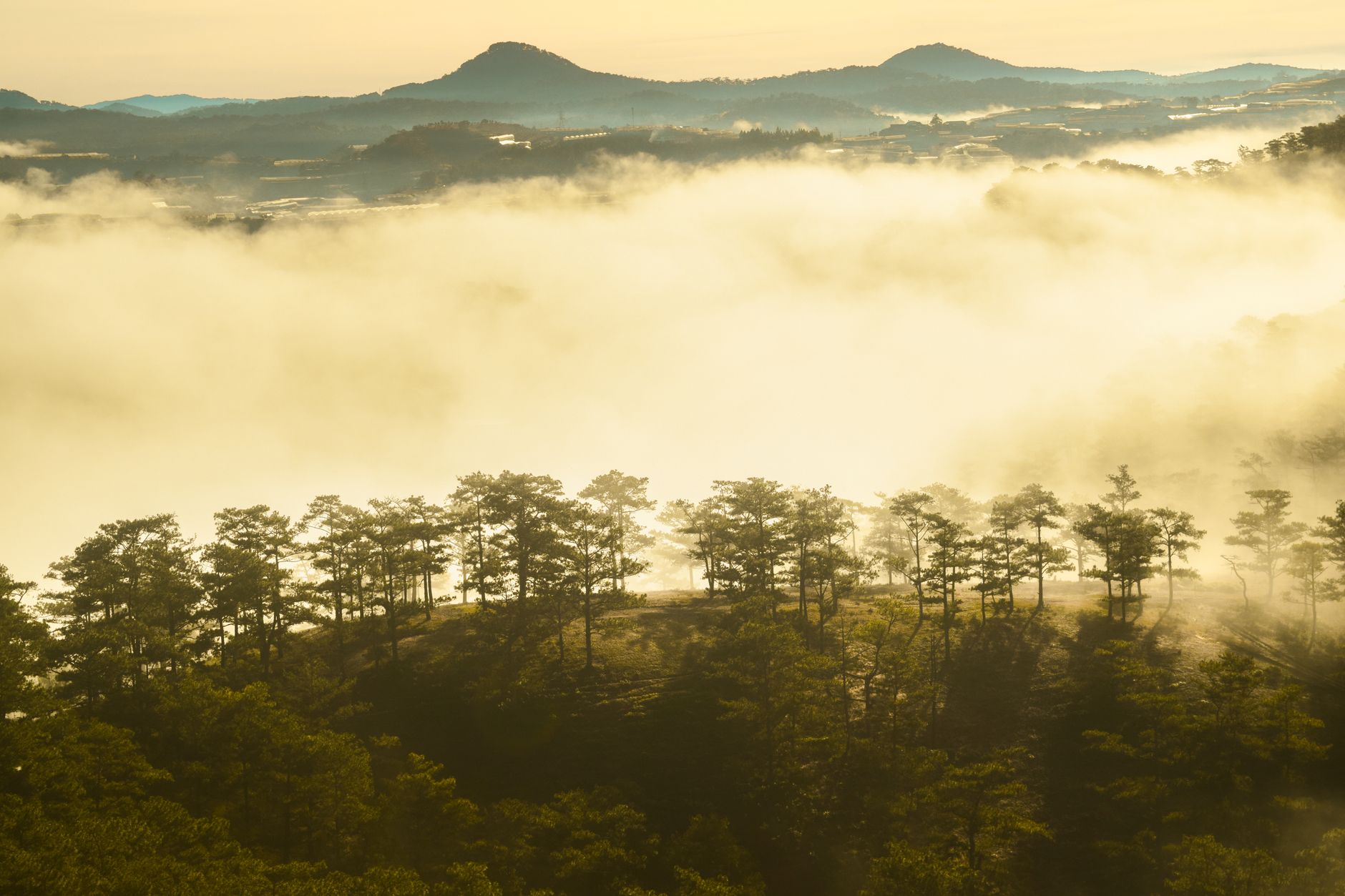
Da Lat was chosen for practical reasons: a cool climate, pine forest, and a lake view suited to retreat. The site sits high enough that mist settles over Tuyền Lâm in the early morning, which is part of why the setting works.
Why it matters today
The Da Lat monastery became a model for the Truc Lam houses built across the country, including the reconstruction at Yen Tu in the early 2000s. It is a working training centre for monks and nuns, not a museum.
It also shows how religious sites in Vietnam now balance practice with mass domestic tourism. On a Sunday morning you can watch a coach party photograph itself in front of the gate while twenty metres away the resident community keeps its own schedule. That tension is the most interesting thing about the place.
What you see on site, in visiting order
The order depends on how you arrive. The cable car drops you above the main complex, while the road ends at the car park below the gate. Both sequences work; the difference is whether you climb first or descend.
Arriving by cable car: upper terrace, gardens and Bodhidharma statue, main hall, courtyard and bell tower, tam quan gate, stone stairway down, path to Tuyền Lâm Lake.
Arriving by road: stone stairway and tam quan gate, courtyard and bell tower, main hall, gardens and Bodhidharma statue, Tịnh Tâm lake, path to Tuyền Lâm Lake.
| Stop | What to look at | Time to spend | Photo allowed? |
|---|---|---|---|
| Stone stairway and tam quan gate | Pine slope, three-entrance gate, first group photo spot | 10 min | Yes |
| Courtyard and bell tower | Great bell, Ly-Tran roof lines, open layout | 15 min | Yes |
| Main hall | Shakyamuni Buddha holding a lotus, carved panels | 20 min | No inside |
| Gardens and Bodhidharma statue | Seasonal flowers, white statue under bougainvillea | 20 min | Yes |
| Tịnh Tâm lake | Willows, fish, turtles, benches | 10 min | Yes |
| Path to Tuyền Lâm Lake | Roofs against the water, boat pier | 20 min down | Yes |
The stone stairway and the three-entrance gate
From the road car park you climb through pines to the tam quan gate, the three-entrance portal that marks the boundary between ordinary ground and monastic ground. The steps are steep enough to matter for older visitors and anyone carrying luggage. This is where Vietnamese visitors take their first group photo, and the gate frames the complex well from below.
The courtyard and the bell tower
The main courtyard is open and uncluttered, with the bell tower to one side. The great bell is the object most people photograph without listening to. If you are there at a fixed hour you may hear it struck; the sound carries across the whole hill. The construction is restrained and mostly concrete, dressed in traditional Ly-Tran roof lines rather than gilded ornament. That austerity is deliberate.
The main hall and the Buddha holding a flower
The statue inside is Shakyamuni Buddha holding a lotus. It refers to the "flower sermon," in which the Buddha raised a flower before an assembly and said nothing. Only Mahakashyapa smiled. Zen traces its origin to that moment, so the statue is a statement of what this monastery is about: direct transmission, not scripture.
Look for the carved panels of the Buddha's life along the walls. They are worth a few minutes, though the details vary between descriptions in guidebooks, so read them on site rather than trusting a secondhand list.
Shoes off at the entrance, and no photography inside the main hall. The rule is posted and enforced by volunteers.
The gardens and the Bodhidharma statue
The flower gardens are tended by the resident monks and nuns, and they change with the season: hydrangeas, roses, salvia, snapdragons and orchids all appear at different times of year. Do not pick anything.
The white Bodhidharma statue under bougainvillea is the most photographed spot on the grounds. Bodhidharma was the Indian monk credited with bringing Zen (Chan) to China, and his stern, bearded figure is a standard marker of a Zen site. Expect a short queue at peak times.
Tinh Tam lake
Tịnh Tâm ("calm heart") is a small artificial pond with willows, fish and turtles. It is the best place to sit for ten minutes, and almost nobody does. Most visitors walk straight past it toward the statue.
Down to Tuyen Lam Lake
A stone path through pines leads down to the boat pier on Tuyền Lâm, a reservoir created in the 1980s. The walk down takes about 15 to 20 minutes; the walk back up is honest effort, especially in the afternoon heat. At the pier you can hire boats or kayaks, and the view back up to the monastery roofs is the best photograph on the site.
The inner monastery: what is off-limits and why
The monks' and nuns' quarters (nội viện) are signposted and closed to visitors. The men's and women's sections are separate, and the boundary is not decorative. Crossing the line to peek at a courtyard is the most common tourist faux pas here, and it is treated as an intrusion rather than curiosity.
A working monastery: daily life and etiquette
Most visitors arrive with no idea what happens here, which is why the rules matter.
The monks' day
The daily rhythm runs roughly from a pre-dawn wake-up through meditation sessions, work and study, with meals taken in silence. Exact times are not published for visitors and vary by season, so ask at reception if you need them rather than assuming a schedule.
There are no drop-in meditation classes in English. Retreats are organised mainly for Vietnamese lay practitioners and require advance arrangement with the monastery.
Dress code and behaviour
Cover shoulders and knees. No shorts, tank tops or sheer clothing. Bring a scarf or sarong in your bag for warm afternoons when you want to cover up before entering.
Speak quietly, do not pick flowers or step on lawns, and keep children off the statues. These are ordinary rules in any Vietnamese pagoda, and they are taken seriously here because people live on site.
Photography and drones
No photos or video inside the main hall. Photographing monks up close without asking is intrusive, and a smile plus a gesture is usually enough to get a yes or a no.
Drones are subject to Vietnamese flight regulations and are unwelcome at a working monastery. Leave it in the bag.
How it compares with other Da Lat pagodas
| Site | Built | Style | Distance from centre | Entry | Best for |
|---|---|---|---|---|---|
| Truc Lam | 1993-1994 | Restrained Zen, lakeside | 5 to 7 km south | Free | Gardens, lake views, Zen context |
| Linh Phuoc (Trai Mat) | 20th century, expanded later | Mosaic of broken pottery, long dragon | About 8 km east | Free | Ornate spectacle, photography |
| Linh Son | 1930s | Older town pagoda | In town, walkable | Free | A quick visit without leaving the centre |
| Truc Lam Yen Tu | Origin site, rebuilt early 2000s | Pilgrimage architecture | Quang Ninh, far north | Varies | The historical birthplace of the lineage |
Choose Truc Lam for restraint and setting, Linh Phuoc for colour and craft, Linh Son for convenience, and Yen Tu if you want the origin story in person.
Is it worth the detour? An honest verdict
Who will love it: garden lovers, photographers at opening time, anyone pairing it with the cable car, and visitors curious about Vietnamese Zen.
Who may be disappointed: those expecting an ancient temple (it is a 1990s building), visitors who arrive mid-morning when tour groups take over the courtyard, and people with limited mobility because of the steps.
Bottom line: the cable car ride and the walk down to the lake are often the highlight. Treat the monastery as part of a two to three hour loop rather than a standalone visit.
Practical information
Opening hours and entrance fee
Hours are about 07:00 to 17:00 daily as of October 2026, though some sources cite an earlier opening. Entry is free. Donation boxes are voluntary and there is no pressure to give. Hours occasionally shift for ceremonies, so treat the times as the last known value rather than a guarantee.
Robin Hill cable car: fares and hours
The route is about 2.3 km and takes roughly 12 minutes each way. Fares are about 100,000 VND one way (≈3.80 USD / 3.30 EUR) and about 120,000 VND return for adults, with lower child fares. Fares have risen several times, so check at the station.
The cable car commonly breaks for lunch around 11:30 to 13:00 or 13:30. Plan around it, because it can strand you at the top. It may also pause in high wind or storms.
Address and the 2025 administrative change
The monastery is reached via Truc Lam Yen Tu Street, off the Prenn Pass road. Older addresses read Ward 3, Da Lat. Since the July 2025 province and ward mergers, addresses read "Xuan Huong - Da Lat Ward, Lam Dong Province." Apps and older guidebooks may show either version.
Facilities and accessibility
Parking is about 5,000 to 10,000 VND for motorbikes and 20,000 to 30,000 VND for cars, approximate. There are toilets and small stalls for drinks, vegetarian snacks and Buddhist books near the entrance.
Accessibility is poor. Steep stone steps run throughout, and the path to the lake is steep. The cable car avoids the climb from the road car park but not the internal stairs, so wheelchairs are impractical.
How to get there from the city centre
| Mode | Time from Xuan Huong Lake | Approx. cost | Pros | Watch out for |
|---|---|---|---|---|
| Cable car from Robin Hill | 10 min ride to station, 12 min flight | 100,000 VND one way | The view is the point | Midday break, weather pauses |
| Grab car | 15 to 20 min | 90,000 to 130,000 VND (≈3.50 to 5 USD) | Door to door | Return fares higher from the car park |
| Grab bike | 15 to 20 min | 35,000 to 55,000 VND | Cheapest | Exposed on the pass |
| Metered taxi (Mai Linh, Lado) | 15 to 20 min | 100,000 to 150,000 VND | Reliable | Ask for the meter |
| Motorbike rental | 20 min | 100,000 to 150,000 VND per day | Freedom to stop | Licence and insurance issues |
The cable car station sits on the Prenn hill, about 3 km from Xuan Huong Lake. It is a 10 minute Grab ride or a 40 to 50 minute uphill walk via 3 Thang 4 Street. Riding down by cable car and returning by Grab is a smart combination.
By motorbike, the route runs Tran Quoc Toan, Ho Tung Mau, 3 Thang 4 Street, then toward Prenn Pass and right onto Truc Lam Yen Tu Street.
Riders need a licence valid in Vietnam. An IDP under the 1968 convention plus a home licence is required, and travel insurance is often void without it. Prenn is a busy pass with trucks and buses.
Walking the whole 6 km on the pass road is unpleasant and not advised. There is no practical public bus for visitors.
When to go and how to avoid the crowds
Best hour
Arrive at opening, roughly 07:00 to 08:00. Mist over Tuyền Lâm usually lifts by mid-morning. Tour groups typically arrive from about 08:30 to 11:00 and again mid-afternoon. Late afternoon before closing is the second-best slot.
Best season
The dry season, roughly November to April, brings clearer views and peak garden colour, but also peak domestic tourism. The rainy season, roughly May to October, means short heavy afternoon showers and slippery steps, but quieter grounds. Winter mornings can drop to 12 to 15°C.
Busy dates to plan around
| Occasion | Usual period | Next date after October 2026 | Effect on crowds |
|---|---|---|---|
| Weekends | Every Saturday and Sunday | Ongoing | Noticeably busier from mid-morning |
| Lunar 1st and 15th | First and fifteenth of each lunar month | Ongoing | Local worshippers arrive early |
| Christmas and New Year | Late December | Late December 2026 | Heavy domestic holiday traffic |
| Tet | Lunar New Year | 6 February 2027, with crowds for about a week either side | The busiest week of the year |
| Reunification and Labour Day | 30 April to 1 May | 2027 | Long weekend crowds |
| Vesak | 15th day of the 4th lunar month | Around late May 2027 | Ceremonies, more visitors |
| Vu Lan | 15th day of the 7th lunar month | Around mid-August 2027 | Families visiting |
Confirm lunar dates on a Vietnamese calendar before you book around them.
Insider tips: what most visitors miss
- Ride the cable car down and walk out by the lower gate. You see the complex in its intended order and skip the climb.
- Sit at Tịnh Tâm lake rather than queuing at the Bodhidharma statue.
- Wait for the bell to be struck instead of only photographing it.
- The best view of the monastery roofs against the lake is from a spot on the path down to the pier. Look back as you descend.
- Check the cable car lunch break before setting off.
- Carry small notes for parking and drinks.
- Bring a layer for the cold mornings.
What to combine within walking distance or a short ride
Tuyền Lâm Lake is on foot from the monastery. Datanla Waterfall is a short ride away, with an alpine coaster that rewards following the speed and braking rules. Robin Hill is the cable car terminal. Further along the lake you reach the Clay Tunnel and other sights.
| Time | Stop | Transport | Cost |
|---|---|---|---|
| 07:15 | Robin Hill station, cable car down | Grab to station, cable car | 50,000 VND Grab bike, 100,000 VND cable car |
| 07:45 | Monastery walkthrough | On foot | Free |
| 09:30 | Path down to Tuyền Lâm pier | On foot | Free |
| 10:15 | Datanla Waterfall | Grab | 60,000 to 90,000 VND |
| 12:00 | Lunch back in town | Grab | 90,000 to 130,000 VND |
FAQ
Q: Is there an entrance fee at Truc Lam Zen Monastery in Da Lat? A: Entry is free as of October 2026. You pay only for parking or the Robin Hill cable car if you use it, and donation boxes are voluntary.
Q: How long should I spend at Truc Lam Monastery? A: Allow 1 to 1.5 hours for the grounds, or 2.5 to 3 hours if you add the cable car and the walk down to Tuyền Lâm Lake. A half day covers it with Datanla.
Q: What are the cable car hours and does it close at lunch? A: It typically runs from early morning to late afternoon with a midday break commonly reported around 11:30 to 13:00 or 13:30. Fares and times change often, so check at Robin Hill station.
Q: Can tourists meditate or stay overnight at the monastery? A: There are no drop-in meditation sessions in English, and the practice quarters are closed to visitors. Retreats exist mainly for Vietnamese lay practitioners and require advance arrangement.
Q: What should I wear to Truc Lam Zen Monastery? A: Cover shoulders and knees, and remove shoes before entering the main hall. Bring a warm layer for Da Lat mornings and a scarf for covering up on warm afternoons.
Q: Is Truc Lam Da Lat the same as Truc Lam Yen Tu? A: No. Yen Tu in Quang Ninh is the 13th-century birthplace of the Truc Lam school, while the Da Lat monastery was built in 1993 to 1994 as part of its modern revival. Many other Truc Lam monasteries exist across Vietnam.
Q: Can I walk from Da Lat centre to the monastery? A: Walking the full distance along the Prenn Pass road is not advised because of traffic and the lack of pavement. Take a short Grab ride to Robin Hill, then the cable car.
Q: Is Truc Lam Monastery accessible for wheelchairs or people with limited mobility? A: Not really. The grounds rely on stone stairways and the path to the lake is steep. The cable car avoids the climb from the road car park but not the internal steps.