Po Nagar Cham Towers at a glance
| Item | Detail | Note on reliability |
|---|---|---|
| Address | 61 Hai Thang Tu (2/4) Street, Bac Nha Trang Ward, Khanh Hoa Province | The 2025 administrative reform dissolved Nha Trang City as a unit and replaced the old Vinh Phuoc Ward. Many maps still use the old address, so search for both. |
| Setting | Cu Lao Hill, about 10 m above the mouth of the Cai River | Firm |
| Towers | Four standing | Firm |
| Height | Main North tower about 23 m | Some sources say 25 m |
| Dates | Sacred site active before 781; surviving towers 8th to 13th century; main tower commonly dated 813 to 817 | Firm on the inscriptions, approximate on the construction dates |
| Status | National Historic Monument since 1979 | Several published sources report an upgrade to Special National Relic in January 2025; confirm against the ministry decision before treating it as settled |
| Hours | Most commonly reported 06:00 to 17:30 daily | Sources disagree; see the discrepancies table below |
| Fee | 30,000 VND (about USD 1.15) | Some guides still list 25,000 VND |
| Time needed | 45 to 90 minutes | Firm |
| Dress code | Shoulders and knees covered | Firm |
The story of Po Nagar: from Cham goddess to Thien Y A Na
Kauthara, the southern heart of Champa
Champa was not a single kingdom with one capital. It was a group of Indianized principalities strung along the central coast, each with its own ruling family and its own patron deity. Kauthara, centred on what is now Khanh Hoa, was one of them, and Po Nagar was its sanctuary.
The state is documented, not legendary. Its inscriptions are cut in Sanskrit and Old Cham, and they record kings, donations, wars and repairs with dates. That is how a hill above a fishing port can be traced across five centuries. The Cham people themselves still live in Vietnam, mainly in the former Ninh Thuan and Binh Thuan provinces and around An Giang. Since July 2025, Ninh Thuan has been part of the same Khanh Hoa province as Po Nagar, which matters more for itinerary planning than for history.
A temple raided, robbed and rebuilt: the stelae timeline
The inscriptions on site, read by scholars including Coedès, Maspero and Ngô Văn Doanh, tell a story of repeated damage and repair. That is the real explanation for why the towers look like a patchwork of periods.
| Year | Ruler or event | What happened |
|---|---|---|
| 774 to 781 | Seaborne raiders, often identified as Javanese | The mukhalinga is stripped of its jewels and the temple is burned. The inscription calls the raiders "frightful, completely black and gaunt". |
| 781 | Satyavarman | The king regains power and restores the temple |
| 784 | Satyavarman | A new linga is installed |
| 817 | Senapati Par under Harivarman I | Endowments recorded; the period usually linked to the main tower |
| 918 | Indravarman III | A gold statue of Bhagavati is ordered |
| c. 950 | Rajendravarman II of the Khmer | The gold statue is taken away |
| 965 | Jaya Indravarman I | A stone image replaces it, the lineage of the statue venerated today |
| 1050, 1084, 1141 to 1143, 1160 | Various reigns | Successive royal donations |
Read that list as a sequence of thefts and restorations and the site makes sense. It was never sealed off as a ruin. It was lived in, robbed, patched up and used again.
Who is the goddess?
Yan Po Nagar, Po Ina Nagar, "Mother of the Country", is tied to land, agriculture and weaving. Over time she was identified with Bhagavati and with Durga Mahishasuramardini, the buffalo-demon slayer. The simplification that she "is" a Hindu goddess misses the point. She keeps her own identity in Cham belief, and the Hindu identifications are layers added by different courts at different times.
Thien Y A Na: how the Vietnamese adopted her
Vietnamese settlers took over the site in the 17th century and renamed the goddess Thiên Y A Na Thánh Mẫu. The Vietnamese legend runs like this: a girl is raised by an elderly couple who grow melons; she disappears inside a log of agarwood; she marries a prince of the North; she returns to teach farming and weaving to the local people. That version was carved in 1856 on a stele by the mandarin Phan Thanh Gian under Emperor Tu Duc.
Today's worshippers are mostly Vietnamese practising Mother Goddess (Đạo Mẫu) belief, alongside Cham communities. One sanctuary, two religious traditions, continuous use. That is rare anywhere in Southeast Asia.
Heritage status today
Po Nagar was listed as a national monument in 1979. The Po Nagar festival was recognised as national intangible heritage in 2012. Several published sources report a further upgrade to Special National Relic in January 2025. Older guides still cite only the 1979 date, so expect to see both.
What you see on site, spot by spot
The entrance and the lost gate tower
The ticket booth sits on Hai Thang Tu Street, with car and motorbike parking under Tran Phu Bridge. Only foundations remain of the gate tower that once framed the approach. This is also where loaner robes are handed out if your clothing is too short.
The mandapa: the forest of brick pillars
Ten large and twelve smaller octagonal brick pillars stand in two rows. They once supported a roof or wooden platform used for offerings and ritual dance. One guide describes "five large and six small per row", which is the same count, so do not let the wording confuse you. This is the best spot to frame the towers above you.
The steep stairs to the upper terrace
The brick steps are steep, narrow, with little handrail, and slippery after rain. Wear shoes with grip and take them slowly.
The North tower (main sanctuary of the goddess)
Three receding tiers, entrance facing east. Look up at the lintel above the door: a four-armed Durga standing on a buffalo, flanked by musicians. It is Tra Kieu style, late 10th to early 11th century, and most visitors walk straight underneath it without looking.
Inside, the dark, incense-filled chamber holds the black stone goddess against a large leaf-shaped back slab. Published figures vary: about 1.2 m for the seated figure, about 2.6 m when figure, pedestal and slab are measured together. Both are correct.
The goddess is usually dressed in Vietnamese silk robes, so the ten arms described in scholarly texts are mostly hidden. Almost nobody realises she has them.
Etiquette inside: shoes off, hats off, move clockwise, let worshippers go first.
The Central, South and Northwest towers
The Central tower is dedicated to a linga of Shiva, and its brickwork is visibly rougher and more heavily restored. The South tower holds a Shiva linga and yoni. The Northwest tower, associated with Ganesh, keeps the best-preserved roofline detail of the group. Dedications should be checked against Ngô Văn Doanh's Champa: Ancient Towers before quoting them as certain.
Look for the colour line where modern restoration bricks meet the originals. The difference in tone and texture is obvious once you know to look, and it is better to have it explained than to pretend the site is untouched.
Stelae and inscriptions
The inscribed stones behind and around the towers include the 1856 Phan Thanh Gian stele carrying the Thien Y A Na legend, plus a modern stele summarising the site. Multilingual information is available on site, partly through QR codes.
The exhibition house and performance area
On the lower slope, a small display covers photos and Cham artefacts. A stage hosts Cham dance and music at intervals, with the Ginang drum, Kanhi fiddle and Saranai oboe, plus pottery and weaving demonstrations sometimes linked to Bau Truc village. These performances are staged for visitors, but they are performed by Cham artists, and that distinction is worth keeping in mind.
The river viewpoint
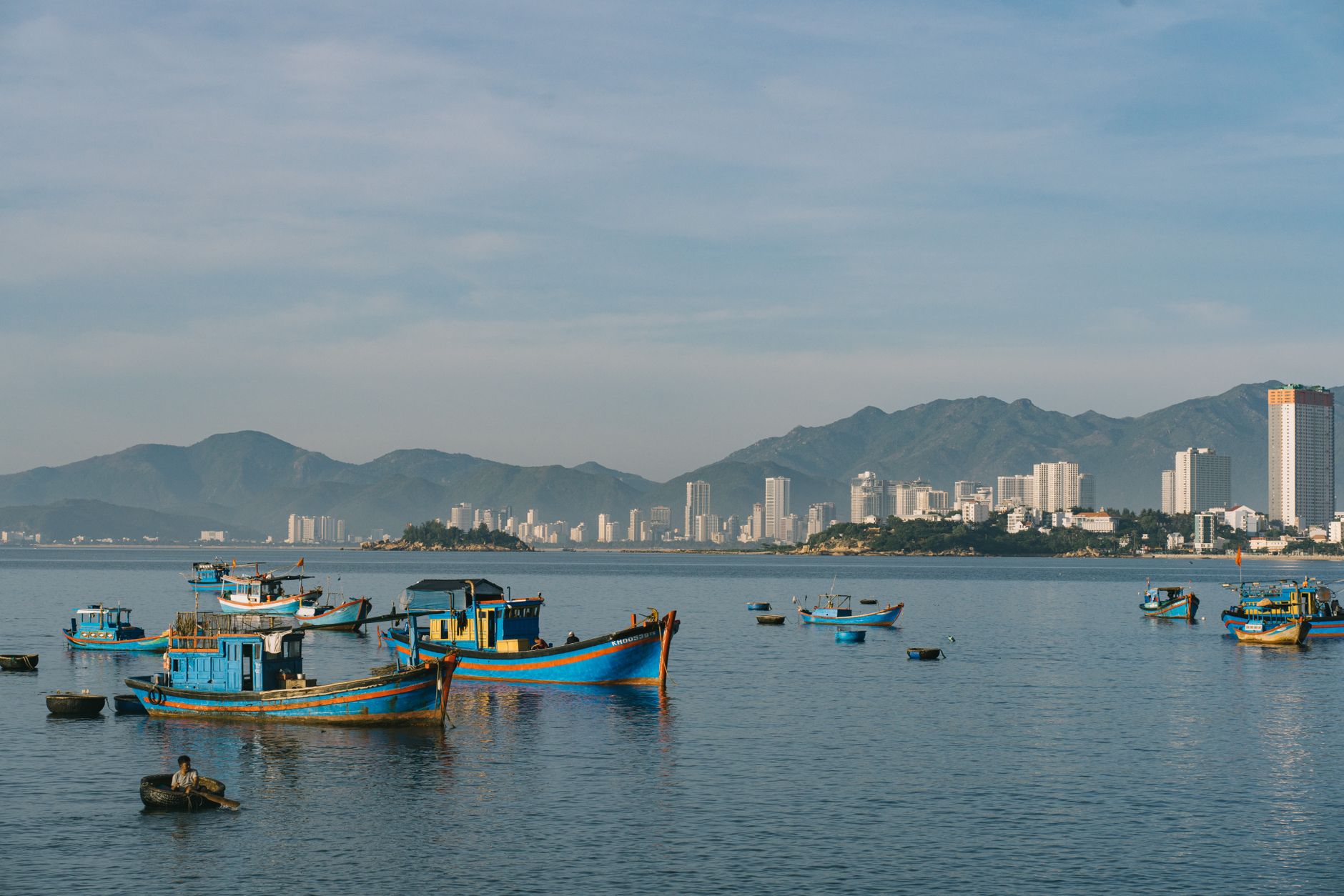
Behind and beside the main tower, the Cai River mouth opens up with blue fishing boats, the Tran Phu and Xom Bong bridges, and the city skyline. This is the low-angle spot several guides recommend for photographing the full tower against the sky.
How Po Nagar compares with other Cham sites
| Site | Location and distance | Period | Condition | Active worship? | Fee (last reported) | Best for |
|---|---|---|---|---|---|---|
| Po Nagar | Nha Trang | 8th to 13th century | Restored, four towers | Yes, daily | 30,000 VND | Living religion, easy access |
| My Son | Quang Nam, near Hoi An | 4th to 13th century | Ruined, jungle valley | No | 150,000 VND | Scale, UNESCO listing, the royal centre of Champa |
| Po Klong Garai | Phan Rang, about 100 km south, now in the same province | Late 13th to early 14th century | Better preserved | Yes, Katê festival | 30,000 VND | Architecture without crowds |
| Po Sah Inu | Phan Thiet | 8th century onward | Partly ruined | Yes | Small fee | Completing the picture on a coastal route |
| Binh Dinh towers (Banh It, Duong Long) | Binh Dinh Province | 11th to 13th century | Varied | Partly | Varies | Cham architecture off the tourist track |
Po Nagar is the most alive of the group. My Son is the most famous and the most ruined. Po Klong Garai is the best preserved and, since the 2025 merger, sits in the same province as Po Nagar, which makes a Cham-focused loop easier to plan than it used to be.
Is Po Nagar worth visiting? An honest verdict
Who will love it
Travellers interested in living religion and syncretism will find few better places in Vietnam. Anyone staying in Nha Trang and able to see only one Cham site should come here. Photographers should come at opening. Families wanting a short, cheap cultural break from the beach will find it fits in an hour.
Who may be disappointed
Visitors expecting Angkor or My Son scale will see four towers and be done in under an hour. Purists will notice the heavy restoration. Anyone sensitive to commercial touches will notice the souvenir stalls, incense sellers and scheduled shows. People with limited mobility face steep stairs and no ramp to the upper terrace. Anyone arriving at 10:00 on a cruise-ship day will meet the worst of the crowds.
The verdict
Worth one to two hours if you are in Nha Trang, ideally at opening or in the last 90 minutes before closing. Not worth a dedicated detour from Da Nang or Ho Chi Minh City on its own. If Cham heritage is the goal, pair it with Po Klong Garai.
Best time to visit
Time of day and light
At opening, the morning sun hits the east-facing entrances and lintels, the air is coolest, and worshippers outnumber tourists. Tour groups typically peak between about 08:30 and 11:00. Late afternoon gives side light on the west faces and the river view. Midday brings very little shade and hot brick.
Season and weather
The dry season runs roughly January to August, with February to April the most comfortable. The rainy season runs roughly September or October to December, with November usually the wettest. Khanh Hoa does see real flood and storm risk in late autumn, and some published sources report earlier closing from October to December.
The Po Nagar festival
The festival is held on the 20th to 23rd days of the third lunar month. The next edition should fall around 26 to 29 April 2027, but confirm this against the official Vietnamese lunar calendar and the provincial announcement before booking around it.
Rituals include the robe-changing and bathing of the goddess statue, lantern release on the river, offerings, mua bong (shadow or offering dance) and prayers for national peace. This is mostly Vietnamese Mother Goddess practice with Cham participation. It is not Katê, which some guides confuse.
Expect dense crowds, closed areas and traffic around 2 Thang 4 Street. The first and fifteenth days of each lunar month also bring more worshippers, which is good for atmosphere and worse for photos.
Tickets, opening hours and rules
Opening hours and entrance fee
Published sources disagree on hours. Variants include 06:00 to 18:00, 06:00 to 17:30, 08:00 to 18:00, and earlier closing from October to December.
| Figure | Values reported | Most likely current value as of October 2026 |
|---|---|---|
| Opening time | 06:00 or 08:00 | 06:00 |
| Closing time | 17:30 or 18:00, earlier October to December | 17:30 |
| Adult fee | 25,000 or 30,000 VND | 30,000 VND (about USD 1.15 / EUR 1.00) |
| Motorbike parking | 4,000 to 5,000 VND | 5,000 VND |
| Car parking | About 30,000 VND | 30,000 VND |
As of October 2026, the most commonly reported hours are 06:00 to 17:30 daily. Arrive before 16:30. Fees and hours change and are not centrally published online, so carry small notes.
Dress code and etiquette
Shoulders and knees covered. Robes are lent at the entrance, though reports differ on whether a small fee applies. Remove shoes and hats inside the towers. Do not point feet at altars, touch statues or offerings, or climb on ruins. Speak quietly and give worshippers priority at the narrow doorways. No food or littering on the terraces.
Photography and restrictions
Photography is fine outdoors. Inside the main sanctuary, follow posted signs: no flash, and photographing the statue is often discouraged. Ask before photographing people praying. Drones require authorisation in Vietnam, so do not fly one over a religious site.
Accessibility and comfort
The upper terrace can only be reached by steep stairs, which rules out wheelchairs and strollers. Shade is limited, and toilets are near the entrance. Bring water, a hat and sunscreen.
Common annoyances
Pressure to buy incense or make "donations", unofficial fortune-tellers, and inflated parking or cyclo prices. None of it is dangerous. Agree prices beforehand and decline politely.
How to get there from the city centre
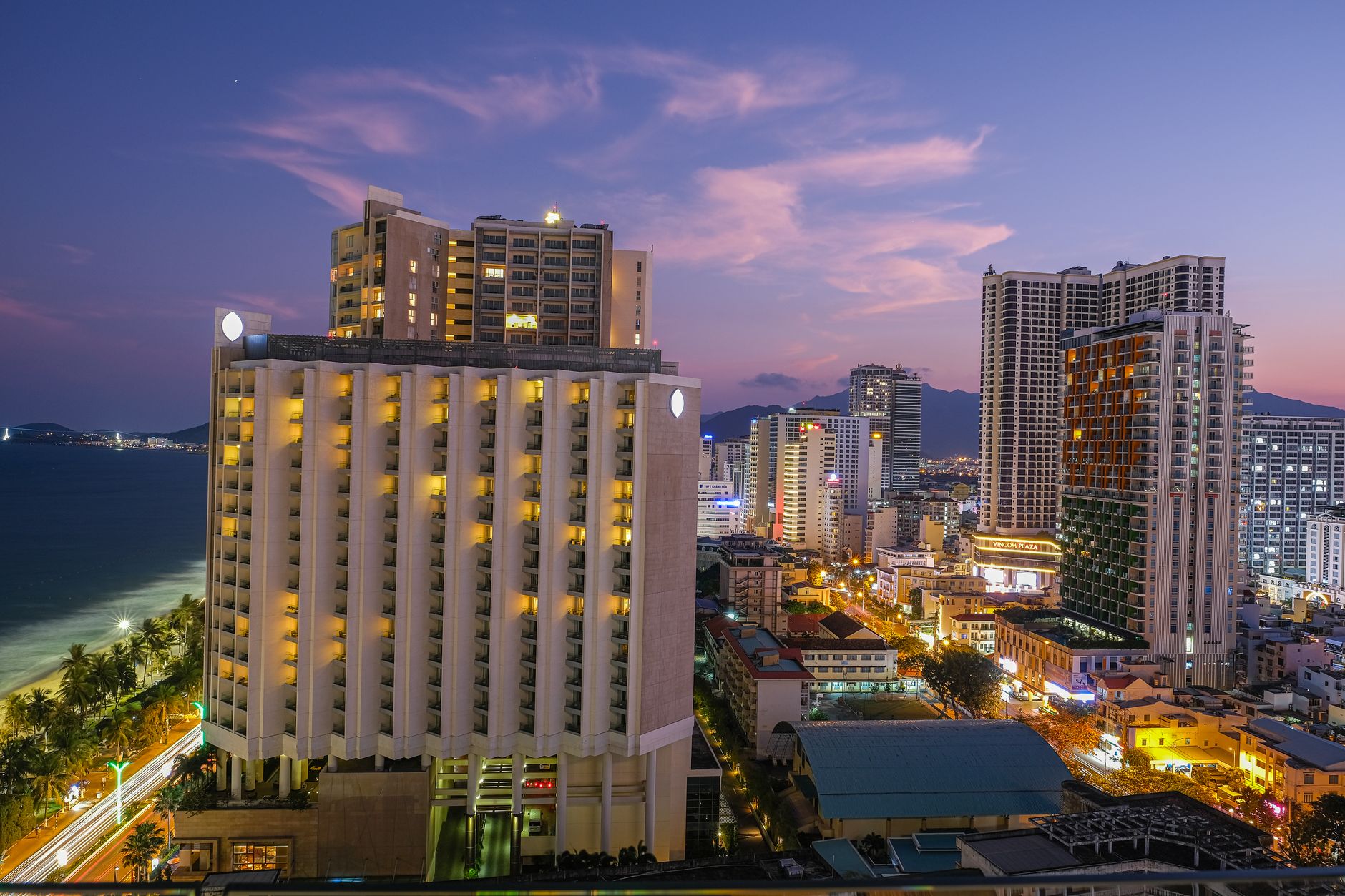
First, the distance confusion. The "2 km from the centre" figure many guides repeat is measured from the Dam Market area. From the beachfront hotel strip on Tran Phu Street, around Tram Huong Tower, it is roughly 4 to 6 km.
| Mode | From | Duration | Estimated cost | Best for | Caveat |
|---|---|---|---|---|---|
| Walk | Dam Market via Xom Bong Bridge and 2 Thang 4 Street | 20 to 25 min | Free | Early mornings | Hot after 09:00 |
| Walk | Mid-Tran Phu along the seafront and over Tran Phu Bridge | 50 to 60 min | Free | Fit walkers at dawn | Long in the heat |
| GrabBike or GrabCar | Anywhere in the centre | 10 to 20 min | Metered in app | Most visitors | Set the pin to the ticket entrance on Hai Thang Tu Street |
| Metered taxi | Anywhere in the centre | 10 to 20 min | Metered | Groups, luggage | Insist on the meter |
| City bus | Routes along 2 Thang 4 Street | 15 to 25 min | About 10,000 VND | Budget travellers | Route numbers change; check a live map |
| Hop-on hop-off bus | Seafront stops | Varies | 250,000 VND for 24 hours (last reported) | Sightseeing loops | Not worth it for this one stop |
| Cyclo | City centre | 20 to 30 min | About 100,000 VND, negotiated | Slow sightseeing | Agree the price first |
| Self-ride motorbike | Rental shop | 10 to 15 min | Rental plus fuel | Confident riders | Check licence and insurance rules for foreigners |
How long to allow and a suggested route
Allow 45 minutes for a quick visit, 60 to 90 minutes for the full route described above, and up to 2 hours if a performance and the exhibition house are running.
A timed micro-itinerary on site: 10 minutes at the entrance and mandapa, 5 minutes up the stairs, 20 minutes in the North tower and around the three smaller towers, 10 minutes at the stelae, 10 minutes at the exhibition house, 10 minutes at the river viewpoint.
For a half-day, start at opening at Po Nagar, continue to Hon Chong about 2 km away, add an optional mud bath, and finish with lunch near Dam Market. An alternative pairs Po Nagar with the Khanh Hoa Museum on Tran Phu Street, where Cham artefacts sit in context.
Insider tips: what most visitors miss
- The Durga lintel above the North tower door, and the musicians flanking her.
- The ten arms hidden under the goddess's silk robes.
- The colour line between original and restoration bricks.
- The 1856 stele text with the Thien Y A Na legend.
- The river viewpoint behind the main tower.
- Arrive at opening, or check whether cruise ships are in port that day.
- Watch worshippers circling the tower with incense before you start photographing.
- Carry your own sarong or scarf; it is faster than queueing for a loaner robe.
- Wear slip-on shoes for the barefoot interior.
- Bring small notes (10,000 to 20,000 VND) for parking and incense.
What to combine nearby
| Place | Distance from Po Nagar | Time needed | Cost (last reported) | Why pair it |
|---|---|---|---|---|
| Hon Chong | About 2 km | 45 min | 30,000 VND | Granite rocks and sea views |
| Thap Ba hot springs and mud baths | About 1.5 km | 1.5 to 2 hours | From 250,000 VND | Recovery after a hot morning |
| Dam Market | About 2 km | 45 min | Free entry | Local food and supplies |
| Long Son Pagoda | About 3 km | 45 min | Free | Large hilltop Buddha |
| Khanh Hoa Museum | About 4 km on Tran Phu Street | 1 hour | Small fee | Cham artefacts in context |
| Hon Do island pagoda | About 5 km south | 45 min | Free | Coastal views and quiet |
Note what is not nearby: the Oceanographic Museum and the island cable car are about 10 km south in Cau Da, which makes them a separate trip.
FAQ
Q: What is the entrance fee for Po Nagar Cham Towers? As of October 2026, the last widely reported adult fee is 30,000 VND (about USD 1.15 / EUR 1.00). Some guides still list 25,000 VND, so carry small notes. Parking is separate: a few thousand VND for a motorbike, about 30,000 VND for a car.
Q: What are the opening hours of Po Nagar? The most commonly reported hours are 06:00 to 17:30 daily. Some sources say 18:00, and some report earlier closing from October to December. Arrive before 16:30, and go at opening for light and fewer crowds.
Q: Did the Champa kingdom really exist in Vietnam? Yes. Champa was a group of Indianized principalities on Vietnam's central and south-central coast, documented from around the 2nd to the 17th century through Sanskrit and Cham inscriptions such as those at Po Nagar. Its descendants, the Cham people, still live in Vietnam today.
Q: What is My Son Sanctuary famous for, and how is it different from Po Nagar? My Son, near Hoi An, is a UNESCO World Heritage Site and was the main religious and royal centre of Champa from the 4th to 13th centuries. Its towers are more numerous and stand in a jungle valley, but they are ruins without active worship. Po Nagar is smaller and urban, and it is still used for prayer.
Q: What is the most famous old temple in Vietnam? It depends on the tradition. Hanoi's Temple of Literature, founded in 1070, is the best-known historic temple overall, and My Son is the most famous Cham site. Po Nagar stands out as one of the oldest sanctuaries in the country still in continuous religious use.
Q: What should I wear to Po Nagar? Cover shoulders and knees. You remove shoes and hats inside the towers. Robes are usually lent at the entrance, but bringing a light scarf or sarong is easier in the heat.
Q: When is the Po Nagar festival? It is held on the 20th to 23rd days of the third lunar month. The next edition should fall around 26 to 29 April 2027, to be confirmed with the official lunar calendar. Expect large crowds, robe-changing and bathing rituals for the goddess, lantern releases and traditional dance.
Q: How long do I need at Po Nagar? Allow 45 minutes for a quick look and 60 to 90 minutes for the full route with the mandapa, all four towers, the stelae and the river viewpoint. Add 30 minutes if a Cham performance is scheduled.
Your questions and tips
A question, an update, an experience to share? Our team reads every message before it is published.
No comments yet. Ask the first question or share a tip!