What congee is, and what it is called in Vietnam
Congee is rice simmered in a large amount of water or broth until the grains collapse into a thick, soupy porridge. In Vietnam it is called cháo, pronounced roughly "chow" with a falling tone. Visitors will rarely see the word "congee" on a menu or a sign. Look for "cháo" followed by the main ingredient: gà (chicken), sườn (rib), lòng (offal), vịt (duck), cá (fish).
Congee vs steamed rice
Congee is not simply wet rice. The water ratio is the whole difference. Steamed rice uses roughly 1 part rice to 1.2 parts water and cooks in about 20 minutes, leaving separate grains. Cháo uses about 1 part rice to 6-10 parts liquid and simmers for 60-90 minutes or longer, until the grains burst and the mixture turns creamy. The result is a different dish with a different texture, a different role in a meal and a different price at the stall.
Where the word "congee" comes from
The English word comes from Tamil kanji, a term for rice gruel that spread through English-language writing about Asia. Vietnamese cháo is closely related to Chinese zhou or jook but developed its own toppings, broths and eating habits.
What cháo tastes like
The base is mild and gently sweet from the rice, with savoury depth from the broth it was cooked in. On its own it is deliberately plain. Most of the flavour arrives at the table: black pepper, ginger, herbs, lime and chili. This is why the same bowl can taste completely different depending on how the eater seasons it.
Texture styles
Vietnamese cháo comes in three broad textures. Cháo trắng (also called cháo hoa) is plain white congee, often thin and clean-tasting, served with salty sides. Cháo hạt keeps the grains visible and slightly separate, closer to a loose rice soup. Cháo nhuyễn is smooth and almost puréed, the style made for babies and invalids. Vietnamese cháo is usually looser and more broth-driven than the thick Cantonese type, which sits on a spoon.
Flavour profile by topping
Offal adds richness and a faint mineral gaminess. Pork rib brings a sweet, fatty depth from the bone. Duck is darker and stronger, usually cut with ginger. Eel and fish give a clean sweetness, often sharpened with pepper or a bitter herb. Cockles and oysters push the bowl toward the sea, salty and briny.
Cháo compared with congee elsewhere in Asia
Readers who know jook, jok or okayu will find the Vietnamese version familiar but not identical. The table below places it in context.
| Dish and country | Typical thickness | Usual base | Typical toppings | Eaten when |
|---|---|---|---|---|
| Cháo (Vietnam) | Loose, broth-driven | Pork bone or chicken broth | Quẩy, rau răm, fried shallots, lime, chili, offal or seafood | Breakfast, late night, sick days |
| Jook / zhou (China) | Thick, creamy | Water or light stock | Century egg, pork floss, scallion, soy | Breakfast, dim sum |
| Jok (Thailand) | Medium, soft | Pork stock | Minced pork, ginger, cilantro, soft-boiled egg | Breakfast |
| Juk (Korea) | Thick, smooth | Water or bone broth | Pine nuts, abalone, pumpkin, ginseng | Breakfast, recovery food |
| Okayu (Japan) | Soft, watery | Water or dashi | Umeboshi, scallion, salmon, egg | Sick days, light meals |
Cháo vs similar Vietnamese dishes
Cháo is not súp (a thicker Western-style soup), not cơm (steamed rice) and not bánh canh (a thick noodle soup). One dish blurs the line: cháo canh, a central Vietnam specialty of thick rice-flour noodles in broth that sits somewhere between congee and noodle soup. Order it expecting noodles, not porridge.
How cháo is eaten in Vietnam
This is the section most English-language guides skip. Congee in Vietnam is not a wellness trend. It is everyday food with a fixed place in the day.
When and where it is eaten
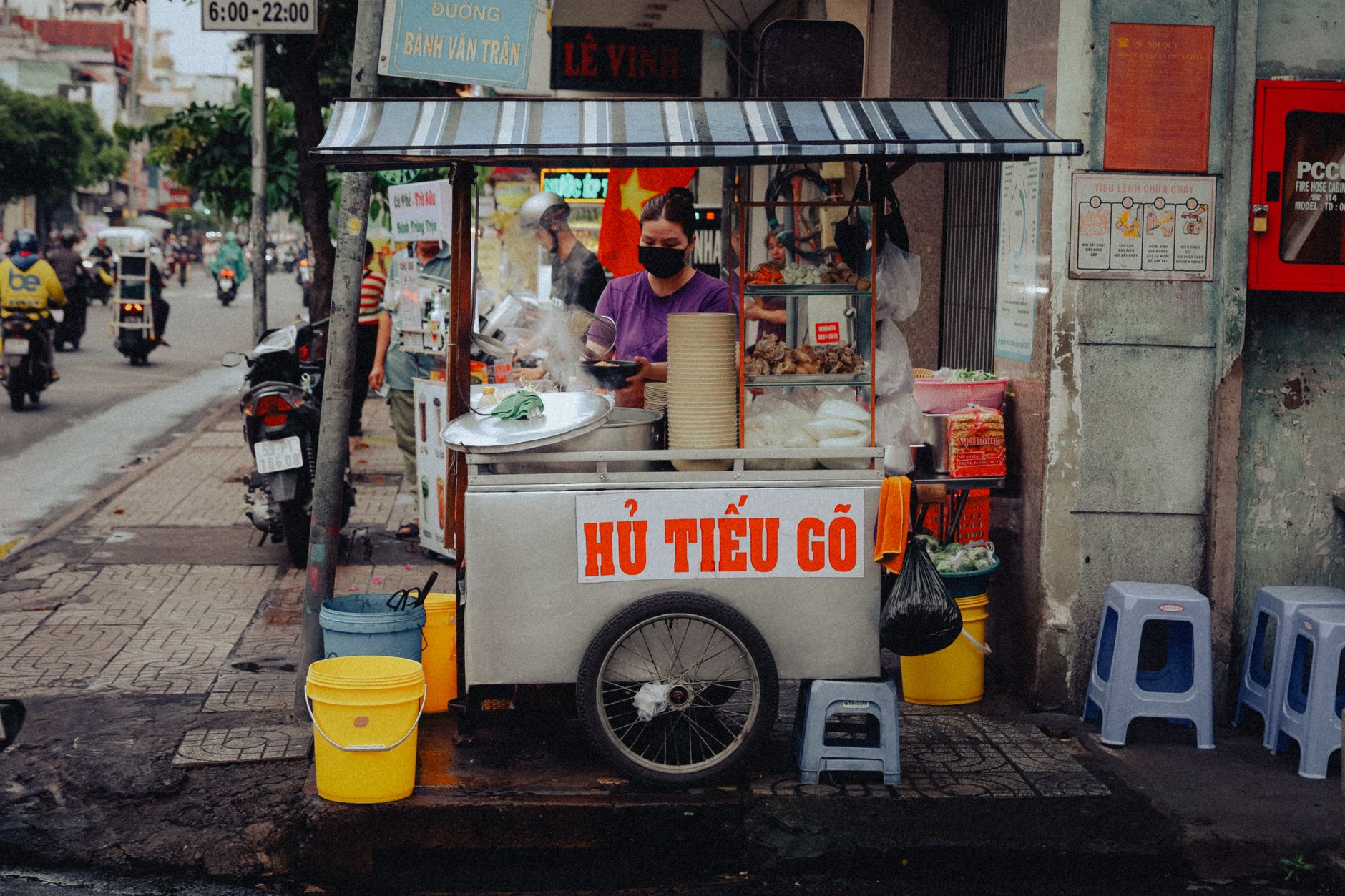
Breakfast runs roughly 6:00 to 9:30, when stalls set up on sidewalks with a single large pot and a few plastic stools. In big cities, evening and late-night cháo stalls run until midnight or later, serving night-shift workers and people leaving bars. It is also the standard sick-day food, the first solid food given to babies (cháo ăn dặm) and a common hangover fix.
What comes on the table
The bowl arrives plain. Everything else is added by the eater: fried shallots, chopped scallions, black pepper, sliced ginger, chili, lime, fish sauce or soy sauce. Quẩy, the fried dough sticks, are dipped or torn into the bowl. A salted duck egg (trứng vịt muối) is a common side with plain cháo.
How to order, with phrases
| English | Vietnamese | Pronunciation hint | When to use |
|---|---|---|---|
| One bowl of offal congee | Cho tôi một tô cháo lòng | chaw lawng | At an offal stall |
| No blood pudding | Không tiết | khome tyet | When offal is served with raw blood |
| Extra dough sticks | Thêm quẩy | tem kway | To add quẩy |
| No scallion | Không hành | khome hanh | If you dislike raw onion |
| Less chili | Ít ớt | eet ut | To reduce heat |
| Takeaway | Mang đi | mang dee | To eat elsewhere |
Etiquette and practicalities
Stir the bowl before eating, because the rice settles and the broth rises. Blow on each spoonful; the bowls are scalding. Season at the table rather than before tasting, since the broth is usually already salted. Pay at the end or at the counter. Ask for a spoon, because chopsticks are not the norm with cháo.
Pro tip: at a busy stall, watch what the locals order. If most bowls come with the same topping, that is the specialty, and it is almost always the freshest pot.
The main types of Vietnamese cháo
Each type has a base, a topping and a region where it is strongest.
Cháo trắng (plain congee)
The simplest version, served with salted egg, fermented tofu, pork floss (ruốc) or dried fish. It is the sickbed and budget classic, and the cheapest bowl on any menu.
Cháo lòng (pork offal congee)
Intestines, liver, heart, stomach and sometimes blood pudding in a pork broth. Most associated with northern Vietnam and Hanoi, but sold nationwide. For squeamish visitors, ask for "không tiết" to skip the blood.
Cháo sườn (pork rib congee)
Cooked with pork ribs, often including soft cartilage pieces, and eaten with quẩy. Common in Hanoi and a family breakfast staple across the north.
Cháo gà (chicken congee)
Shredded chicken with rau răm (Vietnamese coriander), lime leaf or ginger. Found everywhere, and the safest first order for a cautious eater.
Cháo vịt (duck congee)
Often cooked with bamboo shoots in the north. Southern and Chinese-Vietnamese versions come with a ginger, fish sauce and chili dip on the side.
Cháo cá and cháo lươn (fish and eel)
Nghệ An province around Vinh is known for peppery eel congee. The Mekong Delta serves snakehead fish congee with rau đắng, a bitter herb that cuts the richness.
Cháo sò huyết, cháo hàu and other shellfish versions
Blood cockle congee is a Saigon and southern street favourite, and oyster congee appears on open-air seafood streets. These carry hygiene risks (see the health section).
Sweet cháo
Mung bean (cháo đậu xanh) and red bean versions are eaten as a snack or dessert, usually sweeter and thicker than the savoury bowls.
Vegetarian cháo (cháo chay)
Mushroom, tofu and vegetable versions served at Buddhist-style restaurants, most easily found on lunar observance days.
Regional guide: north, centre and south
Northern Vietnam (Hanoi, Hải Phòng, Quảng Ninh)
This is the strongest congee region. Cháo sườn, cháo lòng, cháo vịt and shellfish congee are all standard. The cooler months, roughly October to March, are peak congee season, when a hot bowl makes the most sense.
Central Vietnam (Nghệ An, Huế, Đà Nẵng, Hội An)
Eel congee in Nghệ An and fish-based bowls along the coast. Be honest with expectations: the centre is less of a congee region than the north or south, and the local variants are narrower. Cháo canh is the exception worth seeking out.
Southern Vietnam (Ho Chi Minh City, Mekong Delta)
Late-night cháo is a southern institution. Chinese-Vietnamese stalls in Chợ Lớn (District 5) serve Teochew and Cantonese-influenced bowls. Blood cockle congee, snakehead congee and duck congee are all common.
Where to try cháo
Hanoi
The Old Quarter and neighbouring streets serve breakfast cháo sườn and cháo lòng. To find a good stall, look for a queue, plastic stools on the pavement and one large pot at the front. Area-level guidance is more reliable than any single address, because street-food businesses move.
Ho Chi Minh City
District 1 side streets, Chợ Lớn (District 5) for Chinese-style bowls, and late-night cháo stalls across the city. Shellfish congee is strongest on the open-air seafood streets.
Mekong Delta, central coast and other stops
Cần Thơ and Châu Đốc for snakehead congee, Vinh for eel. Verify any specific stall before travelling to it, because opening hours and locations change often.
How to spot a good cháo stall
A visible pot kept at a simmer, high local turnover, a short menu, no laminated English photo menu and posted prices. Tourist-zone stalls with translated menus and no local customers usually charge double for a worse bowl.
How much cháo costs in 2026
Prices below use about 26,000 VND per USD, to be rechecked at publication.
Typical prices
| Type of venue | Bowl type | Price in VND | Price in USD |
|---|---|---|---|
| Local stall | Cháo trắng (plain) | 15,000-30,000 | $0.60-1.15 |
| Local stall | Chicken, rib or offal | 30,000-55,000 | $1.15-2.10 |
| Local stall | Duck, eel or seafood | 45,000-90,000 | $1.75-3.45 |
| Local stall | Quẩy (per stick) | 3,000-8,000 | $0.12-0.30 |
| Tourist area or hotel | Any bowl | Double the above | Double the above |
What changes the price
City versus province, extra offal or an extra egg, the type of seafood, and whether the stall prices by the bowl or by each extra. A bowl in a provincial market can cost half what the same bowl costs in central Hanoi.
Scams and overcharging
Ask the price before ordering when there is no menu. Check whether extras brought to the table, such as quẩy and eggs, will be counted on the bill. This is standard practice, not a scam, but it should be clear before you eat.
Health, safety and dietary notes
Cháo as "sick food"
Vietnamese families serve cháo when someone is ill because it is soft, warm, hydrating and easy to eat. The folk remedy cháo hành, scallion and pepper congee, is the classic cold-day bowl. State it plainly: this is comfort food, not a medical treatment. The TCM and gut-health claims common in English recipe blogs are traditional beliefs, not proven effects.
Real risks
| Ingredient or situation | Risk | What to do |
|---|---|---|
| Tiết canh (raw blood pudding) | Streptococcus suis, hepatitis E | Skip it |
| Lightly blanched blood cockles | Hepatitis A, gastrointestinal bacteria | Choose fully cooked shellfish |
| Raw herbs washed in tap water | Stomach upset | Eat at busy stalls with high turnover |
| Scalding bowls | Burns | Blow on each spoonful |
| Duck and rib versions | Small bones | Chew carefully |
Allergies and diets
Shellfish, peanuts and fish sauce are common. Vegetarians should say "ăn chay" and confirm the broth is not meat-based, because fish sauce and pork stock are defaults. Gluten is rarely an issue in the congee itself, but soy sauce and quẩy contain wheat. The sodium level is high, which matters for anyone watching salt.
Vegetarian days
On the 1st and 15th days of the lunar month, many Buddhists eat vegetarian and cháo chay becomes easier to find. Around this publication date, the full moon falls near 26 October 2026 and the new moon near 9 November 2026. Verify with a lunar calendar.
Seasoning and customising a bowl
The classic Vietnamese finish
Black pepper, fried shallots, chopped scallion, coriander or rau răm, ginger, a squeeze of lime, a few drops of fish sauce and chili. Add in that order, tasting as you go.
Add-ins worth trying
Salted duck egg, century egg (trứng bách thảo), pork floss (ruốc), quẩy, fermented tofu and pickled mustard greens. Each adds salt, fat or acid, which is what a plain bowl needs.
What to avoid
Sweet sauces, heavy soy and over-salting before tasting. The broth is already seasoned, and it is easy to ruin a good bowl in the first ten seconds.
Making cháo at home (Vietnamese style)
Basic ratio and method
Use about 1 cup of short or medium-grain rice to 8-10 cups of water or broth. Rinse the rice, optionally toast it in a dry pan for a nuttier flavour, then simmer for 60-90 minutes with occasional stirring until the grains burst. Season at the end.
Pork-bone or chicken-bone broth version
Parboil the bones for a few minutes and discard the water. Simmer them for 1.5-2 hours with ginger and shallot, then strain. Cook the rinsed rice in the strained broth. Add shredded meat and toppings in the bowl, not in the pot, so each serving stays clean.
Shortcuts
A rice cooker works with a higher water ratio and a longer keep-warm cycle. An Instant Pot takes roughly 30 minutes at high pressure. A slow cooker takes 6-8 hours on low. If the congee is too thick, add hot water or broth. If it is too thin, simmer uncovered.
Storing and reheating
Cháo thickens as it cools, so loosen it with water or broth when reheating. It keeps about three days refrigerated.
Common mistakes and quick tips for visitors
Order a small first bowl. Ask what the stall specialises in. Avoid tiết canh if unsure. Eat soon after it is served, while it is hot. Drink bottled or boiled water. Treat the first taste as a base, then season gradually. At a stall with no menu, ask the price first.
FAQ
Q: What is congee called in Vietnam? It is called cháo, pronounced roughly "chow" with a falling tone. The word "congee" rarely appears on menus, so look for "cháo" plus the main ingredient: gà, sườn, lòng or vịt.
Q: How is congee different from rice? Congee is rice cooked with far more water or broth, roughly 1:6 to 1:10, for much longer, until the grains break down into a creamy porridge. Steamed rice uses just enough water to keep the grains separate.
Q: What does congee taste like? Mild, comforting and slightly sweet from the rice, with savoury depth from the broth. Most of the flavour comes from the toppings and the table seasonings: pepper, ginger, lime, fried shallots, herbs and chili.
Q: What seasoning should I add to congee? In Vietnam: black pepper, fried shallots, scallions, ginger, lime juice, chili and a little fish sauce or soy sauce. Taste first, because the broth is usually already seasoned.
Q: Can you give a recipe for bone broth congee? Simmer parboiled pork or chicken bones with ginger and shallot for 1.5-2 hours, then strain. Cook rinsed rice in the broth at about 1:8 for 60-90 minutes. Finish with salt, pepper and toppings.
Q: Is congee safe for tourists to eat in Vietnam? Plain and cooked-meat versions served piping hot are generally low risk. The main concerns are raw blood pudding (tiết canh), lightly cooked shellfish and unwashed raw herbs, so those are best skipped or chosen carefully.
Q: Is there vegetarian or vegan congee in Vietnam? Yes, as cháo chay, mostly at Buddhist-style restaurants and on the lunar 1st and 15th days. Say "ăn chay" and confirm the broth is not meat-based, since fish sauce and pork stock are common defaults.
Q: How much does a bowl of cháo cost? About 15,000-55,000 VND ($0.60-2.10) at ordinary local stalls, and about 45,000-90,000 VND ($1.75-3.45) for duck, eel or seafood. Tourist areas can charge more.

Your questions and tips
A question, an update, an experience to share? Our team reads every message before it is published.
No comments yet. Ask the first question or share a tip!