Bình Tây Market at a glance
| Item | Detail |
|---|---|
| Names | Chợ Bình Tây, Binh Tay Market, Chợ Lớn Market, formerly "Chợ Lớn mới" (new Big Market); Chinese name 平西市場 |
| Address | 57A Tháp Mười Street, Bình Tây ward (formerly Ward 2, District 6) |
| Hours | Indoor market about 06:00 to 18:00; surrounding wet market from before dawn |
| Entry | Free, no tickets, no official guides |
| Time needed | 1 to 2 hours |
| Distance | About 6 to 7 km from Bến Thành |
| Size | About 2.5 ha of floor area, 108.6 m frontage, clock tower about 13.1 m high |
| Stalls | About 1,446 (698 ground floor, 748 upper floor), according to trade sources; treat as approximate |
| Built | 1928 to 1930; renovated 1992 and restored 2016 to 2018 |
The address needs a word of explanation. A mid-2025 administrative reform abolished districts in Ho Chi Minh City, and the market now sits in Bình Tây ward. Most maps, Grab drivers and older guides still say "Ward 2, District 6," and that is what you should type or say if a driver looks blank. One well-known blog places the market in District 5. That is wrong. Chợ Lớn spans the former Districts 5 and 6, and the market sits in the former District 6, close to the District 5 border.
Is Bình Tây Market worth visiting? An honest verdict
Yes, for the right traveler. No, for the wrong one. The market rewards people who come early, expect a working wholesale space rather than a souvenir arcade, and treat breakfast as part of the visit.
Who will love it
Food lovers, especially for the dawn wet market and the food court. Photographers, who get tiered Chinese roofs, ochre walls and a four-faced clock tower without the Bến Thành crowds. Travelers interested in Hoa (Chinese-Vietnamese) culture and heritage architecture. Anyone who found Bến Thành too polished. Cooks buying spices, dried goods, nuts or kitchenware in quantity.
Who may be disappointed
Souvenir hunters looking for single, pretty items. Many stalls are wholesale and prefer bulk orders. Travelers sensitive to heat: there is no air-conditioning, and the halls can feel hotter than the street by midday. Visitors arriving after 15:00, when activity winds down. Travelers with limited mobility, since the upper floor is reached by stairs and the aisles are narrow and wet.
Bình Tây vs Bến Thành vs An Đông
| Market | Location | Main focus | Tourist level | Price level | Air-con | Best for |
|---|---|---|---|---|---|---|
| Bình Tây | Chợ Lớn, former District 6 | Wholesale dried goods, spices, kitchenware, textiles | Low | Low to moderate | No | Local life, bulk shopping, food court breakfast |
| Bến Thành | District 1 center | Souvenirs, textiles, coffee, food stalls | Very high | High | No | Convenience, one-stop souvenir shopping |
| An Đông | Former District 5, near Nguyễn Trãi | Fabric, clothing, household goods | Low to moderate | Moderate | No | Tailors, fabric by the meter, local crowds |
Opening hours and the best time to visit
Published hours for Bình Tây contradict each other: 06:00 to 19:00, 06:00 to 18:00, even 02:00 to 23:00. The confusion comes from lumping three different things together: the pre-dawn wholesale operation, the outdoor wet market, and the indoor stalls.
The real rhythm of the day
| Time | What is happening |
|---|---|
| About 03:00 to 05:00 | Wholesale deliveries and loading |
| About 05:00 to 09:00 | Outdoor wet market on the Phan Văn Khỏe side at full activity |
| About 06:00 to late afternoon | Indoor stalls open |
| From about 16:00 | Shutters start coming down |
There is no night market at Bình Tây itself. If a guide tells you about evening street food inside the market, it is out of date. Evening food is found in the surrounding Chợ Lớn streets instead.
Best time to go
Arrive between 06:30 and 08:30. You catch the wet market at its peak, the coolest temperatures of the day, and breakfast at the food court. The second-best window is 09:00 to 11:00, when the indoor halls are calmer. Avoid roughly 11:30 to 14:30, when the heat peaks and some vendors nap at their stalls.
If you only have one morning in Chợ Lớn, spend it here before 09:00. The market at dawn and the market at noon are two different places.
Seasons, rain and festivals
The rainy season runs May to November, with short afternoon downpours. The covered market makes a good rain plan, though surrounding streets can flood briefly. The dry season runs December to April, and March to May is the hottest stretch.
Tết, Lunar New Year, next falls on 6 February 2027. Mid-January to early February 2027 is the busiest and most spectacular period, with candied fruit, decorations and huge crowds. Expect most stalls to close from New Year's Eve on 5 February 2027 for several days, with activity typically resuming around the 4th to 8th day of the first lunar month. The Mid-Autumn Festival next falls on 15 September 2027, and mooncake and lantern season builds in Chợ Lớn in the weeks before. The Lantern Festival (Nguyên Tiêu) is on 20 February 2027, an important date for Hoa community temples nearby.
Tickets, prices and money
Entry is free. There are no tickets, no official guides and no audio guide. Budget for small services, food and purchases instead.
| Item | Typical price |
|---|---|
| Entry | Free |
| Motorbike parking | About VND 5,000 ($0.20) |
| Public toilets | About VND 3,000 to 5,000 ($0.10 to $0.20) |
| Bowl of hủ tiếu | About VND 30,000 to 60,000 ($1.15 to $2.30) |
| Iced milk coffee | About VND 15,000 to 25,000 ($0.60 to $1.00) |
| 1 kg cashews | About VND 250,000 to 400,000 ($10 to $15) |
| Aluminum phin coffee filter | About VND 20,000 to 40,000 ($0.80 to $1.55) |
| Ceramic bowl | About VND 20,000 to 60,000 ($0.80 to $2.30) |
All prices are indicative, based on an exchange rate of about VND 26,000 per USD, and should be checked on the ground. Almost all stalls are cash only. Some wholesalers accept bank transfer by QR code, which works if you have a Vietnamese bank account or a supported international app. Bring small notes: VND 10,000, 20,000 and 50,000. ATMs sit along the surrounding streets, including Tháp Mười and Hậu Giang.
How to get there
No metro line reaches Chợ Lớn yet. Metro Line 1 runs from Bến Thành toward Thủ Đức, not west, so ignore any guide that suggests otherwise.
Type "Chợ Bình Tây" or "57A Tháp Mười" into your app. The main gate faces the Chợ Lớn bus terminal side. Ask to be dropped at the clock-tower entrance on Tháp Mười.
| Mode | Time from the old District 1 | Cost | Best for |
|---|---|---|---|
| Car (Grab, Be, Xanh SM) | 20 to 35 minutes, depending on traffic | About VND 90,000 to 150,000 ($3.50 to $6) | Groups, rainy days, carrying purchases |
| Motorbike (app) | Faster in traffic | About VND 35,000 to 60,000 ($1.35 to $2.30) | Solo travelers, early starts |
| City bus route 01 | 30 to 45 minutes | About VND 5,000 to 7,000 ($0.20 to $0.30) | Budget travelers, Bến Thành to Chợ Lớn terminal |
Rush hours, roughly 07:00 to 08:30 and 16:30 to 18:30, can double journey times. Route 01 links Bến Thành and the Chợ Lớn bus terminal, and you pay cash on board or by card where accepted. The terminal's exact location has been discussed for relocation for years, so check the Google Maps transit layer or the BusMap app before you set out.
Use metered taxis from reputable companies or app bookings. Ignore unofficial drivers and cyclo touts near tourist areas who quote "Chinatown tours."
Walking from elsewhere in Chợ Lớn is feasible but slow. Cha Tam Church is about 15 minutes away, and Thiên Hậu Temple on Nguyễn Trãi is about 25 to 30 minutes. Sidewalks are often blocked by parked motorbikes, so allow extra time.
Understanding the layout: what is sold where
The market is symmetrical around a central courtyard, which makes it easy to orient yourself once you find the fountain.
The ground floor and Tháp Mười frontage hold ceramics, bowls and plates, incense, candles and conical hats, hardware, bags, shoes and jewelry, and dried spices. The upper floor is given over to ready-to-wear clothing and textiles, confectionery and snacks, and quieter aisles with a good view down into the courtyard.
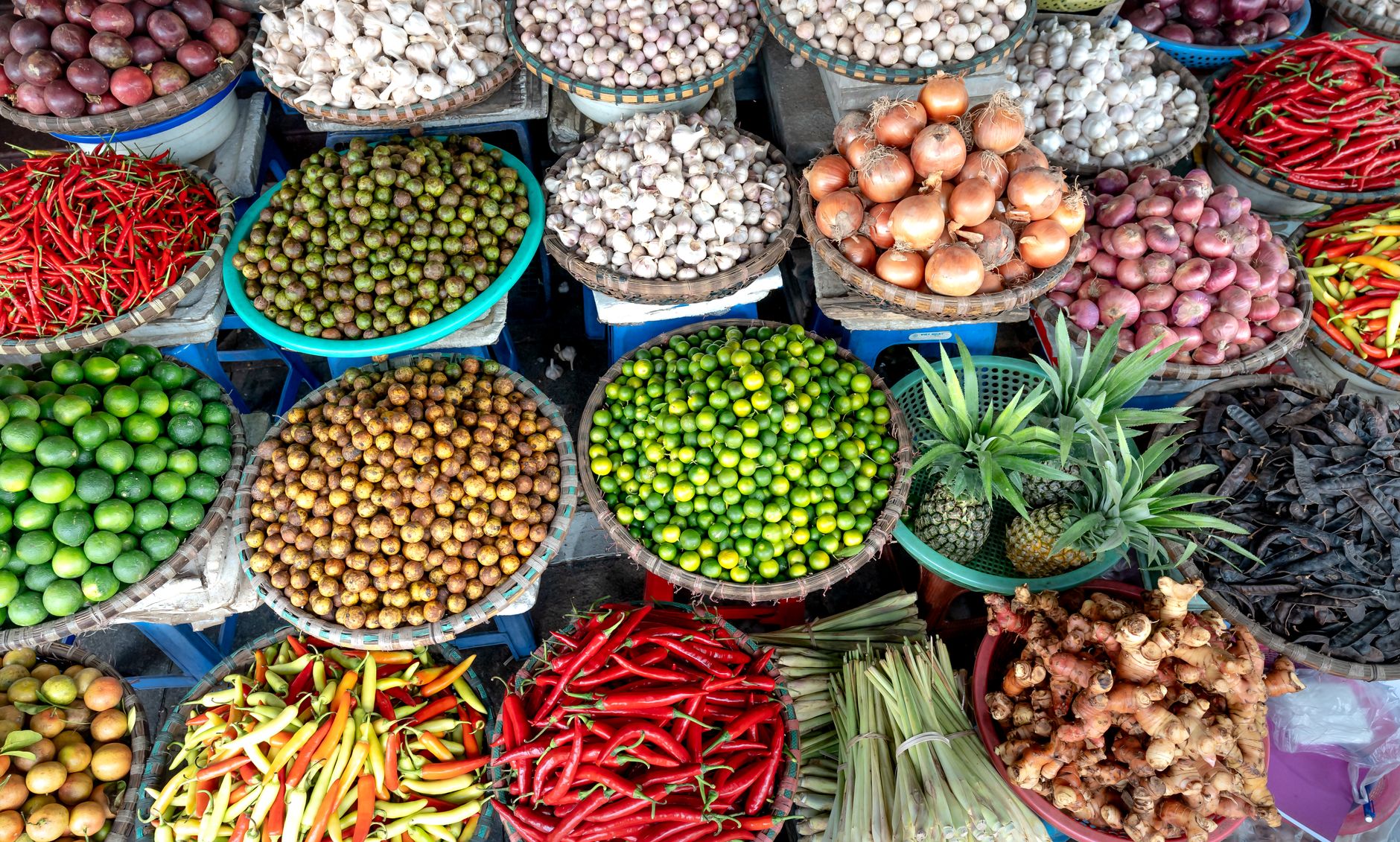
On the Trần Bình side you find spices, tea, coffee, seafood, fruit and flowers. The Lê Tấn Kế side has dried goods, cooking oil, dried seafood, dried vegetables, betel nut and seasonings. Phan Văn Khỏe street, outside at the rear, is the fresh wet market with meat, fish, frogs, tofu, eggs and herbs, busiest at dawn. The central courtyard is your orientation point, with a fountain, lotus pond, benches and the altar to the founder.
A route that works:
- Wet market first, while it is cool.
- Food court for breakfast.
- Central courtyard.
- Ground floor halls.
- Upper floor.
- Exit via Tháp Mười for the façade photo.
What to eat at Bình Tây Market
The food court sits toward the rear of the market. Most stalls focus on breakfast and lunch and wind down in the afternoon. Seating is on low stools and counters, and meals are served to vendors as much as to visitors.
Dishes worth ordering, all around VND 30,000 to 60,000 ($1.15 to $2.30):
- Hủ tiếu, Nam Vang or Teochew-style noodle soup, the signature Chợ Lớn breakfast.
- Mì xào bò, fried noodles with beef.
- Xíu mại, pork meatballs in a light sauce, often eaten with bread.
- Bánh bao, steamed buns with pork or sweet fillings.
- Phá lấu, braised offal with a peppery, coconut-tinged broth.
- Vịt tiềm, herbal braised duck.
- Sủi cảo, dumplings, boiled or fried.
- Chè, sweet dessert soup, served cold.
- Xôi, sticky rice, savoury or sweet.
- Cà phê sữa đá, iced milk coffee.
Snacks to buy and carry: fried fish cakes, Chinese sausage (lạp xưởng) to eat locally rather than export, fresh-roasted nuts, and coconut sticky rice desserts.
A hygiene reality check. Choose busy stalls with high turnover. Peel fruit, or buy fruit cut in front of you. Be cautious with ice and raw herbs if your stomach is sensitive. Carry hand sanitizer and tissues, since many stalls have no napkins.
After the market closes, Chợ Lớn food streets take over. Dumpling and Hoa noodle shops toward Hà Tôn Quyền in the former District 11 are the obvious direction to explore.
Shopping at a wholesale market: how buying works
This is the part no other guide explains, and it causes the most frustration. Bình Tây is primarily a business-to-business market. Many stalls quote by the kilo, the dozen or the carton. Asking for one piece may get you a higher price or a polite refusal. Stalls facing the Tháp Mười and Trần Bình sides are more retail-friendly.
Bargaining etiquette is gentler here than at Bến Thành. Prices are generally fairer, so aggressive haggling is unnecessary and can offend. Ask the price, compare two or three stalls, and negotiate modestly with a smile. Do not bargain at food stalls.
Good buys include cashews and other nuts, dried fruit, spices, star anise and pepper, tea and coffee, kitchenware such as aluminum phin filters, ceramic bowls, chopsticks and clay pots, incense and paper lanterns, and fabric.
| Item | Verdict | Reason |
|---|---|---|
| Cashews, dried fruit, tea, coffee | Buy | Good value, easy to pack, usually allowed through customs if sealed |
| Phin filters, ceramics, chopsticks | Buy | Cheap, light, useful |
| Counterfeit branded clothing | Skip | Can be seized by customs in the EU, US and elsewhere |
| Traditional medicine of unclear origin | Skip | Risk of illegal wildlife content |
| Dried seafood, dried meat, sausage, seeds | Think twice | Restricted or banned in Australia, New Zealand, the US, Canada, Japan and the EU |
Never buy anything that may contain wildlife parts, including pangolin scale, rhino horn or bear bile products. It is illegal under Vietnamese law and CITES, and enforcement is real.
Check your home country's customs rules before packing dried seafood, meat or seeds. Sealed, commercially labelled nuts and tea are usually the safest choices. Ask vendors to vacuum-seal or double-bag strong-smelling dried goods, and weigh your luggage before flying.
History and architecture: what to look at
A fire destroyed the earlier Chợ Lớn market, on the site of today's Chợ Lớn Post Office. The replacement was built between 1928 and 1930, financed by Quách Đàm (Guo Yan, 郭琰), a Teochew merchant from Chaozhou who started as a scrap collector and traded as "Thông Hiệp." The French firm known locally as Xáng (Tàu Cuốc) built it. It was renovated in 1992 and restored again from 2016 to 2018 at a cost of about VND 104 billion (about $4 million). The city recognized it as an architectural and artistic heritage site in the mid-2010s.
Details to spot as you walk: the tiered Chinese tile roofs, the ochre-yellow walls, the four-faced clock tower, the ceramic mosaic of two dragons flanking a pearl, the carved ventilation openings, and the symmetrical plan built around the courtyard.
In the courtyard, the original life-size bronze statue of Quách Đàm was replaced between 1976 and 1980 and is now held at the Ho Chi Minh City Museum of Fine Arts. A smaller bust and an altar funded by vendors stand in its place, with bronze dragons and lions around the fountain.
Dress code, etiquette and photography
There is no formal dress code, but this is a working space and etiquette matters more than at tourist markets. Wear light, breathable clothing and closed shoes, since wet market floors are slippery with water and fish scales. Cover shoulders and knees if you are combining the visit with Thiên Hậu Temple, Cha Tam Church or other Chợ Lớn temples.
Step aside for porters, trolleys and motorbikes. Do not block narrow aisles. Do not touch produce without intending to buy. Avoid stepping on goods laid out on tarps.
For photography, ask before shooting people up close, using a smile and a gesture, and accept a refusal gracefully. Buying something small is a courteous way to thank a vendor. Drones are not appropriate in this dense area and are subject to Vietnamese flight restrictions. Some vendors light incense at the courtyard altar and at their own stall shrines, so do not touch offerings.
Safety, comfort and accessibility
Pickpocketing happens in crowded aisles, and vendors themselves warn visitors with cameras. Use a cross-body bag worn in front, and keep phones away from the curbside on surrounding streets, where motorbike snatch theft occurs. Surrounding streets carry heavy motorbike and truck traffic, so cross slowly and predictably.
There is no air-conditioning, and indoor temperatures often exceed outdoor ones by midday. Carry water and take breaks in the courtyard. The wet market involves live animals and raw meat, so wash your hands before eating and avoid touching live poultry.
Accessibility is limited. Floors are uneven and wet, the upper floor is reached by stairs, aisles are crowded, and the market is not suitable for strollers at peak times. A baby carrier works better. Paid public toilets are inside the market.
Combining Bình Tây with a half-day in Chợ Lớn
Most visitors come for half a day. A realistic loop, about four to five hours:
| Time | Stop | Walking time from previous stop | What to see | Dress note |
|---|---|---|---|---|
| 07:00 to 09:00 | Bình Tây wet market and breakfast | - | Wet market, food court | Casual, closed shoes |
| 09:00 to 10:00 | Indoor halls and courtyard | 0 min | Ground floor, upper floor, founder's altar | Casual |
| 10:15 | Cha Tam Church | About 15 min | Colonial church linked to Ngô Đình Diệm's final hours in 1963 | Shoulders and knees covered |
| 11:00 | Hội quán along Nguyễn Trãi / Hồng Bàng, such as Phước An Hội Quán | About 10 min | Chinese assembly halls | Shoulders and knees covered |
| 11:45 | Thiên Hậu Temple | About 15 min | Hanging incense coils | Shoulders and knees covered |
| Optional | Hải Thượng Lãn Ông street | About 10 min | Traditional medicine shops | Casual |
Return to the center by Grab in about 20 to 30 minutes. In the heat, take short Grab hops between distant stops rather than walking the whole loop. For more on the neighborhood, see the Chợ Lớn guide, the Thiên Hậu Temple page, the Bến Thành Market guide, the Saigon food guide and the Ho Chi Minh City Museum of Fine Arts page.
FAQ
Q: Is Binh Tay Market worth visiting? Yes for food lovers, photographers and anyone curious about local life and Chinese-Vietnamese heritage, especially early in the morning. It is less rewarding for souvenir shoppers wanting single items, or for visitors arriving in the late afternoon heat. Pair it with Chợ Lớn temples to justify the 20 to 35 minute ride from the center.
Q: Is there an entrance fee for Bình Tây Market? No, entry is free. Budget only for small paid services such as toilets (about VND 3,000 to 5,000) and motorbike parking (about VND 5,000), plus food and purchases in cash.
Q: What are Bình Tây Market's opening hours? Indoor stalls generally trade from about 06:00 until late afternoon, with many closing from around 16:00 to 18:00. The outdoor wet market on Phan Văn Khỏe peaks from about 05:00 to 09:00. Stalls largely close for several days around Tết, which next falls on 6 February 2027.
Q: Is Bình Tây cheaper than Bến Thành Market? Generally yes for dried goods, nuts, spices and kitchenware, because Bình Tây serves wholesale buyers rather than tourists. The trade-off is fewer English speakers, fewer souvenir-style products, and some vendors preferring bulk sales.
Q: What is Ben Thanh Market famous for, and what is the most famous market in Vietnam? Bến Thành is famous for its 1914 clock tower building, central location and souvenir, textile and food stalls, and it is widely considered Vietnam's best-known market. Đồng Xuân in Hanoi is the northern counterpart. Bình Tây is the more local Saigon alternative.
Q: What is the best night market in Saigon? Bình Tây has no night market. In the evening, the Bến Thành night market streets are the most central but touristy, and the Hồ Thị Kỷ food alley is livelier and more local. Chợ Lớn's own food streets are also worth trying after the market closes.
Q: What is worth buying in Vietnam at a market like Bình Tây? Good buys include cashews, pepper, tea, Vietnamese coffee with a phin filter, ceramics, incense and fabric. Avoid counterfeit brands and any medicine of unclear animal origin. Check your home country's customs rules before packing dried seafood, meat or seeds.
Q: Is Bình Tây Market safe for tourists? It is generally safe, but pickpocketing happens in crowded aisles, and phone snatching by motorbike occurs on surrounding streets. Carry a front-worn bag, keep phones away from the curb, watch for slippery wet floors and moving trolleys, and stay hydrated in the heat.