The two visa-free regimes in one minute
A bilateral exemption is a reciprocal agreement between Vietnam and another country, with no end date. A unilateral exemption is decided by the Vietnamese government alone, for a fixed period, and currently gives 45 days per entry. Vietnam's Ministry of Foreign Affairs list dated 30 June 2025 counts 15 bilateral nationalities and 24 unilateral ones.
Bilateral exemption: a reciprocal agreement with no end date
Both countries waive visas for each other's citizens. Length of stay and conditions, such as a return ticket, are set country by country in each agreement. These arrangements do not carry an expiry date. They stay in force until one side withdraws, and the terms can differ sharply from one passport to the next: 14 days for Brunei, 90 for Chile.
Unilateral exemption: a decision by Vietnam alone, for a set period
Vietnam grants it by Government Resolution, without waiting for the other country to reciprocate. Every nationality on the list gets the same 45 days per entry, and the resolution carries both a start date and an end date. The government can renew it when it expires, as it did in March 2025.
Why the difference matters to a traveller
The regime determines four things: how long the stay can be, which purposes are covered, whether there is an expiry date to watch, and which extra conditions apply.
As a rule of thumb, bilateral is stable but varies by country, while unilateral is uniform at 45 days but time-limited. A Singaporean planning a five-week trip and a German planning the same trip face different problems: the Singaporean runs out of days, the German does not.
The bilateral list: 15 nationalities, from 14 to 90 days
90 days for Chile and Panama
These are the longest visa-free stays Vietnam grants to any nationality, and they come from bilateral agreements rather than from any resolution. Travellers from both countries should still carry proof of onward travel, since airlines check documents at check-in.
30 days for neighbours and partners
Cambodia, Indonesia, Laos, Malaysia, Myanmar, Singapore, Thailand, Kyrgyzstan and Mongolia all sit at 30 days. Mongolia is named explicitly on the Ministry of Foreign Affairs list, and some older guides leave it out altogether. Singapore's agreement requires a return or onward ticket.
Kazakhstan and Belarus: 30 days with a ceiling
Kazakhstan has been covered since 25 May 2024, with at most 90 days in any 180-day period. Belarus has been covered since 30 January 2025, with at most 90 days per calendar year. Belarus left the unilateral list on 15 March 2025 and now falls under its bilateral agreement, which is why some guides still list it among the 45-day countries.
The Belarus switch is the most common source of outdated advice about this list. If a page tells you Belarus gets 45 days, it was written before March 2025.
21 days for the Philippines, 14 days for Brunei
The Philippines agreement requires a return or onward ticket. Brunei has the shortest stay on either list, at 14 days.
The unilateral list: 24 nationalities, 45 days per entry
Two separate resolutions sit behind this list. Their end dates and permitted purposes differ, and some guides merge them into one.
Resolution 44/NQ-CP: twelve countries, any purpose, until 14 March 2028
Adopted on 7 March 2025 and valid from 15 March 2025 to 14 March 2028, it covers Germany, France, Italy, Spain, the United Kingdom, Russia, Japan, South Korea, Denmark, Sweden, Norway and Finland. The resolution does not restrict the purpose of the visit.
Visa-free entry is not a work authorisation, though. Taking up paid employment is a separate matter governed by work permit and visa rules, and it requires the appropriate visa and permit from the start.
Resolution 229/NQ-CP: twelve more countries, tourism only, until 14 August 2028
Adopted on 8 August 2025 and valid from 15 August 2025 to 14 August 2028, it covers Belgium, Bulgaria, Croatia, Czechia, Hungary, Luxembourg, the Netherlands, Poland, Romania, Slovakia, Slovenia and Switzerland.
The practical consequence is easy to miss: a Belgian, Dutch or Swiss traveller coming for meetings, a conference or any other non-tourism purpose is not covered by this resolution and should use the e-visa.
British citizens and BN(O) passports
The exemption covers British citizens only. British National (Overseas) passports are excluded, and their holders use the e-visa.
What happens when a resolution reaches its end date
The government can renew a resolution, as it did for the original twelve countries in March 2025. Until a renewal is published, the published end date is the only date that counts.
If your trip falls close to 14 March 2028 or 14 August 2028, check the Ministry of Foreign Affairs or Immigration Department channels before booking. Do not assume a renewal will be announced in time.
Worked example: Singapore, with two comparisons
A Singaporean on a three-week trip
Singapore falls under a bilateral agreement with no end date. The traveller gets 30 days, needs a passport valid at least 6 months on entry, and must show the return or onward ticket the agreement requires. Airlines may also ask for this ticket at check-in. No visa is needed.
The same Singaporean on a five-week trip
The stay exceeds the 30 days, and a visa-free stay cannot be extended on the spot without a Vietnamese sponsor. The official route is to apply before departure for an e-visa of up to 90 days on evisa.gov.vn (25 USD single entry, about 3 working days) and to enter on that e-visa rather than on the exemption.
Side by side with a German and a Dutch traveller
| Passport | Regime | Days per entry | Purpose covered | End date | Extra condition | Route if staying longer |
|---|---|---|---|---|---|---|
| Singapore | Bilateral | 30 | Any | None | Return or onward ticket | E-visa before departure |
| Germany | Unilateral (Res. 44) | 45 | Any | 14 March 2028 | None | E-visa or sponsor at Immigration Department |
| Netherlands | Unilateral (Res. 229) | 45 | Tourism only | 14 August 2028 | None | E-visa for business or longer stays |
Country-by-country summary table
| Country | Regime | Days per entry | Basis / in force | End date | Conditions |
|---|---|---|---|---|---|
| Chile | Bilateral | 90 | MFA list 30/06/2025 | None | |
| Panama | Bilateral | 90 | MFA list 30/06/2025 | None | |
| Cambodia | Bilateral | 30 | MFA list | None | |
| Indonesia | Bilateral | 30 | MFA list | None | |
| Laos | Bilateral | 30 | MFA list | None | |
| Malaysia | Bilateral | 30 | MFA list | None | |
| Myanmar | Bilateral | 30 | MFA list | None | |
| Singapore | Bilateral | 30 | MFA list | None | Return or onward ticket |
| Thailand | Bilateral | 30 | MFA list | None | |
| Kyrgyzstan | Bilateral | 30 | MFA list | None | |
| Mongolia | Bilateral | 30 | MFA list | None | |
| Kazakhstan | Bilateral | 30 | Since 25/05/2024 | None | Max 90 days in any 180 |
| Belarus | Bilateral | 30 | Since 30/01/2025 | None | Max 90 days per calendar year |
| Philippines | Bilateral | 21 | MFA list | None | Return or onward ticket |
| Brunei | Bilateral | 14 | MFA list | None | |
| Germany | Unilateral | 45 | Res. 44/NQ-CP, from 15/03/2025 | 14/03/2028 | Any purpose |
| France | Unilateral | 45 | Res. 44/NQ-CP | 14/03/2028 | Any purpose |
| Italy | Unilateral | 45 | Res. 44/NQ-CP | 14/03/2028 | Any purpose |
| Spain | Unilateral | 45 | Res. 44/NQ-CP | 14/03/2028 | Any purpose |
| Russia | Unilateral | 45 | Res. 44/NQ-CP | 14/03/2028 | Any purpose |
| Japan | Unilateral | 45 | Res. 44/NQ-CP | 14/03/2028 | Any purpose |
| South Korea | Unilateral | 45 | Res. 44/NQ-CP | 14/03/2028 | Any purpose |
| Denmark | Unilateral | 45 | Res. 44/NQ-CP | 14/03/2028 | Any purpose |
| Sweden | Unilateral | 45 | Res. 44/NQ-CP | 14/03/2028 | Any purpose |
| Norway | Unilateral | 45 | Res. 44/NQ-CP | 14/03/2028 | Any purpose |
| Finland | Unilateral | 45 | Res. 44/NQ-CP | 14/03/2028 | Any purpose |
| United Kingdom | Unilateral | 45 | Res. 44/NQ-CP | 14/03/2028 | British citizens only, BN(O) excluded |
| Belgium | Unilateral | 45 | Res. 229/NQ-CP, from 15/08/2025 | 14/08/2028 | Tourism only |
| Bulgaria | Unilateral | 45 | Res. 229/NQ-CP | 14/08/2028 | Tourism only |
| Croatia | Unilateral | 45 | Res. 229/NQ-CP | 14/08/2028 | Tourism only |
| Czechia | Unilateral | 45 | Res. 229/NQ-CP | 14/08/2028 | Tourism only |
| Hungary | Unilateral | 45 | Res. 229/NQ-CP | 14/08/2028 | Tourism only |
| Luxembourg | Unilateral | 45 | Res. 229/NQ-CP | 14/08/2028 | Tourism only |
| Netherlands | Unilateral | 45 | Res. 229/NQ-CP | 14/08/2028 | Tourism only |
| Poland | Unilateral | 45 | Res. 229/NQ-CP | 14/08/2028 | Tourism only |
| Romania | Unilateral | 45 | Res. 229/NQ-CP | 14/08/2028 | Tourism only |
| Slovakia | Unilateral | 45 | Res. 229/NQ-CP | 14/08/2028 | Tourism only |
| Slovenia | Unilateral | 45 | Res. 229/NQ-CP | 14/08/2028 | Tourism only |
| Switzerland | Unilateral | 45 | Res. 229/NQ-CP | 14/08/2028 | Tourism only |
Any nationality not in this table, for example the United States, Canada, Australia, New Zealand, India or China, needs a visa, normally the e-visa.
Conditions checked at the border, whatever the regime
Being on the list is not the same as being admitted. Officers check the documents, and airlines check them again before boarding.
Passport valid at least 6 months on entry
This applies to everyone, bilateral or unilateral. A passport close to expiry can stop a trip at check-in even when the nationality is exempt.
Return or onward ticket
It is required by the Singapore and Philippines agreements. Other travellers may also be asked to show one, and airlines check documents before boarding.
Purpose of the visit
Resolution 229 covers tourism only. Visa-free entry under any regime is not permission to work.
Entry through an international checkpoint
Visa-free entry applies at international airports, land border gates and seaports.
Staying longer: the official routes
Why a visa-free stay cannot be extended on the spot
The exemption grants a fixed number of days. Without a Vietnamese sponsor, it cannot be extended at an immigration office.
The sponsor route at the Immigration Department
A Vietnamese sponsor, which can be an employer, an organisation or a relative depending on the case, can apply to the Immigration Department. The documents and processing time depend on the sponsor's situation and the category requested.
Planning a longer trip with an e-visa from the start
If the trip will exceed the exemption, apply for an e-visa of up to 90 days before departure. This is the simplest route for a 45-day national planning 60 days, or a Singaporean planning five weeks.
Itineraries that leave and return to Vietnam
For a trip such as Vietnam, then Cambodia or Laos, then back to Vietnam, a multiple-entry e-visa (50 USD, valid up to 90 days) covers every entry within its validity window. Leaving and re-entering does not move the e-visa's expiry date, and a single-entry e-visa is used up on exit.
The e-visa for every other nationality
Who it is for
All nationalities can use it, including exempt travellers who need more days or another purpose of visit. Validity is up to 90 days.
Fees and timing
| Item | Detail |
|---|---|
| Validity | Up to 90 days |
| Single-entry fee | 25 USD |
| Multiple-entry fee | 50 USD |
| Processing | About 3 working days |
| Official portal | evisa.gov.vn |
| Refund | None if the application is refused |
| Accepted checkpoints | 83 (17 airports, 27 land border gates, 39 seaports) |
Processing slows in the November to April high season and around Tet, when government offices close for several days. The next Tet falls on 6 February 2027, so travellers arriving in late January or February 2027 should apply well in advance.
Applying on the official portal only
The official portal is evisa.gov.vn. Some private sites with government-looking addresses resell the same e-visa at higher prices. The details entered must match the passport exactly, including name order, passport number and dates, because mismatches are the most common cause of refusal or problems at boarding.
Where it can be used
E-visas are accepted at 83 checkpoints: 17 international airports, 27 land border gates and 39 seaports. The traveller enters through the checkpoint chosen in the application and can exit through any approved gate.
Special cases outside the two lists
Phu Quoc island
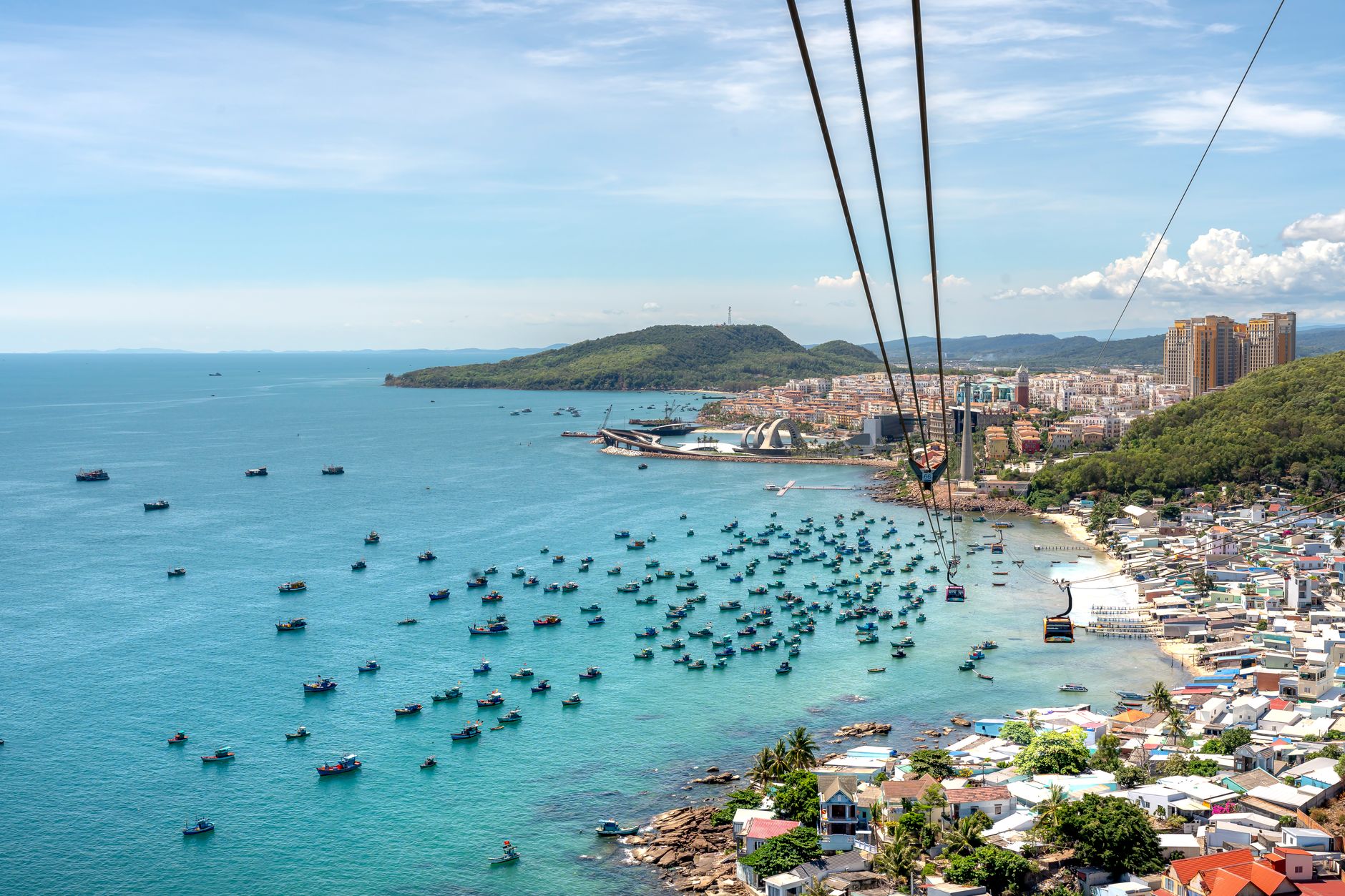
Travellers of any nationality can stay 30 days visa-free on the island when arriving from abroad, either on a flight that lands directly at Phu Quoc or after a transit through the international transit area of another Vietnamese airport, without clearing immigration there. Continuing to the mainland requires a visa obtained in advance, usually the e-visa, unless the traveller's nationality is exempt. After a visa-free arrival on the island, a mainland visa has to be requested through a Vietnamese sponsor.
The Khanh Hoa pilot for Chinese tour groups
Resolution 325/NQ-CP, dated 12 October 2026, sets up a pilot for Chinese group tours to Khanh Hoa. Chinese individual travellers remain outside the exemption lists and use the e-visa.
The five-year visa exemption certificate is not a nationality exemption
People of Vietnamese origin, and the foreign spouses and children of Vietnamese citizens, can apply for a visa exemption certificate. It is valid for up to five years, allows stays of up to six months per entry and costs 10 USD. Investors, scientists and other foreigners the government wants to attract fall under a separate scheme: Decree 221/2025/ND-CP lets them receive a special visa exemption card, valid for up to five years, with stays of up to 90 days per entry. Both are individual documents, unrelated to the 45-day rule, and mixing them up with the nationality exemptions is a frequent source of confusion.
APEC Business Travel Card
Holders of an ABTC endorsed for Vietnam can stay up to 90 days for business.
Why published lists disagree
Totals of 38 or 25 countries reflect lists from before August 2025 or lists that leave out Mongolia. The current total is 39.
Myanmar appears as 14 days in some lists. The Ministry of Foreign Affairs list gives 30. Kazakhstan appears as 45 days in some lists, but it is 30 days under its bilateral agreement, with the 90-in-180 cap. Belarus is still listed as unilateral in some guides, although it moved to a bilateral agreement on 15 March 2025. Some guides cite only Poland, Czechia and Switzerland from the August 2025 resolution, while the resolution covers twelve countries.
The reference points are the Ministry of Foreign Affairs list and the two resolutions.
After arrival: staying within the rules
Accommodation registers the traveller's temporary residence. Carry the passport or valid identification when required, and do only activities that match the purpose of entry.
Leave before the last permitted day. Overstaying can lead to fines, delays at exit and problems entering Vietnam later.
FAQ
Q: What does unilateral visa exemption mean? A: Vietnam waives the visa for a country's citizens on its own decision, by Government Resolution, without the other country having to do the same. It runs for a fixed period, currently until 14 March 2028 or 14 August 2028 depending on the resolution, and gives 45 days per entry.
Q: Can you visit Vietnam without a visa? A: Yes, if you hold a passport from one of the 39 exempt countries, valid at least 6 months on entry, and meet any condition attached to your country. Everyone else uses the e-visa, apart from the Phu Quoc island rule.
Q: How much is a visa for Vietnam for US citizens? A: US citizens are not exempt. The e-visa on evisa.gov.vn costs 25 USD for single entry or 50 USD for multiple entry, is valid up to 90 days and takes about 3 working days. Private sites charge more for the same document.
Q: What are the main visa types for Vietnam? A: For a trip, the useful distinctions are visa-free entry (bilateral or unilateral), the e-visa, and single versus multiple entry. Longer-term categories exist, such as DL for tourism, DN for business, LĐ for work and DH for study, and they usually involve a sponsor and the Immigration Department.
Q: Is Singapore's visa exemption bilateral or unilateral? A: Bilateral. It gives 30 days, has no end date, and the agreement requires a return or onward ticket.
Q: Can a visa-free stay in Vietnam be extended? A: Not on the spot. The only extension route is through a Vietnamese sponsor at the Immigration Department. Anyone who knows the trip will be longer should apply for an e-visa of up to 90 days before departure.
Q: Do Dutch, Belgian or Swiss travellers need a visa for a business trip? A: Yes. Resolution 229/NQ-CP covers tourism only, so business, conference or other non-tourism visits require an e-visa.
Q: What happens to the 45-day exemption after 2028? A: The two resolutions end on 14 March 2028 and 14 August 2028. The government can renew them, as it did in 2025. Until a renewal is published, those dates apply.
Your questions and tips
A question, an update, an experience to share? Our team reads every message before it is published.
No comments yet. Ask the first question or share a tip!