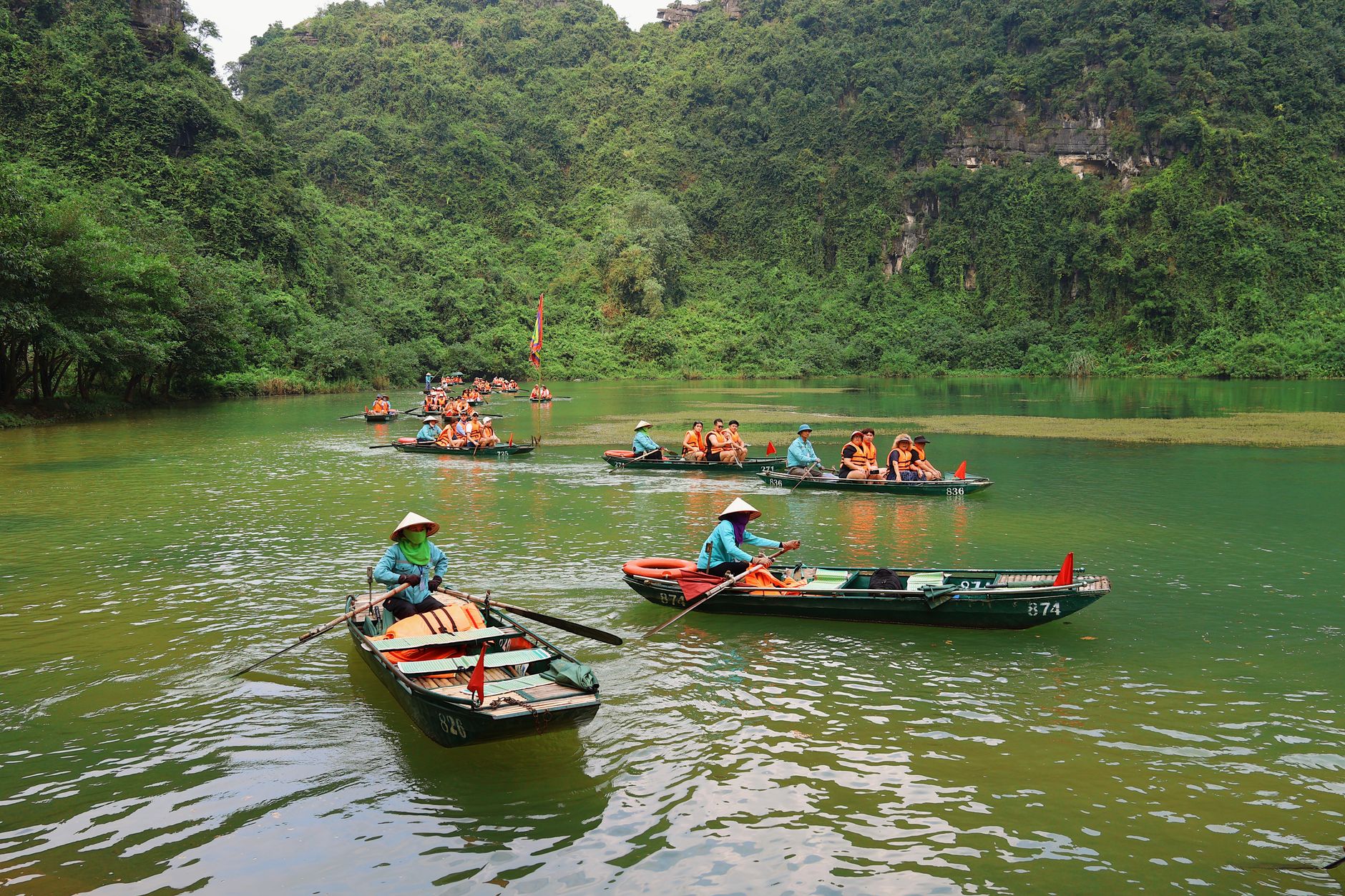
This guide covers what Trang An actually is, what happens on the water, how to get there, what it costs in 2026, and whether it deserves a place on your itinerary alongside or instead of nearby Tam Coc.
What Trang An is, and why it matters
The landscape formed over millions of years as the Red River delta pushed against a belt of limestone. Sea levels rose and fell, dissolving the rock into caves and leaving isolated karst towers surrounded by flat, floodable ground. What you see today is the result: vertical cliffs rising 200 metres from rice paddies and wetlands, connected by narrow waterways that thread through cave tunnels.
Humans arrived early. Archaeologists have found evidence of continuous occupation in Trang An's cave systems dating back roughly 30,000 years, through the Hoabinhian and Bac Son cultures. Some caves contain shell middens, stone tools, and human burials. This is one reason UNESCO classified the site as mixed rather than purely natural.
The cultural layer sits on top of the geological one. In the 10th century, after the Chinese Tang dynasty collapsed, a local leader named Dinh Bo Linh established his capital at Hoa Lu, just outside the Trang An core zone. He chose the location because the karst towers formed natural walls. The waterways were his roads. In 968 he declared himself emperor of Dai Co Viet, the first independent Vietnamese state after a thousand years of Chinese rule. The temples at Hoa Lu, still standing, commemorate him and his successors.
The third layer is modern. Parts of the 2017 film Kong: Skull Island were shot on the rivers here, and some rowers still point out the spots. The film brought a wave of international visitors that has not fully receded.
What you actually see on the boat
Tours depart from the Trang An wharf, a large concrete dock about 7 km west of Ninh Binh city on Trang An Street. You buy a ticket, walk down to the water, and are assigned a rower and a small metal sampan that seats four passengers. The rowers are almost all local women from surrounding villages, and many row with their feet, a technique unique to this region.
There are three main routes, numbered 1, 2, and 3. Each takes a different combination of caves, temples, and film locations.
| Route | Duration | Caves | Highlights | Best for |
|---|---|---|---|---|
| Route 1 | 3-3.5 hours | 9 caves | Longest route, most caves, Sang Cave, Toi Cave | Travellers with time who want the full circuit |
| Route 2 | 2.5-3 hours | 4 caves | Kong: Skull Island filming site, Hang Nau Ruou | Most visitors; best balance |
| Route 3 | 2-2.5 hours | 3 caves | Trinh Temple, shorter loop | Families, limited time, older travellers |
Route 2 is the most popular and the one most tour operators book. It passes through four cave tunnels, stops at the Kong filming location (a small clearing with a wooden sign), and visits Trinh Temple, a hillside shrine with a view over the valley. Route 1 adds more caves but also more time on open water, which can be hot at midday. Route 3 skips the film site and focuses on the temple and a shorter cave section.
If you have knee or back problems, ask for Route 3. The boats are low, the seats are hard, and climbing in and out at stops is awkward. There is no backrest.
The caves themselves vary. Some are long, dark tunnels where the rower pulls the boat through by hand on a rope fixed to the ceiling. Others are short arches you pass under in a minute. The water is shallow, often less than a metre, and clear enough to see the bottom in places. Lotus plants and water hyacinth choke some channels in summer.
Between caves, the boat glides past sheer cliffs covered in ferns and orchids, small floating temples, and the occasional goat grazing on a ledge. The silence is the thing most visitors remember. Even with other boats around, the karst absorbs sound.
What sets Trang An apart from Tam Coc
Tam Coc is the other famous boat ride in Ninh Binh, about 5 km south of Trang An. The two are often confused. The differences matter.
Tam Coc is a single 2-hour route along the Ngo Dong River, through three caves, with rice paddies on both banks. It is more scenic in a postcard sense, especially in May when the rice is golden. It is also more commercial. Rowers pressure passengers to buy drinks and snacks at a floating stop midway, and the tipping expectation is more aggressive.
Trang An is larger, more varied, and less pressured. The trade-off is that Trang An feels less intimate. The wharf is bigger, the boats are metal rather than wooden, and the route is more scripted. Tam Coc is a river through farmland. Trang An is a flooded archaeological landscape.
Many travellers do both. If you only have time for one, choose Trang An for the caves and the UNESCO context, Tam Coc for the rice paddies and a shorter, cheaper ride.
Tickets, hours, and practical costs
The Trang An ticket office is open daily from 7:00 am to 4:00 pm. Boats stop departing at 4:00 pm, but if you are on the water before then, you finish the route. Last boats return around 6:00 pm.
Ticket prices, checked January 2026:
- Adult ticket, Route 1, 2, or 3: 250,000 VND (about $10 / €9)
- Child ticket (under 1.3 metres): 120,000 VND (about $5 / €4.50)
- Children under 3: free
- Private boat charter (if you want the boat to yourself): 1,200,000 VND (about $48 / €44) for up to 4 people
The ticket includes the boat and the rower. It does not include tips, drinks, or the separate entrance fee for Hoa Lu or Bai Dinh.
Rowers are not paid a full wage. They rely on tips. A tip of 50,000-100,000 VND ($2-4) per boat is standard and appreciated. Hand it directly to the rower at the end, not to a middleman.
There is no dress code for the boat itself, but if you plan to visit Trinh Temple or any of the pagodas on the route, cover shoulders and knees. Bring a hat, sunscreen, and water. There is a small cafe at the wharf but nothing on the water except what other boats sell.
How to get to Trang An from Ninh Binh
Trang An is 7 km from Ninh Binh city centre and 5 km from Tam Coc. There is no public bus that goes directly to the wharf.
- Grab or taxi: 50,000-80,000 VND ($2-3) from Ninh Binh city, 40,000-60,000 VND from Tam Coc. Grab works reliably in Ninh Binh. See our guide to Grab in Vietnam for how to use it.
- Motorbike: Rent a scooter in Tam Coc or Ninh Binh for 100,000-150,000 VND per day. The road is flat and easy. Parking at the wharf costs 10,000 VND.
- Bicycle: Many guesthouses rent bicycles for 50,000 VND per day. The ride from Tam Coc takes about 20 minutes on quiet roads.
- Organised tour: Most hotels and guesthouses in Ninh Binh and Tam Coc sell half-day tours that include transport, the boat ticket, and sometimes a stop at Hoa Lu. Expect 400,000-600,000 VND per person.
If you are coming from Hanoi, the easiest route is the train to Ninh Binh station (2 hours, 70,000-150,000 VND) or a limousine bus (2 hours, 200,000-300,000 VND). See our Ninh Binh travel costs guide for a full breakdown. For a deeper look at what to do in the area, see Ninh Binh things to do: caves, rivers and rice paddies.
When to go, and how to avoid the crowds
Trang An is busiest from 9:00 am to 1:00 pm, when domestic tour groups from Hanoi arrive. The wharf can feel like an airport terminal at those hours. The water itself is less crowded than you might fear because the routes spread boats out, but the ticket queue and the dock are chaotic.
The best time to go is 7:00-8:30 am. You get soft light, cooler temperatures, and far fewer boats. The second-best window is after 2:30 pm, when the day-trippers have left but there is still enough light for the caves.
Seasonally, Ninh Binh has two main periods. The dry season runs from November to April, with cooler temperatures and lower humidity. The wet season runs from May to October, with heavy rain, higher water levels, and lush green rice fields. The rice is planted in February and harvested in May and June. For the best light on the fields, see our guide to when to visit Ninh Binh for the best light.
Avoid the Lunar New Year (Tet) period in late January or early February. Trang An is a pilgrimage site for Vietnamese families during Tet, and the crowds are overwhelming. Many boat operators also raise prices or stop taking individual bookings.
Who will love it, and who might not
Trang An works best for travellers who want a full half-day on the water, are comfortable in a low boat for three hours, and care about the UNESCO context. It is excellent for photographers in the early morning, for families with children old enough to sit still, and for anyone who wants to see a landscape that does not exist elsewhere in Southeast Asia at this scale.
It is less good for travellers with limited mobility, anyone prone to motion sickness (the boats are stable but the caves can feel enclosed), and people who want a quick 90-minute experience. If you are short on time, Tam Coc is shorter and cheaper. If you want a more active day, consider Ninh Binh cycling routes instead.
The honest verdict: Trang An is worth the detour if you are already in Ninh Binh. It is not worth a special trip from Hanoi on its own. Pair it with Hoa Lu, Bai Dinh, or Tam Coc to make a full day.
What to combine nearby
- Hoa Lu ancient capital: 8 km from Trang An. The 10th-century temple complex is small but historically important. Entry 20,000 VND.
- Bai Dinh Pagoda: 12 km away. The largest pagoda complex in Vietnam, with a 13-storey tower and a 36-tonne bronze bell. Entry 50,000 VND for the electric car, temple free.
- Tam Coc: 5 km south. The other boat ride, plus restaurants and guesthouses.
- Mua Cave: 6 km from Tam Coc. 500 steps to a viewpoint over the Tam Coc river. Entry 100,000 VND.
- Ninh Binh city: 7 km east. Train station, bus connections, and the best local food. See our Ninh Binh food scene guide for what to eat.
For where to base yourself, see our comparison of Tam Coc versus Trang An.
Your questions and tips
A question, an update, an experience to share? Our team reads every message before it is published.
No comments yet. Ask the first question or share a tip!