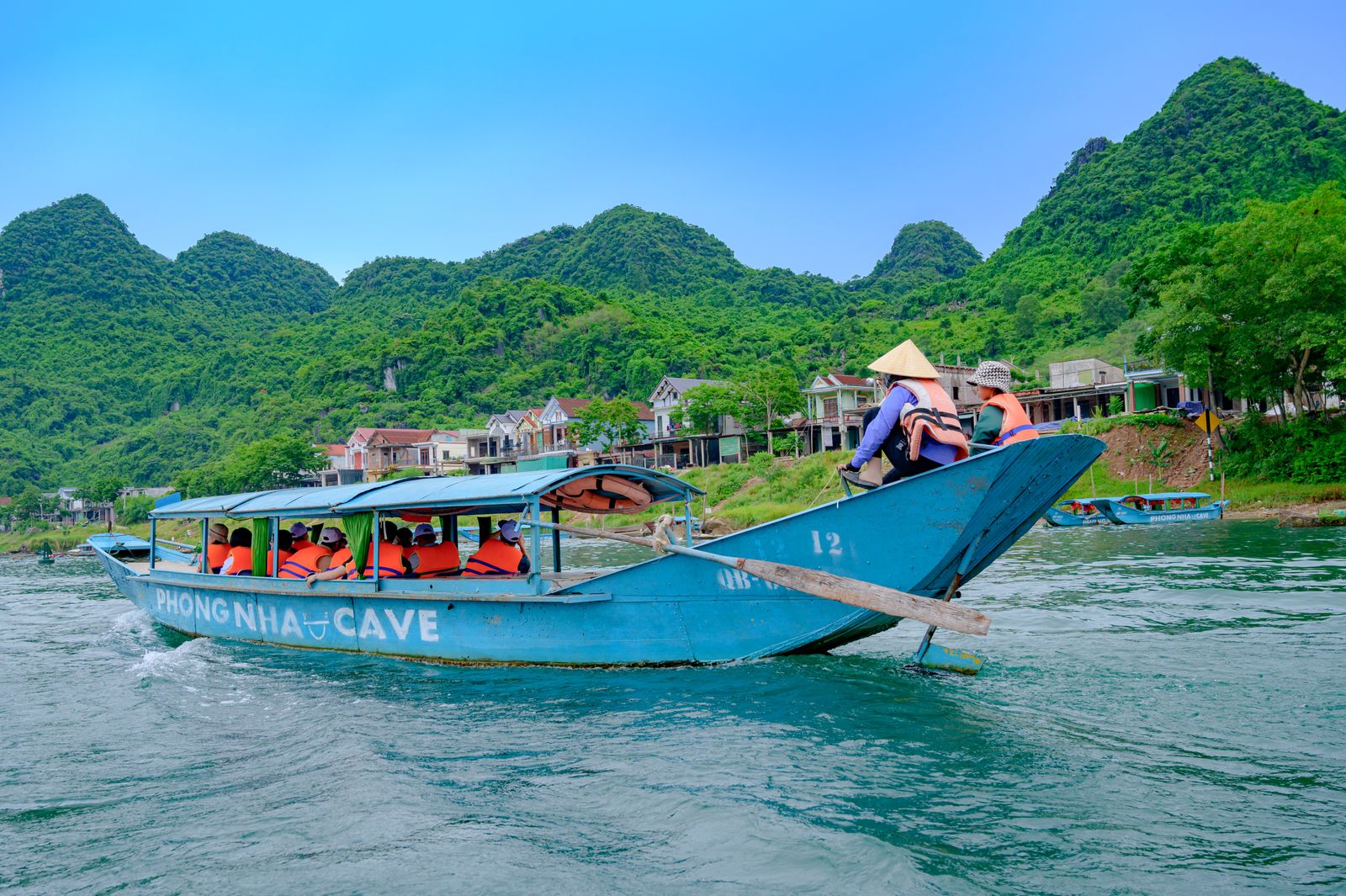
What Tam Cốc-Bích Động is (and what the name means)
Two attractions share one name, and that confusion trips up a lot of planning.
Two attractions under one name
Tam Cốc is the boat ride. Small wooden boats leave Van Lam wharf and follow the Ngô Đồng River through three caves: Hang Cả (about 127 m), Hang Hai (about 60 m) and Hang Ba, the shortest and lowest of the three. Bích Động is a pagoda built into a cliff roughly 2 to 2.5 km from the wharf, across a stone footbridge. They sit in the same valley, which is why they are ticketed and marketed together.
English name and etymology
Most English-language sources write "Tam Coc" or "Tam Coc-Bich Dong". Bích Động is usually rendered "Green Grotto" or "Jade Cave". The Sino-Vietnamese cốc literally means "valley", so "Tam Cốc" is closer to "three valleys" than the common translation "three caves" (hang). The pagoda was reportedly named in 1773 by Prime Minister Nguyễn Nghiêm, who called it the second most beautiful cave under the southern sky. Treat that epithet as tradition rather than verified fact.
Where it sits in the bigger picture
Tam Cốc-Bích Động is part of the Tràng An Landscape Complex, inscribed as a UNESCO mixed World Heritage site in 2014. It is not the same product as the Tràng An boat tour. Tràng An has its own wharf, its own routes and its own ticket. The two are often confused online, sometimes deliberately.
Location and administrative note
The site sits in the old Van Lam village area, historically Ninh Hải commune, Hoa Lư district, about 5 to 7 km southwest of Ninh Binh city and roughly 100 km south of Hanoi. Vietnam's 2025 province and commune mergers changed several official names, and many maps, signs and booking pages still show the old ones. Verify the current ward and province names before relying on an address.
Is it worth it? An honest first look
What it delivers
Karst peaks rising straight out of flooded rice paddies. Cool, dark river caves. The quiet rhythm of a boat being rowed by foot. It is a gentle, photogenic half-day rather than an adventure, and the scenery genuinely holds up.
What disappoints
Midday crowds arrive in busloads, and the rowers' selling can wear you down. Indie Traveller and Wikipedia both report persistent mid-river sales pitches for embroidery, drinks and fruit, plus tip pressure. The Tràng An tour is generally described as calmer. The "Ha Long Bay on land" label is marketing: Ha Long Bay is a sea bay with overnight cruises and island scenery, while Tam Cốc is a river-and-rice-field landscape you visit in a few hours. Different scale, different experience.
Who it suits
First-timers, photographers, families with older children, and slow travelers who stay overnight. It suits less well anyone chasing wilderness or silence at peak hours.
How to get to Tam Cốc-Bích Động
Hanoi to Ninh Binh
Three realistic options. The train takes about 2 to 2.5 hours and costs roughly 100,000 to 200,000 VND ($4 to $8). Limousine vans and tourist minibuses take about 1.5 to 2 hours depending on traffic, roughly 150,000 to 275,000 VND ($6 to $11). A private car is about 2 to 2.5 hours. Some guides quote anything from 1h20 to 3h. Traffic on the southern approach to Hanoi, especially Friday and Sunday evenings, explains most of the gap.
Ninh Binh to Tam Coc
The wharf is 5 to 7 km from Ninh Binh city, about 10 to 15 minutes by taxi, ride-hailing app or motorbike taxi. Fares vary with demand, so treat any quoted number as indicative and confirm before getting in.
From Ho Chi Minh City, Da Nang or Ha Long
Fly to Hanoi and continue overland. The reunification train from Saigon takes 30 to 35 hours, which is not a practical way to reach Ninh Binh on a normal trip. From Ha Long, a direct bus takes about 4 hours according to Indie Traveller.
Driving or riding yourself
Foreign visitors need a valid home license plus an International Driving Permit recognized in Vietnam. Without both, insurance can be void after an accident, and the consequences are serious.
National Highway 1 and the Ninh Binh ring roads carry heavy truck and tour-bus traffic. The village lanes around the paddies are far easier. Bicycles rent for about 50,000 to 100,000 VND ($2 to $4) per day and are the lower-risk way to move between the wharf, Bích Động and the homestay strip.
Entrance fees, boat prices and what is included (2026)
This is where sources contradict each other most, so treat the table below as a reconciled working estimate rather than gospel.
| Item | Adult price | Child price | Confidence |
|---|---|---|---|
| Site entry ticket | 120,000 VND ($4.70) | 60,000 VND ($2.35) | Medium, 2023 figure |
| Boat fare, per boat (up to 4) | 100,000 to 190,000 VND ($4 to $7.50) | Same | Low, sources conflict |
| Boat fare, per person | 150,000 to 200,000 VND ($6 to $8) | Reduced | Low, sources conflict |
| Hang Múa viewpoint | 100,000 VND ($3.90) | Reduced | Medium |
| Bích Động pagoda | Verify at gate | Verify | Low |
| Thái Vi temple | Verify at gate | Verify | Low |
Ticket structure
Entry and boat fare are separate. Some sources quote the boat as a flat fee per boat of up to four people, others as a per-person charge. Before publishing, check the official Ninh Binh tourism promotion center price page or ask at the wharf, and note the date you checked.
What is not included
Tips to rowers, drinks and snacks sold mid-river, and photo extras. Budget a little cash beyond the tickets.
Sample budget per person
An independent half-day runs roughly 250,000 to 400,000 VND ($10 to $16) including entry, boat and a bicycle. A full independent day with Hang Múa and lunch lands around 500,000 to 700,000 VND ($20 to $28). A typical Hanoi day tour sits in the $35 to $50 range according to Oxalis, and private cars cost more.
The boat ride step by step: what to expect on the Ngô Đồng River
Route and duration
Boats leave Van Lam wharf and return the same way, about 1.5 to 2 hours on the water. Some guides quote 2 to 2.5 hours, which usually includes queue time at the wharf. Landmarks in order: the outer gate (Nghi Môn ngoại), the Rồng sluice gate, the Phoenix beak rock, then Hang Cả, Hang Hai and Hang Ba. Boats turn back after the third cave.
The rowers and the foot-rowing technique
Local women and men row, many with their feet, a technique that lets them pull harder with their legs while their hands rest. It is a cooperative livelihood tied to the wharf, not a novelty.
Selling and tipping
Agree on "no stops, no purchases" before you push off. A polite refusal works. A modest tip at the end is customary if the service was good, but it is not mandatory.
The common pattern: a mid-river pause where a companion boat offers embroidery, drinks or fruit. Some rowers push harder than others. Decide your position early and hold it kindly.
Boat logistics
Boats usually carry two passengers, though the maximum should be confirmed at the wharf. Life jackets are provided. Shade is limited, so bring sun protection and a dry bag for cameras. Toilet facilities at the wharf are basic.
When the boats do not run
Heavy rain or high water can suspend trips, most likely between roughly July and October during typhoon season. Have a backup plan for those months.
Bích Động pagoda, Thái Vi temple and Hang Múa: the add-ons
Bích Động pagoda
Three levels, Hạ, Trung and Thượng, built into the cliff. Origin dates conflict across sources: 1428 under Lê Thái Tổ according to Vietnamsiteblog and Wikipedia, the 17th century according to Hải Đăng, the 15th century according to Oxalis. Present the discrepancy honestly rather than picking one. Expect a stone footbridge, a short climb and 30 to 45 minutes. Dress modestly and remove shoes where asked.
Thái Vi temple
A Tran dynasty shrine from the 13th century, about 2 km from the wharf, reached by bicycle or on foot. It is dedicated to the Tran kings Trần Thái Tông and Trần Thánh Tông and follows the "nội công ngoại quốc" layout described by the official source.
Hang Múa viewpoint
About 500 steps, 20 to 45 minutes up, 100,000 VND ($3.90).
The summit is steep, railings are missing at the dragon statue, and the rock is sharp. Avoid midday heat. Sunrise or after 4 pm is better. Skip it with very young children or knee and heart conditions.
The viewpoint shows the whole Tam Coc valley without paying for a boat, which makes it a useful alternative if the wharf is jammed.
Best time to visit: month by month, including the second harvest
Many guides repeat one window, late May to early June. There is a second one.
The rice calendar
The winter-spring crop is planted around January and February, green through March and April, golden in late May and early June. The summer crop is green in August and September and turns gold around late September to October. As of mid-October 2026, that second golden window is closing. The next main golden window is late May to early June 2027.
Weather and comfort
The dry season runs November to April, cool and sometimes grey or misty from January to March. May to August is hot and humid. Rain and typhoon risk climbs from July to October. Oxalis advises avoiding July to October, while Hải Đăng praises September and October. Both can be right: early autumn is beautiful when the weather holds, and miserable when a storm parks over the delta.
Crowds and calendar
Weekends, Tet (next on 6 February 2027), the 30 April to 1 May holidays (next: 30 April 2027) and 2 September fill the wharf. The Thái Vi temple festival falls early in the lunar year; confirm exact 2027 dates locally. The best boat windows are the first departures of the morning or after about 2 pm.
Month-by-month guide
| Month | Rice fields | Weather | Crowds | Boat reliability | Verdict |
|---|---|---|---|---|---|
| Jan-Feb | Bare, planting | Cool, misty | Low | Good | Quiet, grey photos |
| Mar-Apr | Green | Mild | Medium | Good | Strong all-round |
| May | Turning gold | Hot | High | Good | Peak scenery |
| Jun | Golden, harvest | Hot, humid | High | Good | Peak scenery |
| Jul-Aug | Bare, then green | Hot, storm risk | Medium | Variable | Rain risk |
| Sep | Green | Warm, wet | Medium | Variable | Lush, risky |
| Oct | Turning gold | Cooling | Medium | Variable | Second golden window |
| Nov-Dec | Harvested | Cool, dry | Low | Good | Comfortable, bare fields |
Tour from Hanoi or independent visit: how to decide
What a typical day tour includes
Most run Hoa Lư or Bái Đính, lunch, the Tam Cốc boat and sometimes cycling or Hang Múa. Market range is roughly $35 to $50 per Oxalis, higher for private cars. Indie Traveller notes about 3 hours each way, which leaves only 4 to 5 hours on site.
Pros and cons
Tours remove navigation and lock in a price, but the timing is rigid, you arrive with the midday crowd, and shopping stops happen. Independent travel lets you catch sunrise and late afternoon and dodge the peak, at the cost of arranging transport and tickets yourself.
Decision guide
One day only: a tour or private car is fine. Two or more days: go independent and sleep in the area.
How to vet a tour
Ask what the price includes for entry and boat fees, the group size, the departure time, the stops, the cancellation policy, and whether the operator holds a license and insurance. No operator names here on purpose.
Tam Coc, Trang An or both? Comparing the boat rides
| Site | Duration | Price | Scenery | Crowds | Selling pressure | Best for |
|---|---|---|---|---|---|---|
| Tam Cốc | 1.5 to 2 h | Entry plus boat | Rice fields, 3 caves | High midday | Reported | Golden-season paddies |
| Tràng An | 2.5 to 4.5 h | 250,000 to 300,000 VND | Caves, temples, Kong filming | Medium | Lower | Caves and photography |
| Văn Long | About 1.5 h | Verify | Wetland, birdlife | Low | Low | Quiet nature |
| Thiên Hà grotto | Short | Verify | Small local cave | Low | Low | Offbeat stop |
Tam Cốc wins on rice-field scenery in the golden season. Tràng An wins on caves, temples and calm, with Route 1 the longest and quietest per Indie Traveller. Do both only if you have two days. Văn Long wetland reserve and the Thiên Hà "Galaxy" grotto suit anyone who wants to skip the crowds entirely.
Where to stay: Tam Coc village, Trang An side or Ninh Binh city
Tam Coc village
Walkable to the wharf, with restaurants, hostels and guesthouses packed into a few streets. Convenient, but tour buses flood the strip at midday.
Trang An and Hang Múa side
Quieter, set among the karst, better sunsets. You need a bicycle or scooter. Indie Traveller favors this side for stays of two nights or more.
Ninh Binh city
Best for trains and buses, weakest for scenery. Use it for late arrivals or early departures.
Bái Đính and Cúc Phương outskirts
Useful for temple visits or a Cúc Phương National Park combination.
Price brackets and area comparison
| Area | Atmosphere | To wharf | Transport needed | Price range | Best for |
|---|---|---|---|---|---|
| Tam Coc village | Lively | Walk | None | Dorm to mid | First-timers |
| Trang An side | Quiet | 10 to 20 min | Bicycle | Mid to high | Two-night stays |
| Ninh Binh city | Urban | 10 to 15 min | Taxi | Budget to mid | Transit nights |
| Bái Đính area | Remote | 20 to 30 min | Scooter | Mid | Temple combos |
Dorm beds start around 100,000 to 200,000 VND ($4 to $8). Homestays and bungalows run roughly 400,000 to 1,200,000 VND ($16 to $48). Resorts climb higher.
Book weekends and Vietnamese holidays well ahead, and confirm whether bicycles are included in the rate.
Sample itineraries and practical tips
Half day (4 to 5 hours)
Early boat at Tam Cốc, then Bích Động pagoda, then a late lunch on the Tam Coc strip. This is the minimum viable visit.
One full day
Sunrise or sunset at Hang Múa, the boat ride in the opposite window, Bích Động and Thái Vi temple by bicycle. Comfortable and unhurried.
Two days
Day 1 in the Tam Cốc area. Day 2 at Tràng An with Hoa Lư ancient capital, optionally Bái Đính. This is the version that justifies the trip.
Practical checklist
Carry cash, since ATMs are limited outside Ninh Binh city. Bring sun protection, insect repellent (dengue risk rises in the rainy season), water, modest clothing for temples, closed shoes for the Múa steps and a rain cover. Accessibility is limited: steps at boat boarding, no ramps, and 500 steps at Hang Múa.
FAQ
Q: What is Tam Cốc-Bích Động called in English? A: Usually written "Tam Coc-Bich Dong". Tam Cốc is commonly translated as "three caves", though cốc strictly means "valley". Bích Động becomes "Green Grotto" or "Jade Cave". The site is part of the UNESCO-listed Tràng An Landscape Complex.
Q: What is there to do in Tam Cốc? A: The boat ride through three caves, Bích Động pagoda, Thái Vi temple, the Hang Múa viewpoint, cycling through the paddies and local food such as cơm cháy and goat meat. Allow a half day for the boat and pagoda, a full day with Hang Múa.
Q: What are the main sights in Ninh Bình? A: Tràng An, Tam Cốc, Hang Múa, Hoa Lư ancient capital, Bái Đính pagoda, Văn Long reserve, Thung Nham bird garden, Cúc Phương National Park and Phát Diệm cathedral. Most sit within 30 to 45 minutes of Tam Coc.
Q: How much does Tam Cốc cost in 2026? A: Entry is around 120,000 VND ($4.70) for adults, with the boat fare quoted anywhere from 100,000 to 200,000 VND ($4 to $8) depending on whether it is charged per boat or per person. Confirm at the wharf.
Q: Is Tam Cốc worth visiting as a day trip from Hanoi? A: It is feasible but tight. About 3 hours each way leaves only 4 to 5 hours on site. Staying one night improves the timing and avoids the midday crowd.
Q: Are the rowers pushy, and how much should be tipped? A: Some are, according to several reports. Agree on no stops at the start, decline purchases politely and tip modestly at the end if the service was good. Tipping is optional.
Q: Should I choose Tam Cốc or Tràng An if there is time for only one? A: Tam Cốc for golden rice fields and a shorter ride. Tràng An for caves, temples and a calmer Route 1. See the comparison table above.
Q: Is Ninh Binh better than Ha Long Bay? A: They are different experiences. Ha Long Bay is a sea bay with cruises and island scenery. Tam Cốc is a river-and-rice-field landscape explored on land. Both fit one trip, and Ninh Binh is far easier to do independently.