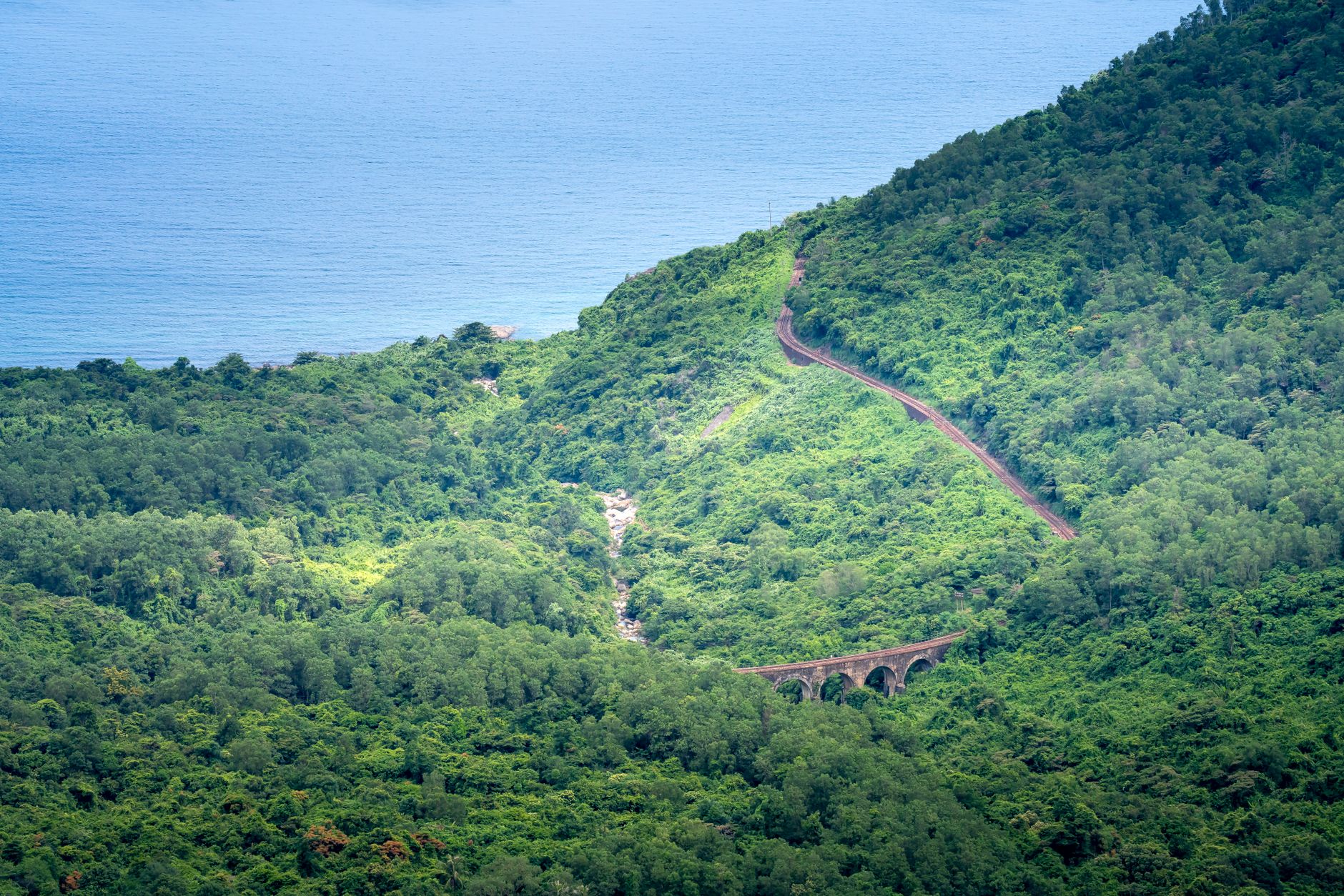
What Bach Ma actually is
The name means "white horse" in Vietnamese. The legend says a white horse spirit once appeared on the summit, and locals built a temple in its honor. The French arrived in the 1930s and turned the same ridge into a summer retreat, complete with a hotel, a market, and villas for colonial administrators escaping the heat of Hue. By 1945 the resort was abandoned. The jungle took it back within a generation.
In 1991 the Vietnamese government declared the area a national park. In 2008 it became part of the wider Truong Son landscape that UNESCO recognized as a World Heritage extension of the Phong Nha-Ke Bang complex. The park now protects 37,487 hectares of primary and secondary forest, home to the rare crested argus, the Annamite striped rabbit, and over 350 recorded bird species.
What makes Bach Ma different from Cat Tien or Cuc Phuong is the altitude. The road climbs from the coastal plain to 1,450 meters in about 16 kilometers. That means you pass through three distinct forest types in under an hour, and the temperature drops by 8 to 10 degrees Celsius along the way.
The story of the place
Bach Ma matters to Vietnam for two reasons. First, it is a biodiversity hotspot. The park sits on the northern edge of the Annamite Range, a mountain chain that has produced more large mammal discoveries in the last 30 years than almost anywhere else on earth, including the saola in 1992. Second, it is a living ruin. The French hill station at the summit is one of the few colonial-era sites in central Vietnam that was never rebuilt or repurposed. You walk through the remains of villas, a swimming pool, and a tennis court, all half-eaten by moss and tree roots.
There is also a darker chapter. During the Vietnam War, the summit was used as a lookout by both sides at different points, and the surrounding forest was heavily defoliated. Some of the secondary growth you see today dates from that period. The park's recovery is one of the quieter environmental success stories in the country.
What you see, spot by spot
The visit follows a clear sequence. You enter at the gate on Highway 1A, about 28km south of Hue and 40km north of Da Nang. From there, a single paved road climbs to the summit parking area. Private vehicles are allowed, but the road is steep and narrow, and the last 3km is often closed to cars in wet weather. Most visitors park at the gate and take the park's own 16-seat shuttle for 100,000 VND (about $4) per person round trip.
The summit and Vong Hai Dai. The road ends at a small clearing near the old hotel ruins. A short 500m trail leads to Vong Hai Dai, the "sea observation tower." On a clear day you can see the coastline at Lang Co, the Hai Van Pass, and the East Sea. This is the single best viewpoint in central Vietnam, and most tour groups skip it because they run out of time.
The five lakes trail. From the summit, a 2km trail descends through mossy forest to a series of natural rock pools fed by a stream. The water is cold year-round. Swimming is allowed, but the rocks are slippery and there are no lifeguards. Leeches are common from September to December.
Do Quyen waterfall. The park's signature waterfall drops 300 meters in a single tier, and the trail to the base is a steep 1.5km descent. The name means "rhododendron," and the flowers bloom in March and April. The water volume is highest from September to November, but that is also when the trail is most dangerous.
The birding trail. A 3km loop near the summit passes through primary forest and is the best place to spot the crested argus at dawn. Local guides charge 500,000 to 800,000 VND (about $20 to $32) for a half-day birding walk.
Pro tip: arrive at the gate by 7am. The summit is often clear in the early morning and clouded over by 10am. Afternoon visits are frequently a washout.
Bach Ma vs Phong Nha vs Cat Tien
| Feature | Bach Ma | Phong Nha-Ke Bang | Cat Tien |
|---|---|---|---|
| Distance from Hue | 40km | 220km | 150km from HCMC |
| Main draw | Hill station ruins, birding | Caves, karst | Gibbons, night safari |
| Entry fee (2026) | 60,000 VND | 150,000 VND | 60,000 VND |
| Best season | March to August | February to August | December to May |
| Time needed | 1 full day | 2 to 3 days | 2 days |
| Crowd level | Low | Medium to high | Low |
Bach Ma wins on solitude and altitude. Phong Nha wins on scale and drama. If you have time for only one, and you are already in Hue, Bach Ma is the smarter half-day. For a deeper cave experience, see the Phong Nha-Ke Bang National Park tickets guide.
Who will love it, and who will not
Bach Ma rewards travelers who like forests, birds, and ruins. It is not a theme park. There is no cable car, no cafe at the summit, and no signage in English beyond the gate. The trails are muddy, the steps are uneven, and the leeches are real.
Travelers who will love it: birdwatchers, photographers, hikers, and anyone who has already done the Hue citadel and wants a contrast. Families with children over 8 will manage the summit and the lakes trail. The waterfall trail is harder and not suitable for young kids.
Travelers who may be disappointed: those expecting a manicured national park, those with mobility issues, and anyone visiting in October or November, when the road often floods and the summit is socked in for days.
Warning: the park closes the summit road without notice after heavy rain. Call the gate at least a day ahead if you are visiting between September and December.
Practical information
Opening hours. The gate opens at 7am and closes at 5pm. Last entry to the summit road is 3pm. Hours checked in January 2026.
Entrance fee. Adults 60,000 VND (about $2.40). Children under 1.2m free. Motorbike parking 10,000 VND. Car parking 30,000 VND. Shuttle from gate to summit 100,000 VND round trip per person.
How to get there from Hue. The gate is on Highway 1A at the Phu Loc district turnoff, about 28km south of Hue. Options:
- Grab car from Hue city center: 400,000 to 600,000 VND one way. Return trips are hard to book from the gate, so arrange a pickup time with your driver.
- Private car with driver: 700,000 to 1,200,000 VND round trip for the day. Book through your hotel.
- Motorbike rental from Hue: 120,000 to 180,000 VND per day. The ride takes about 45 minutes on Highway 1A, which is busy with trucks.
- Local bus from Hue to Phu Loc: 30,000 VND, then a 12km xe om ride to the gate for about 80,000 VND. Slow and unreliable.
How to get there from Da Nang. The gate is about 65km north of Da Nang, roughly 1.5 hours by car. A private car round trip costs 1,500,000 to 2,000,000 VND. Most travelers combine it with the Hai Van Pass and Lang Co on the same day.
How long to allow. A half day is enough for the summit and the lakes trail. A full day lets you add the waterfall and a birding walk. Two days is only worth it if you are a serious birder.
What to bring. Sturdy shoes, long trousers, insect repellent with DEET, a rain jacket, and at least 1.5 liters of water per person. There is no food or drink for sale inside the park beyond a small kiosk at the gate.
Rules. No drones without a permit. No littering. No picking plants. No swimming in the waterfall pools, which are sacred to some local communities. Dress modestly if you visit the small temple near the summit.
What to combine nearby
Bach Ma sits in the middle of one of the most scenic stretches of central Vietnam. Within a short drive:
- Lang Co beach. A 10km curve of sand on the north side of the Hai Van Pass, about 25km from the park gate. Good for a seafood lunch.
- Hai Van Pass. The famous 21km mountain road between Hue and Da Nang. Ride it, drive it, or take the train. See the Hai Van Pass and Lap An lagoon guide.
- Lap An lagoon. A quiet inlet on the Da Nang side of the pass, good for oyster lunches.
- Hue city. The imperial citadel, tombs, and food scene deserve at least two days. See the Hue things to do guide.
If you are continuing north, the sleeper bus or train to Phong Nha takes 4 to 5 hours. See the Dong Hoi to Phong Nha transport guide for the onward leg.
Is Bach Ma worth the detour?
Yes, with conditions. If you are in Hue for two or more days and the weather is clear, Bach Ma is one of the best half-day trips in central Vietnam. The summit viewpoint alone justifies the drive, and the birding is genuinely world-class. If you are rushing through Hue in one day, skip it. If you are visiting between October and December, check the weather first and have a backup plan.
The park is not for everyone. It is quiet, rough, and often cloudy. That is exactly why it still feels like a discovery.
FAQ
Q: Do I need a guide to visit Bach Ma? No. The park is self-guided and the main trails are marked. A guide is only worth it for serious birding or if you want the colonial history explained.
Q: Can I stay overnight inside the park? Yes. There are basic rooms at the summit and a small guesthouse near the gate. Prices run 400,000 to 900,000 VND (about $16 to $36) per night in 2026. Book through the park office in Hue.
Q: Is the road to the summit safe for motorbikes? The road is paved but steep and narrow, with blind curves. It is rideable in dry conditions for experienced riders. Avoid it in rain. The park shuttle is the safer option.
Q: What is the best time to see the rhododendrons at Do Quyen waterfall? March and April. The flowers are the reason for the waterfall's name, and the trail is usually dry enough to descend safely.
Q: Are there leeches? Yes, especially from September to December. Wear long socks and trousers, and use repellent. They are unpleasant but not dangerous.
Q: Can I visit Bach Ma as a day trip from Da Nang? Yes, but it makes for a long day. Leave Da Nang by 6:30am to reach the gate by 8am. Combine with the Hai Van Pass on the return leg.
Q: Is Bach Ma suitable for children? The summit and lakes trail are fine for children over 8. The waterfall trail is steep and not recommended for young kids or anyone with knee problems.