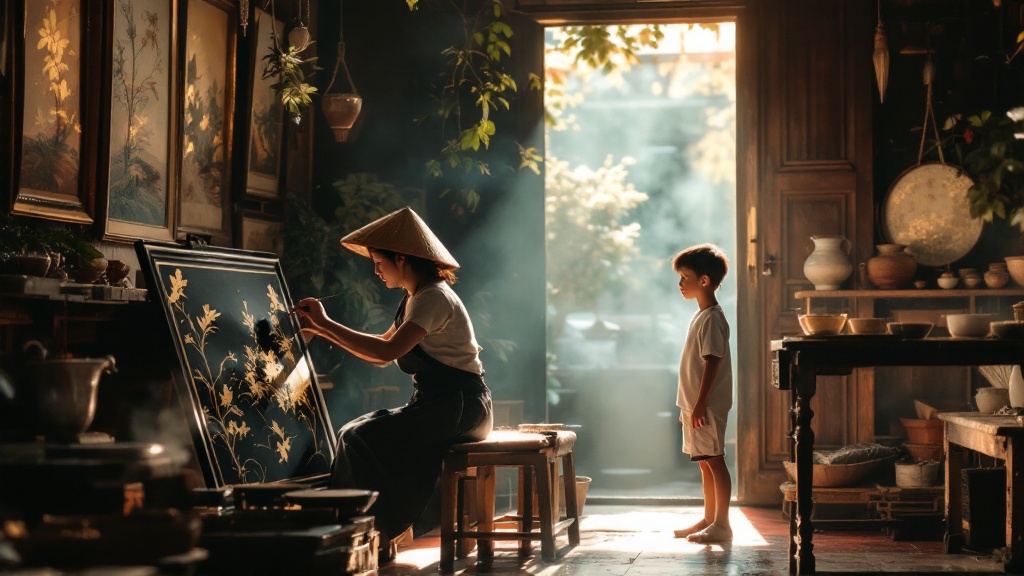
Many of the works sold as "traditional Vietnamese art" were invented less than a century ago. The French colonial art school reshaped Vietnamese painting in the 1930s. Silk painting and lacquer painting, now considered the country's most prestigious fine art forms, emerged from that period. This guide separates the genuine traditions from the souvenirs, names the artists worth knowing, and tells you exactly where to find authentic work.
What counts as traditional Vietnamese art
Traditional Vietnamese art covers visual arts such as painting, sculpture, ceramics, lacquerware, textiles, and woodblock prints. It also includes performing arts like water puppetry, music, and dance. For travelers, the visual arts are the most accessible.
The term "traditional" in Vietnam means pre-colonial techniques and motifs. But this definition has a catch. Many celebrated forms, including lacquer painting and silk painting, were refined under French colonial influence at the École des Beaux-Arts de l'Indochine, founded in Hanoi in 1925. Vietnamese artists learned Western oil painting, perspective, and plein air techniques. They then adapted these methods to local materials. The result was a hybrid style. It is traditional in technique but modern in origin.
This matters because travelers often assume "traditional" means ancient. Some iconic forms emerged only in the 1930s. Knowing this helps you understand what you are looking at and what you are paying for.
A brief timeline of Vietnamese art history
Prehistoric and Bronze Age (8,000 BCE – 1st century BCE)
The oldest surviving Vietnamese art comes from the Đông Sơn culture. Their bronze drums, cast between 600 BCE and 200 CE, are masterpieces of metalwork. The drums show scenes of daily life, warfare, and ritual. They are decorated with geometric patterns, birds, and boats. The best originals are at the Vietnam National Museum of History in Hanoi.
Chinese domination and independence (111 BCE – 15th century)
For over a thousand years, Vietnam was under Chinese rule. Chinese techniques in ceramics, calligraphy, and Buddhist sculpture were absorbed and transformed. The Lý dynasty (1009–1225) was a golden age. The Temple of Literature in Hanoi dates from this period. So do many of the country's finest Buddhist statues. Few pre-15th century paintings survive because of Vietnam's humid climate and the fragility of silk and paper.
Nguyễn dynasty court art (1802–1945)
The last imperial dynasty produced detailed court paintings, imperial portraits, and refined enameled ceramics. The Huế royal tombs are open-air art galleries. The best collection of Nguyễn court art is at the Huế Royal Fine Arts Museum.
French colonial period and the birth of modern Vietnamese painting (1925–1945)
This is the period that produced the most famous Vietnamese paintings. The École des Beaux-Arts de l'Indochine trained the first generation of modern Vietnamese artists. They adapted Western techniques to local materials. They invented lacquer painting as a fine art form. They transformed silk painting from folk craft to high art. This period ended with the outbreak of the First Indochina War in 1946.
War and post-war art (1945–1990s)
During the war years, art in the North was dominated by revolutionary realism and propaganda. Artists in the South had more freedom. After reunification in 1975, the state controlled artistic production. The "Gang of Five" emerged in the 1990s as Vietnam reopened to the world. This group of five Hanoi artists pushed boundaries and helped revive contemporary Vietnamese art.
The major traditional art forms (and how to tell quality)
Lacquer painting (sơn mài)
Lacquer painting is the most distinctly Vietnamese fine art form. The process is labor-intensive. Artists apply 20 or more layers of lacquer, sanding between each layer. They inlay eggshell, mother-of-pearl, and gold leaf. The surface is polished to a deep, reflective finish.
Genuine sơn mài is extremely hard. Scratch it gently with a fingernail. If it marks, it is cheap resin, not real lacquer. Real lacquer painting costs more than oil painting because of the materials and labor. A good piece by an unknown artist starts at VND 5,000,000 (USD 200). Works by masters cost much more.
The masters to know: Nguyễn Gia Trí (1908–1993) pioneered the form. Công Quốc Hà (born 1964) is a leading contemporary artist. Đỗ Khải (born 1969) specializes in lotus motifs.
Silk painting (tranh lụa)
Vietnamese silk painting differs from Chinese and Japanese traditions. The palette is softer. The colors are more transparent. Subjects are everyday scenes, not just landscapes or court life.
Nguyễn Phan Chánh (1892–1984) is the most important silk painter. He won international recognition at the 1931 Paris Colonial Exhibition. His paintings show rural Vietnamese life with warmth and dignity.
To tell quality: hold the silk up to light. Real hand-painted silk shows visible brushstrokes and uneven dye absorption. Machine prints have uniform color. If a "silk painting" costs less than VND 500,000 (USD 20), it is almost certainly a machine print.
Đông Hồ folk woodblock prints
This is a 300-year-old tradition from Bắc Ninh province, northeast of Hanoi. Artists carve images into woodblocks, then print them using natural pigments. Black comes from charcoal. Red from cinnabar. Blue from copper rust. White from eggshell. The paper is dó, made from the bark of the dó tree.
The prints are fragile and rare. Authentic originals are hard to find. You can buy modern reproductions at Đông Hồ village or the Vietnam Museum of Ethnology in Hanoi. The difference between original prints and modern reproductions is the paper and the pigments. Originals use dó paper and natural colors. Reproductions use machine-made paper and synthetic paints.
Ceramics and pottery
Vietnam has several pottery villages worth visiting. Bát Tràng, 30 minutes from Hanoi, produces fine porcelain. Chu Đậu makes antique-style blue-and-white ceramics. Phù Lãng specializes in rustic brown glaze.
Handmade pieces show slight irregularities in shape and glaze. Factory-molded pieces are perfectly uniform. Quality ceramics cost VND 200,000 to 2,000,000 (USD 8 to 80).
Lacquerware (decorative objects)
This is different from lacquer painting. Lacquerware includes boxes, trays, vases, and furniture. The traditional colors are black, red, brown, and gold. Modern designers use bright colors and abstract patterns. The best place to buy is Hanoi's Hàng Trống street.
Hand embroidery
Machine embroidery is sold everywhere. Hand-stitched pieces take weeks to make. You can tell the difference by looking at the back. Machine embroidery has a uniform, machine-made back. Hand embroidery has irregular stitches. Tan My Design in Hanoi and Văn Phúc silk village are recognized centers. Prices for hand-embroidered paintings range from VND 1,000,000 to 10,000,000 (USD 40 to 400).
Water puppetry (múa rối nước)
This performance art is unique to Vietnam. It originated in the Red River Delta. Puppeteers stand waist-deep in water behind a screen. They control carved wooden puppets on long rods. The water hides the rods and creates special effects. An orchestra accompanies the performance. The best venue is Thăng Long Water Puppet Theatre in Hanoi. Book tickets in advance.
The artists every traveler should know
Silk painting masters
Nguyễn Phan Chánh (1892–1984) is the father of Vietnamese silk painting. His work is in the Vietnam National Museum of Fine Arts. Lê Phổ (1907–2001) studied in France and blended Vietnamese subjects with French impressionism. Mai Trung Thứ (1906–1980) painted children and family scenes with gentle humor.
Lacquer painting masters
Nguyễn Gia Trí (1908–1993) transformed lacquer from craft to fine art. His large-scale works are national treasures. Công Quốc Hà (born 1964) uses lacquer to paint contemporary Vietnamese life. Đỗ Khải (born 1969) is known for his luminous lotus paintings.
Oil painting pioneers
Tô Ngọc Vân (1906–1954) painted "Girl by the Lily," the most famous Vietnamese painting. It hangs in the Vietnam National Museum of Fine Arts. Bùi Xuân Phái (1920–1988) painted Hanoi's old quarter obsessively. His "Phố Phái" (Phái streets) style has become iconic.
Contemporary artists with traditional roots
Phạm Hoàng Minh paints Hanoi street scenes with a nostalgic touch. The "Gang of Five" includes Hồng Việt Dũng, Hà Trí Hiếu, Đặng Xuân Hòa, Trần Lương, and Phạm Quang Vinh. They revived Vietnamese contemporary art in the 1990s.
Where to see traditional Vietnamese art (museums and galleries)
Hanoi
The Vietnam National Museum of Fine Arts is the best public collection. Entry costs VND 40,000 (USD 1.60). It covers all periods from Đông Sơn drums to contemporary art. The Vietnam National Museum of History has the best Bronze Age collection. The Vietnam Museum of Ethnology shows folk art, Đông Hồ prints, and ethnic minority textiles. Gallery hopping on Tràng Tiền and Hàng Trống streets is worth an afternoon.
Ho Chi Minh City
The Fine Arts Museum is housed in a beautiful colonial building. It has a strong modern collection. The Ho Chi Minh City Museum of Fine Arts is smaller but well curated.
Huế
The Huế Royal Fine Arts Museum displays Nguyễn dynasty court art. The imperial tombs are outdoor sculpture gardens.
Hoi An
Private galleries line Nguyễn Thái Học street. Reaching Out is a fair-trade shop selling ceramics and embroidery made by artisans with disabilities. Lantern-making workshops let you try the craft yourself.
How to buy Vietnamese art without getting ripped off
The price range for authentic work
| Art form | Low quality (USD) | Good quality (USD) | Investment quality (USD) |
|---|---|---|---|
| Silk painting | Under 20 | 40-120 | 400-4,000+ |
| Lacquer painting | Under 50 | 200-500 | 1,000-10,000+ |
| Ceramics | Under 5 | 8-80 | 100-500+ |
| Đông Hồ prints | Under 10 | 20-50 | 100-500+ |
| Hand embroidery | Under 20 | 40-200 | 400-4,000+ |
Signs of quality and red flags
For silk paintings: hold it up to light. Look for brushstrokes. Run your finger across the surface. Hand-painted silk has texture. Machine prints are smooth.
For lacquer: scratch gently with a fingernail. Genuine lacquer is rock hard. Cheap resin scratches easily. Look at the inlay. Real eggshell shows cracks and irregular edges. Fake inlay is perfectly uniform.
For ceramics: check the base. Handmade pieces have slight unevenness. Factory pieces are perfectly symmetrical. Look for the potter's mark.
For "antiques": almost nothing sold in tourist markets is genuinely old. Assume everything is a reproduction. If the price seems too low for a real antique, it is a reproduction.
Where NOT to buy
Avoid tourist markets like Đồng Xuân in Hanoi and Bến Thành in Ho Chi Minh City. Most pieces sold here are factory-made. Avoid street vendors near temples. Avoid "art galleries" that are actually souvenir shops. Always buy from established galleries with certificates of authenticity.
Shipping and customs
Small pieces can be carried on the plane. Large paintings need professional packing. Most galleries can arrange shipping. Declare the value honestly. Customs duties vary by country. Ask the gallery for a receipt and certificate of authenticity.
Craft villages worth visiting
From Hanoi
Bát Tràng (ceramics) is 30 minutes from central Hanoi. Take bus 47A from Long Biên station. Visit the workshops, not just the showrooms. Đông Hồ (woodblock prints) is 1.5 hours away. Go early in the morning. Văn Phúc (silk weaving) is 1 hour away. Hạ Thái (lacquerware) is 1 hour away.
From Hoi An
Thanh Hà (pottery village) is 3 kilometers from town. Rent a bicycle. Kim Bồng (wood carving) requires a short boat ride across the river. Trà Quế (herb village) is not art, but it is often combined with craft tours.
Traditional art in modern Vietnamese culture
Contemporary Vietnamese artists are reviving traditional techniques. Young collectors are rediscovering Đông Hồ prints. Lacquer painting has reached international auction houses. Christie's and Sotheby's have sold Vietnamese lacquer works for record prices.
The tension between preservation and commercialization is real. Some villages now mass-produce for tourists. Others maintain authentic techniques. The best way to support genuine artisans is to buy directly from workshops, not from middlemen.
Common questions about Vietnamese art (answered)
Is Vietnamese art just a copy of Chinese art?
No. Chinese influence is significant, but Vietnamese art has distinct characteristics. Silk painting uses a softer palette. Lacquer painting is a Vietnamese invention. Ceramic glazes are different. The folk art tradition of Đông Hồ prints has no Chinese equivalent.
Why is lacquer painting unique to Vietnam?
The French art school encouraged experimentation with local materials. Vietnamese artists solved technical problems that Chinese and Japanese lacquer artists had not attempted. They mixed pigments into the lacquer itself. They achieved depth and luminosity through multiple layers and polishing. This technique does not exist elsewhere.
What happened to Vietnamese art during the war years?
The country split. In the North, artists worked under state control. Socialist realism and propaganda were the official styles. In the South, artists had more freedom and experimented with abstraction and expressionism. Many artists fled to France. The post-war generation reconnected with tradition while absorbing international influences.
FAQ
Q: What are the 7 types of traditional Vietnamese art? The seven major forms are lacquer painting, silk painting, Đông Hồ woodblock prints, ceramics and pottery, lacquerware (decorative objects), hand embroidery, and water puppetry. Some sources also include calligraphy, bamboo crafts, and stone carving.
Q: What is the most famous Vietnamese painting? The most internationally recognized Vietnamese painting is "Girl by the Lily" by Tô Ngọc Vân, painted in 1944. It hangs in the Vietnam National Museum of Fine Arts in Hanoi. Nguyễn Gia Trí's lacquer paintings and Nguyễn Phan Chánh's silk paintings are also among the most celebrated.
Q: What kind of art is popular in Vietnam? Among Vietnamese collectors, lacquer painting commands the highest prices and prestige. Among tourists, silk paintings and ceramics are most commonly purchased. Contemporary oil painting has grown significantly since the 1990s, with abstract and impressionist styles dominating gallery sales.
Q: What are some traditional Vietnamese crafts? Beyond fine art, traditional crafts include lacquerware (boxes, trays, furniture), ceramics from Bát Tràng and Chu Đậu, silk weaving from Văn Phúc, bamboo and rattan weaving, conical hat (nón lá) making, bronze casting, stone carving in Non Nước (Đà Nẵng), and silver jewelry from ethnic minority groups.
Q: Is Vietnamese lacquer painting the same as Chinese lacquerware? No. Chinese lacquerware focuses on decorative objects with carved or inlaid surfaces. Vietnamese lacquer painting is a fine art medium developed in the 1930s, where colored lacquer is painted onto a flat surface to create pictorial compositions. The techniques and visual effects are distinctly different.
Q: How can I tell if a Vietnamese painting is authentic? For silk paintings: hold it up to light. Real hand-painted silk shows visible brushstrokes and uneven dye absorption. Machine prints have uniform color. For lacquer: scratch gently with a fingernail. Genuine lacquer is extremely hard and will not mark. Cheap resin versions scratch easily. Always buy from established galleries with certificates of authenticity.
Q: Can I visit craft villages near Hanoi? Yes. Bát Tràng (ceramics) is the most accessible at 30 minutes from central Hanoi by bus or taxi. Đông Hồ (woodblock prints) takes about 1.5 hours. Văn Phúc (silk) is 1 hour away. All can be done as half-day trips. Most villages have workshops where you can watch artisans and buy directly.
Q: How much should I pay for a good Vietnamese silk painting? A genuine hand-painted silk painting by an unknown artist starts around VND 1,000,000 to 3,000,000 (USD 40 to 120). Works by established artists cost VND 10,000,000 to 100,000,000+ (USD 400 to 4,000+). If a "silk painting" costs less than VND 500,000 (USD 20), it is almost certainly a machine print.