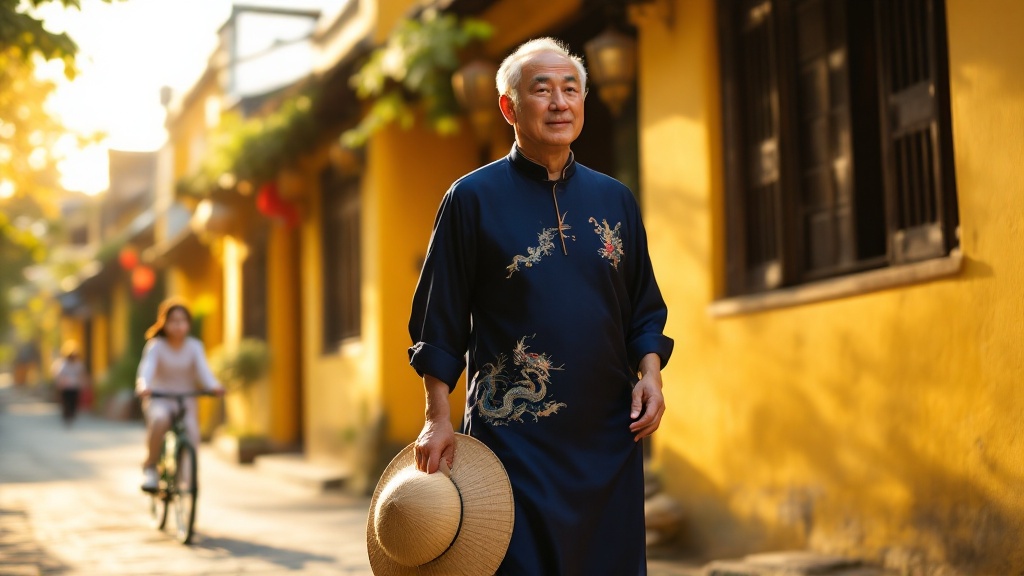
What is the traditional Vietnamese men's costume?
Many visitors confuse the terms. You will also hear about áo gấm (brocade tunic), áo the (dark fabric tunic), or áo nhật bình (four-panel tunic). These names refer to specific variants of the áo dài nam, used depending on the occasion and region.
Áo dài nam: the long tunic for men
The áo dài nam is a long tunic, slit on the sides, worn over loose trousers. The tunic generally falls below the knee, sometimes to the calves. The sleeves are long and loose. The collar is high but lower than on the female version.
Colors are sober: black, dark blue, gray, brown. For weddings, red and gold dominate. Patterns are discreet, often embroidered with dragons or stylized clouds.
Other names: áo gấm, áo the, áo nhật bình
Áo gấm is the brocade tunic, reserved for grand occasions. It is thicker, stiffer, and often adorned with complex embroidery. Grooms frequently wear it.
Áo the is a light tunic made of dark fabric (black or midnight blue). It was the daily attire for men before the 1970s. Today, it is mainly seen at religious ceremonies.
Áo nhật bình (four-panel tunic) is an older version, worn during the Nguyễn dynasty. It has four slits instead of two and a looser cut.
Key differences from the female áo dài
| Piece | Male version | Female version | Key difference |
|---|---|---|---|
| Tunic | Straight cut, not very fitted | Very fitted, hugs the curves | Men do not seek to accentuate their silhouette |
| Length | Below the knee | To the ankles | The male tunic is shorter |
| Collar | High, 2-3 cm | High, 4-5 cm | The male collar is lower |
| Sleeves | Loose, straight | Fitted | More freedom of movement for men |
| Trousers | Very wide, pleated | Wide but more fitted | Male trousers are more voluminous |
| Colors | Sober, dark | Bright, varied | Men avoid overly flashy colors |
History and origins of the Vietnamese men's costume
The Vietnamese men's costume has a less spectacular history than the female version. It has changed little since the 19th century. This stability is explained by its role: it had to be practical and conform to Confucian codes of male modesty.
Under the Nguyễn dynasty (1744-1945): the birth of the male áo dài
The first male áo dài appeared under the reign of Lord Nguyễn Phúc Khoát in the 18th century. He imposed a dress code to differentiate the Vietnamese from the Chinese. The five-panel tunic (áo ngũ thân) was born at this time. It symbolized the five Confucian virtues: humanity, justice, politeness, wisdom, and loyalty.
Under the Nguyễn emperors, the men's costume became a social marker. Mandarins wore colors according to their rank. Yellow was reserved for the emperor. Purple and dark blue were for high officials. Black and brown were for the common people.
French colonial influence on the cut
The French introduced Western cuts in the 1930s. The male áo dài gained simplicity. Excessive embroidery disappeared. The five-panel tunic gave way to the two-panel version, closer to the European jacket.
Vietnamese people adopted the Western-style white shirt and black trousers for daily wear. The áo dài nam became a ceremonial garment.
Why the men's costume remained more sober than the women's
The answer is cultural. In traditional Vietnamese society, men were expected to embody restraint and dignity. Bright colors and fitted cuts were considered feminine or ostentatious. This male sobriety has persisted to this day, even though younger generations are beginning to challenge it.
The pieces that make up the traditional men's outfit
A complete men's costume is not just the tunic. Here are the elements to know if you want to buy or rent an outfit.
The áo dài nam (long tunic)
This is the centerpiece. It closes on the right side with hidden buttons. The side slits go up to the waist to facilitate movement. The sleeves are set-in, never raglan. The lining is silk or light cotton.
The quần (loose trousers)
The trousers are wide, with an elastic or drawstring waist. They fall straight to the ankles. They are always the same color as the tunic or a lighter shade. Never darker.
The khăn đóng (traditional turban)
The turban is worn for formal ceremonies. It is a long strip of fabric (2 to 3 meters) wrapped around the head. The turban can be black, white, or the same color as the tunic. Putting it on correctly takes practice. Many modern men wear a pre-formed version.
Accessories: belt, shoes, fan
The silk belt (dây lưng) is worn at the waist, over the tunic. Shoes are black loafers or traditional sandals. The folding fan is a ceremonial accessory for weddings and ceremonies.
When is the traditional men's costume worn in Vietnam?
Occasions are limited but specific. Here are the situations where you will see men in áo dài nam.
Weddings: the groom's and guests' attire
The groom wears a silk or brocade áo dài nam, often red or gold. It is accompanied by a matching khăn đóng. Male guests wear a sober suit (blue, gray, black) or an áo dài depending on the formality.
Tết (Lunar New Year)
During Tết, men wear the áo dài nam for family visits and religious ceremonies. Traditional colors are red (luck) and yellow (prosperity). Many men opt for modernized versions (cách tân) that are more comfortable.
Religious ceremonies and funerals
For funerals, men wear a white or black áo dài, without any ornamentation. The turban is mandatory. Buddhist religious ceremonies require sober attire, often brown or gray.
Official and cultural events
Diplomats, artists, and professors wear the áo dài nam during national holidays, official receptions, and cultural performances. Some tour guides wear it as a uniform.
Daily wear: myth or reality?
No, the male áo dài has not been worn daily since the 1970s. Only a few artisans, elderly professors, and tourism sector employees wear it regularly. For daily life, Vietnamese men wear Western clothing.
How to dress for a Vietnamese wedding as a foreign guest?
This is the most common question from travelers invited to a Vietnamese wedding. Here are the rules to know.
Permitted and forbidden colors
| Color | Meaning | Appropriate use | Avoid for |
|---|---|---|---|
| Red | Luck, prosperity | Wedding, Tết | Funerals |
| White | Purity, mourning | Funerals, religious ceremonies | Wedding (bride's color) |
| Black | Sobriety, formal | Ceremonies, receptions | Wedding (too funereal) |
| Blue | Serenity | Wedding, official events | Funerals |
| Yellow | Royalty, prosperity | Tết, wedding | Daily use (too flashy) |
| Green | Nature, youth | Wedding, spring | Funerals |
Should a non-Vietnamese guest wear the áo dài?
A dark Western suit is perfectly acceptable. Wearing an áo dài is appreciated but not mandatory. If you decide to wear one, follow these rules:
- Choose a sober color (blue, gray, burgundy)
- Avoid all-white and all-black
- Wear it with matching trousers
- Do not wear a turban if you are not Vietnamese (it can be poorly perceived)
Ceremony attire vs. reception attire
The religious ceremony requires formal attire. The reception allows more freedom. Many guests wear a Western suit for the ceremony and change into an áo dài for the reception.
Where to buy or rent a costume for a wedding in Vietnam
In Hanoi, the Cửa Nam neighborhood specializes in traditional costumes. In Hoi An, all tailor shops offer the áo dài nam. In Ho Chi Minh City, Bến Thành Market has several stalls. Rental costs between 200,000 and 500,000 VND ($8 to $20 USD) per day.
Regional variants of the men's costume
The men's costume is not uniform across Vietnam. Each region has its particularities.
The Huế style: elegance of the ancient imperial capital
Huế is the birthplace of the most refined male áo dài. Tunics are made of light silk, with discreet embroidery on the cuffs and collar. Colors are pastel: sky blue, seafoam green, pearl gray. The turban is worn with particular elegance, leaving a panel of fabric protruding over the shoulder.
The Northern style (Hanoi): sobriety and refinement
In Hanoi, the male áo dài is stricter. Colors are dark (black, navy blue, charcoal gray). Embroidery is minimal. The cut is straight, almost military. The trousers are very wide. This is the most conservative style.
The Southern style (Ho Chi Minh City): modernity and color
In the South, the male áo dài is more relaxed. Colors are brighter (red, green, electric blue). Cuts are more fitted. Fabrics are lighter (linen, cotton). Young men often wear collarless versions or short sleeves.
Ethnic minority men's costumes (Hmong, Dao, Cham)
Ethnic minorities have their own men's costumes, very different from the áo dài nam. The Hmong wear tunics embroidered with geometric patterns, wide trousers, and conical hats. The Cham wear sarongs and short tunics. The Dao wear indigo blue tunics with sewn-on coins.
Áo dài nam vs. other traditional Asian costumes
Confusion is common between the áo dài nam and costumes from neighboring countries. Here is how to distinguish them.
Differences from the Chinese cheongsam
The male cheongsam (changshan) is a tunic without side slits or with very low slits. The collar is higher and straighter. It is worn with fitted trousers. The áo dài nam has side slits that go up to the waist and wide trousers.
Differences from the Korean hanbok
The male hanbok consists of a short jacket (jeogori) and wide trousers (baji). There is no long tunic. The hanbok is more colorful and looser than the áo dài nam.
Differences from the Japanese kimono
The male kimono is a T-shaped tunic, without side slits. It is closed with a wide belt (obi). The sleeves are very wide and square. The áo dài nam has set-in sleeves and a side closure.
Practical guide: buying or having a custom áo dài nam made
If you want to bring a costume back from Vietnam, here is everything you need to know.
Price of an áo dài nam in 2026 (VND and USD)
| Costume type | Min price (VND/USD) | Max price (VND/USD) |
|---|---|---|
| Simple cotton model | 800,000 VND ($32 USD) | 1,200,000 VND ($48 USD) |
| Solid silk model | 1,500,000 VND ($60 USD) | 2,000,000 VND ($80 USD) |
| Embroidered silk model | 2,500,000 VND ($100 USD) | 3,500,000 VND ($140 USD) |
| Brocade model (áo gấm) | 3,000,000 VND ($120 USD) | 5,000,000 VND ($200 USD) |
| Rental (1 day) | 200,000 VND ($8 USD) | 500,000 VND ($20 USD) |
The best neighborhoods to order: Hanoi, Huế, Hoi An, Ho Chi Minh City
Hanoi: Cửa Nam Street, the traditional tailor district. Moderate prices, reliable quality. Huế: Nguyễn Trãi Street, silk specialists. High prices, exceptional quality. Hoi An: Nguyễn Thái Học Street, tailors for tourists. Variable prices, uneven quality. Ho Chi Minh City: Bến Thành Market, costume stalls. Low prices, average quality.
Fabrics: silk, linen, brocade – which to choose?
Silk is the traditional choice. It is light, breathable, and elegant. Linen is more rustic and cheaper. Brocade is reserved for grand occasions. For everyday use, prefer silk or cotton.
Manufacturing time and measurements
Allow 2 to 5 days for a custom-made costume. Tailors take measurements on site. Bring a shirt you like to give the right proportions. Check the sleeve length and collar height before finalizing.
Renting vs. buying: options and rates
Renting is ideal for a wedding or ceremony. Hotels and travel agencies offer this service. Expect 200,000 to 500,000 VND ($8 to $20 USD) per day. The costume is cleaned and ironed before delivery.
How to wear and care for an áo dài nam
A traditional costume requires specific care.
The correct way to put on and adjust the outfit
Put on the trousers first, then the tunic. Fasten the buttons on the right side. Adjust the slits so they fall straight. The collar should be straight, without wrinkles. The turban is put on last. If you wear a pre-formed turban, secure it with invisible pins.
Fabric care: washing, ironing, storage
Wash the áo dài by hand or in the machine on a delicate cycle, at a maximum of 30°C. Use a mild detergent. Do not wring it out. Iron it at a low temperature, on the reverse side of the fabric. Store it on a padded hanger, away from light.
When NOT to wear the áo dài (cultural mistakes to avoid)
Do not wear the áo dài in the following situations:
- During a religious ceremony if you are not invited
- Without trousers underneath (the tunic is slit)
- With sports shoes
- In a disheveled version (open buttons, wrinkled collar)
- Wearing a turban if you are not Vietnamese (unless explicitly permitted)
Modern evolution: the áo dài nam cách tân
Younger generations are reinventing the men's costume.
Contemporary cuts and innovative materials
The áo dài cách tân (modernized) abandons the traditional cut. Sleeves are short or three-quarter length. The collar is replaced by a round or V-neck. Fabrics are technical (stretch cotton, blended linen). Colors are bright and patterns are contemporary.
The áo dài nam in Vietnamese streetwear fashion
Designers are integrating the áo dài into streetwear outfits. The tunic is worn open over a t-shirt and jeans. The slits are higher. Embroidery is replaced by graphic prints. This trend is popular among young Vietnamese in the diaspora.
Where to find cách tân models online and in Vietnam
Online, Vietnamese brands like Mai Lam, Chula, and Viet Mode offer modernized versions. In Vietnam, shops in Ho Chi Minh City (District 1, Lê Lợi Street) have the largest selections. Prices range from 500,000 to 2,000,000 VND ($20 to $80 USD).
Frequently asked questions about the Vietnamese men's costume
Q: What is the traditional Vietnamese men's costume called? A: The traditional Vietnamese men's costume is called the áo dài nam (long tunic for men). It consists of a long tunic slit on the sides, worn over loose trousers. Depending on the occasion, it can be completed with a turban (khăn đóng) and specific accessories.
Q: What is a man's traditional attire for a Vietnamese wedding? A: The groom typically wears a silk or brocade áo dài nam, often in red, gold, or dark blue, with matching trousers and a khăn đóng. Male guests can wear a sober-colored áo dài (blue, gray, black) or a Western suit depending on the wedding's formality.
Q: How should a foreigner dress for a wedding in Vietnam? A: A dark Western suit is perfectly acceptable for a foreign guest. Wearing an áo dài is appreciated but not mandatory. Avoid white (mourning color), all-black, and favor bright but not overly flashy colors. Always ask the couple for advice if you are unsure.
Q: What is the difference between the male and female áo dài? A: The male áo dài is more sober and less fitted than the female version. The male tunic generally falls below the knee (not to the ankles), the sleeves are looser, and the collar is lower. The male trousers are also wider. Colors and patterns are more discreet.
Q: Do Vietnamese men still wear the áo dài every day? A: No, the male áo dài has not been worn daily since the 1970s. It is reserved for special occasions: weddings, Tết, religious ceremonies, funerals, and official events. Some tourism sector employees (guides, hotel staff) may wear it as a uniform.
Q: Can I buy a custom-made áo dài nam in Vietnam? A: Yes, it is even recommended. Prices in 2026 range from 800,000 VND ($32 USD) for a simple cotton model to 3,000,000 VND ($120 USD) for an embroidered silk model. Allow 2 to 5 days for manufacturing. The best places are in Hoi An, Hanoi (Cửa Nam neighborhood), and Ho Chi Minh City.
Q: What is the meaning of the colors of the male áo dài? A: Red symbolizes luck and prosperity (wedding). White is associated with mourning and purity. Blue and green were historically worn by junior mandarins. Black is sober and formal. Yellow was reserved for royalty. Nowadays, the codes are more flexible, but red remains dominant for weddings.
Q: How to distinguish an áo dài nam from a Chinese cheongsam? A: The áo dài nam has side slits that go up to the waist, a high but lower collar than the cheongsam, and is always worn with wide trousers. The male cheongsam (changshan) is a tunic without side slits or with very low slits, with a higher, straighter collar, and is worn with more fitted trousers.
Editor's note: This guide is independent. We do not sell costumes and receive no commission from the tailors mentioned. Prices indicated are valid for 2026 and may vary according to season and negotiation.