What makes a train ride scenic in Vietnam?
Scenic means different things on different routes. In Vietnam, three main landscape types compete for your attention: coastal views where the track hugs cliffs above turquoise water, mountain passes where the train climbs through cloud forests, and countryside panoramas of rice terraces and farming villages.
But not every stretch delivers equally. Tunnel frequency matters. Time of day matters. Seasonality matters. A route that looks spectacular in February might be socked in by fog in November.
The three main contenders for the title are:
- Hue to Da Nang (the Hai Van Pass route) — 3 hours, coastal drama
- Da Nang to Quy Nhon — 6 hours, less crowded coastal scenery
- Hanoi to Lao Cai (the Sapa approach) — overnight journey with mountain views
Each has strengths and weaknesses. Here is how they compare.
The undisputed king: Hue to Da Nang (Hai Van Pass route)
This is the most famous scenic train segment in Vietnam, and for good reason. The 3-hour journey between Hue and Da Nang crosses the Hai Van Pass by rail, offering stunning views of Lang Co Bay, white sand beaches, and forested mountains plunging into the South China Sea.
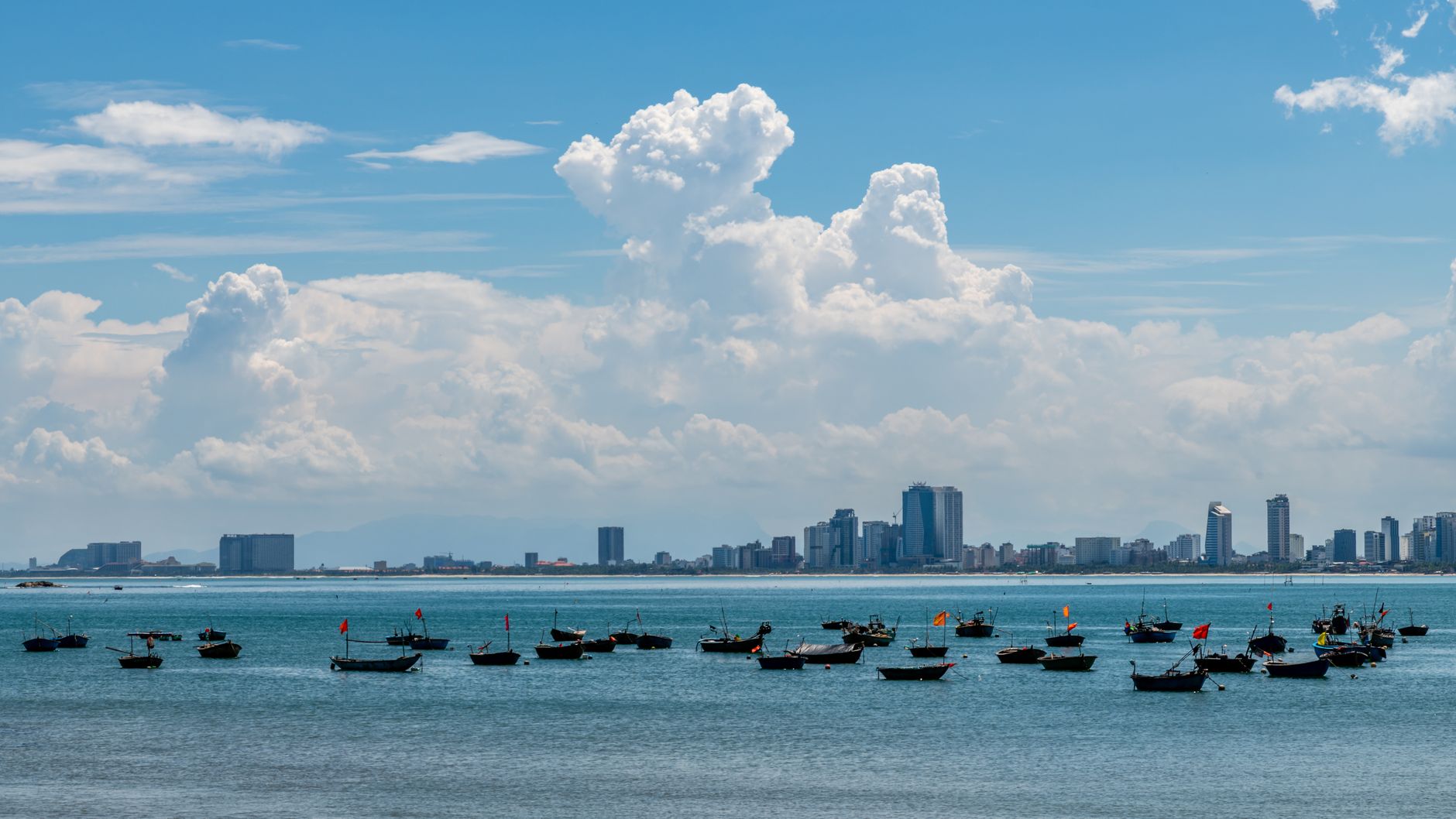
What you actually see: The train emerges from tunnels onto cliffside tracks with the ocean stretching to the horizon. Lang Co Bay appears as a perfect arc of white sand and palm trees. Fishing boats dot the water. Mountains rise on the inland side.
The tunnel problem: Most guides romanticize this route without mentioning the 30+ tunnels that block views for roughly 40% of the journey. You will experience repeated stretches of complete darkness, sometimes lasting several minutes. The views come in bursts between tunnels. This is still worth it, but adjust your expectations.
Seat selection strategy: For southbound trains (Hue to Da Nang), sit on the right side for ocean views. For northbound trains (Da Nang to Hue), sit on the left side. Request seats in carriages 1–4 for the best window placement. On most trains, these carriages are closest to the locomotive and offer the clearest views.
Train types and prices:
| Train type | Duration | Hard seat | Soft seat | Sleeper (6-bed) | Sleeper (4-bed) |
|---|---|---|---|---|---|
| Local train (TN) | 3.5–4 hours | 80,000 VND ($3) | 150,000 VND ($6) | N/A | N/A |
| Express train (SE) | 3 hours | 150,000 VND ($6) | 250,000 VND ($10) | 350,000 VND ($14) | 500,000 VND ($20) |
Best time of day: The 9:00 AM departure from Hue gives the best morning light over Lang Co Bay. The 1:00 PM departure offers good afternoon light but can be hazy. Avoid the last train of the day (around 5:00 PM) as the sun sets behind the mountains.
Pro tip: Book a soft seat on an express train. Hard seats are uncomfortable for 3 hours, and sleeper carriages feel cramped during daytime. Soft seats have reclining backs and clean windows.
Second contender: Da Nang to Quy Nhon (central coast)
This route is gaining popularity among repeat visitors who want coastal scenery without the crowds. The 6-hour journey from Da Nang to Quy Nhon passes through fishing villages, lagoons, and beaches that few tourists see.
What you actually see: The track runs close to the coast for most of the journey. You will pass through the fishing port of Tam Ky, the lagoons of Sa Huynh, and the long beaches of Binh Dinh province. The landscape is less dramatic than the Hai Van Pass but more consistently scenic with fewer tunnels.
Tunnel count: Only 8–10 tunnels on this route. Views are blocked far less frequently than on the Hue-Da Nang segment.
Ticket prices:
| Class | Price |
|---|---|
| Hard seat | 200,000 VND ($8) |
| Soft seat | 350,000 VND ($14) |
| Sleeper (6-bed) | 450,000 VND ($18) |
| Sleeper (4-bed) | 600,000 VND ($24) |
Best time of day: Morning departures from Da Nang (around 7:00–8:00 AM) give the best light. The sun will be behind you for most of the journey.
Warning: This route has fewer daily departures than Hue-Da Nang. Check schedules on dsvn.vn or 12Go.asia at least 3 days in advance.
Third contender: Hanoi to Lao Cai (the Sapa approach)
The overnight train from Hanoi to Lao Cai is the standard way to reach Sapa. The journey takes 8–9 hours, but only the final 3–4 hours offer scenic views as the train climbs into the mountains.
What you actually see: The first 4–5 hours from Hanoi are flat and unremarkable — rice paddies, small towns, and industrial areas. The scenery improves after Yen Bai station, where the track enters the foothills. The best views come in the last 2 hours: terraced rice fields, deep valleys, and glimpses of the Hoang Lien Son mountains.
Daytime vs overnight: Most travelers take the overnight train and miss the scenery entirely. For the best views, book a daytime departure. The LV (Lao Cai) train departs Hanoi at 6:00 AM and arrives at 2:30 PM. This gives you 3+ hours of mountain views in good light.
Ticket prices:
| Train type | Soft sleeper (4-bed) | Hard sleeper (6-bed) | VIP (2-bed) |
|---|---|---|---|
| Standard (SP3/SP4) | 600,000 VND ($24) | 450,000 VND ($18) | 900,000 VND ($36) |
| Tourist carriage (Livitrans, Chapa Express) | 800,000 VND ($32) | 600,000 VND ($24) | 1,500,000 VND ($60) |
Which train to choose: Tourist carriages (Livitrans, Chapa Express, Violette) offer cleaner cabins and better service than standard carriages. The price difference is worth it for overnight journeys. For daytime travel, standard soft seats are fine.
Pro tip: Book the lower bunk in a 4-bed cabin for overnight journeys. Upper bunks are cramped and harder to sleep in. The lower bunk costs slightly more but is worth it.
The Reunification Express: Hanoi to Ho Chi Minh City (full length)
The full Reunification Express takes 30+ hours and covers 1,726 km. Most travelers break it into segments. Here is an honest assessment of which sections are worth riding.
Scenic segments rated:
| Segment | Duration | What to see | Best direction | Rating (1–5) |
|---|---|---|---|---|
| Hanoi to Ninh Binh | 2 hours | Karst mountains, rice paddies | Southbound | 3/5 |
| Ninh Binh to Vinh | 4 hours | Flat farmland, factories | Either | 2/5 |
| Vinh to Dong Hoi | 3 hours | Mountains, rural villages | Southbound | 3/5 |
| Dong Hoi to Hue | 3 hours | Hai Van Pass approach, beaches | Southbound | 4/5 |
| Hue to Da Nang | 3 hours | Hai Van Pass, Lang Co Bay | Either | 5/5 |
| Da Nang to Quy Nhon | 6 hours | Coast, lagoons, fishing villages | Either | 4/5 |
| Quy Nhon to Nha Trang | 5 hours | Mountains, rural farmland | Either | 2/5 |
| Nha Trang to Phan Rang | 2 hours | Coastal views, beaches | Southbound | 4/5 |
| Phan Rang to Saigon | 5 hours | Flat, urban, industrial | Either | 1/5 |
The honest truth: Only 6–8 hours of the 30+ hour journey are truly scenic. The rest is flat farmland, industrial areas, or mountains with limited views. Do not ride the full Reunification Express expecting non-stop scenery.
Ticket prices for the full route:
| Class | Price |
|---|---|
| Hard seat | 900,000 VND ($36) |
| Soft seat | 1,200,000 VND ($48) |
| Sleeper (6-bed) | 1,500,000 VND ($60) |
| Sleeper (4-bed) | 2,000,000 VND ($80) |
| VIP (2-bed) | 2,500,000 VND ($100) |
Warning: The full journey is exhausting. Even in a sleeper cabin, the constant noise, heat, and movement make sleep difficult. Break the journey into 2–3 segments for a better experience.
Luxury options: The Vietage and other premium services
For travelers who want comfort alongside scenery, several luxury options exist.
The Vietage by Anantara: This luxury carriage runs between Da Nang and Quy Nhon. The 6-hour journey costs $300+ per person. You get gourmet meals, complimentary drinks, a spa treatment, and a private booth with large windows. The route covers the same coastal scenery as the standard train but in far more comfort.
Is it worth the money? For a special occasion or if you have the budget, yes. The food is excellent, the service is attentive, and the large windows offer unobstructed views. But regular first-class carriages on the same route cost a fraction of the price and offer similar views. The Vietage is a luxury experience, not a transport option.
Lady of the Lake (Da Lat): This luxury train runs from Da Lat to Trai Mat, a 30-minute journey through pine forests and coffee plantations. Tickets cost 150,000–300,000 VND ($6–$12). The carriages are restored French colonial-era trains with wooden interiors. The route is short but charming.
Other premium services: Some tourist trains on the Hanoi-Lao Cai route offer VIP carriages with private cabins, air conditioning, and meals included. These cost 1,500,000–2,500,000 VND ($60–$100) per person.
How to choose the right scenic train ride for your trip
Use this decision framework:
If you have 3 hours and want the most famous views: Choose Hue to Da Nang. Book a soft seat on an express train. Sit on the right side for southbound, left side for northbound.
If you have 6 hours and want consistent coastal scenery without crowds: Choose Da Nang to Quy Nhon. Book a soft seat or sleeper. Take a morning departure.
If you are heading to Sapa and want mountain views: Choose a daytime train from Hanoi to Lao Cai. Book a tourist carriage for comfort. Skip the overnight option if scenery matters.
If you have the budget and want a luxury experience: Choose the Vietage from Da Nang to Quy Nhon. Book 2–3 weeks in advance.
If you are riding the full Reunification Express: Break it into segments. Ride Hue-Da Nang and Da Nang-Quy Nhon for scenery. Fly or take the bus for the boring sections.
Practical tips for the best experience
Booking tickets: Book online through dsvn.vn (official site) or 12Go.asia (third-party with English support). Avoid booking through hotel concierges or street agents — scams are common. Book at least 3 days in advance for popular routes.
Seat selection: On dsvn.vn, you can select specific carriages and seats. Choose carriage 1–4 for the best window placement. For the Hue-Da Nang route, request seat numbers 1–4 (right side) or 5–8 (left side) depending on direction.
What to bring: Snacks (train food is mediocre), layers (air conditioning can be strong), motion sickness medication (the track is bumpy), a neck pillow (hard seats have no headrest), and wet wipes (bathrooms vary in cleanliness).
Photography tips: Clean your window before departure. Avoid midday glare (11:00 AM–2:00 PM). Use a fast shutter speed (1/500 or faster) to avoid motion blur. Shoot through open windows at stations for clearer shots.
Dealing with delays: Vietnamese trains run 15–60 minutes late on average. Build buffer time into your schedule. Do not book connecting transport within 2 hours of your scheduled arrival.
Safety, comfort, and what to expect
Cleanliness: Varies by class. Soft seats and sleeper cabins on express trains are clean. Hard seats on local trains can be dusty and worn. Tourist carriages on the Hanoi-Lao Cai route are the cleanest.
Bathrooms: Eastern-style squat toilets on most trains. Bring your own toilet paper and hand sanitizer. VIP carriages on luxury trains have western-style toilets.
Air conditioning: Works well on express trains and tourist carriages. Local trains may have unreliable AC. Bring a light jacket regardless.
Food: Vendors sell snacks and drinks on board. Prices are 20–30% higher than at stations. The noodle soup is edible but not memorable. Bring your own food for longer journeys.
Personal safety: Keep valuables close, especially on overnight trains. Lock your cabin door from inside. Do not leave phones or wallets on tables while sleeping. Pickpocketing happens on crowded trains, particularly on the Hanoi-Lao Cai route.
Warning: Do not accept food or drinks from strangers on overnight trains. There have been reports of drugged drinks leading to theft. Buy your own supplies.
Alternatives to the train: when not to take the scenic route
Trains are not always the best option. Consider alternatives in these situations:
Tight schedules: If you have only 2–3 days in Vietnam, flying saves significant time. A flight from Hanoi to Da Nang takes 1.5 hours and costs 500,000–1,500,000 VND ($20–$60). The train takes 15+ hours.
Large groups: Trains have limited seating in the same carriage. Groups of 4+ may need to split across multiple cabins. Private cars or minibuses are easier.
Mobility issues: Vietnamese train stations have limited accessibility. Steps are steep, platforms are uneven, and bathrooms are cramped. Travelers with mobility issues should consider private cars.
Rainy season (October–December): Coastal views are obscured by rain and fog during these months. The Hai Van Pass route is particularly affected. Consider flying or taking a bus instead.
Cost comparison:
| Route | Train (soft seat) | Flight | Private car (per person, 4 people) |
|---|---|---|---|
| Hanoi to Da Nang | 400,000 VND ($16) | 800,000 VND ($32) | 700,000 VND ($28) |
| Da Nang to HCMC | 800,000 VND ($32) | 600,000 VND ($24) | 1,000,000 VND ($40) |
| Hanoi to Lao Cai | 600,000 VND ($24) | 1,500,000 VND ($60) | 500,000 VND ($20) |
The train wins on scenic value but loses on speed and convenience. Choose based on your priorities.
FAQ
Q: What is the most scenic train ride in Vietnam?
A: The Hue to Da Nang segment (Hai Van Pass) is widely considered the most scenic, with 3 hours of coastal views, mountains, and beaches. However, the Da Nang to Quy Nhon route offers 6 hours of similar coastal scenery with fewer tourists. The answer depends on your time and budget.
Q: Is the train from Da Nang to Hoi An scenic?
A: There is no direct train to Hoi An. The closest station is Da Nang, and from there you need a taxi or bus for the remaining 30 km. The scenic train ride ends at Da Nang station.
Q: What is the best side to sit on for the Hue to Da Nang train?
A: For southbound trains (Hue to Da Nang), sit on the right side for ocean views. For northbound trains (Da Nang to Hue), sit on the left side. Request seats in carriage 1–4 for the best window placement.
Q: How much does the scenic train from Hue to Da Nang cost?
A: Prices range from 80,000 VND ($3) for a hard seat on a local train to 500,000 VND ($20) for a soft seat on an express train. Sleeper carriages cost 300,000–600,000 VND ($12–$24).
Q: Is the Vietage worth the money?
A: At $300+ per person for a 6-hour journey, the Vietage is a luxury experience with gourmet dining and spa treatments. Worth it for a splurge or special occasion, but regular first-class carriages offer similar views for a fraction of the price.
Q: What is the best time of year for scenic train rides in Vietnam?
A: February to August offers the clearest skies and best visibility on coastal routes. September to October is ideal for northern routes with green rice terraces. Avoid October to December for coastal routes due to rain and fog.
Q: How long is the most scenic part of the Reunification Express?
A: The most scenic sections total about 6–8 hours: Hue to Da Nang (3 hours), Da Nang to Quy Nhon (6 hours, partially scenic), and Nha Trang to Phan Rang (2 hours of coastal views). The rest of the 30+ hour journey is through flat farmland or mountains.
Q: Can I book specific seats on Vietnamese trains?
A: Yes, but it depends on the booking platform. Direct website bookings (dsvn.vn) allow seat selection. Third-party sites like 12Go.asia offer carriage and seat requests. For the best views, book soft seats in the first carriages (closest to the locomotive).