What you need to know before visiting a floating market in Vietnam
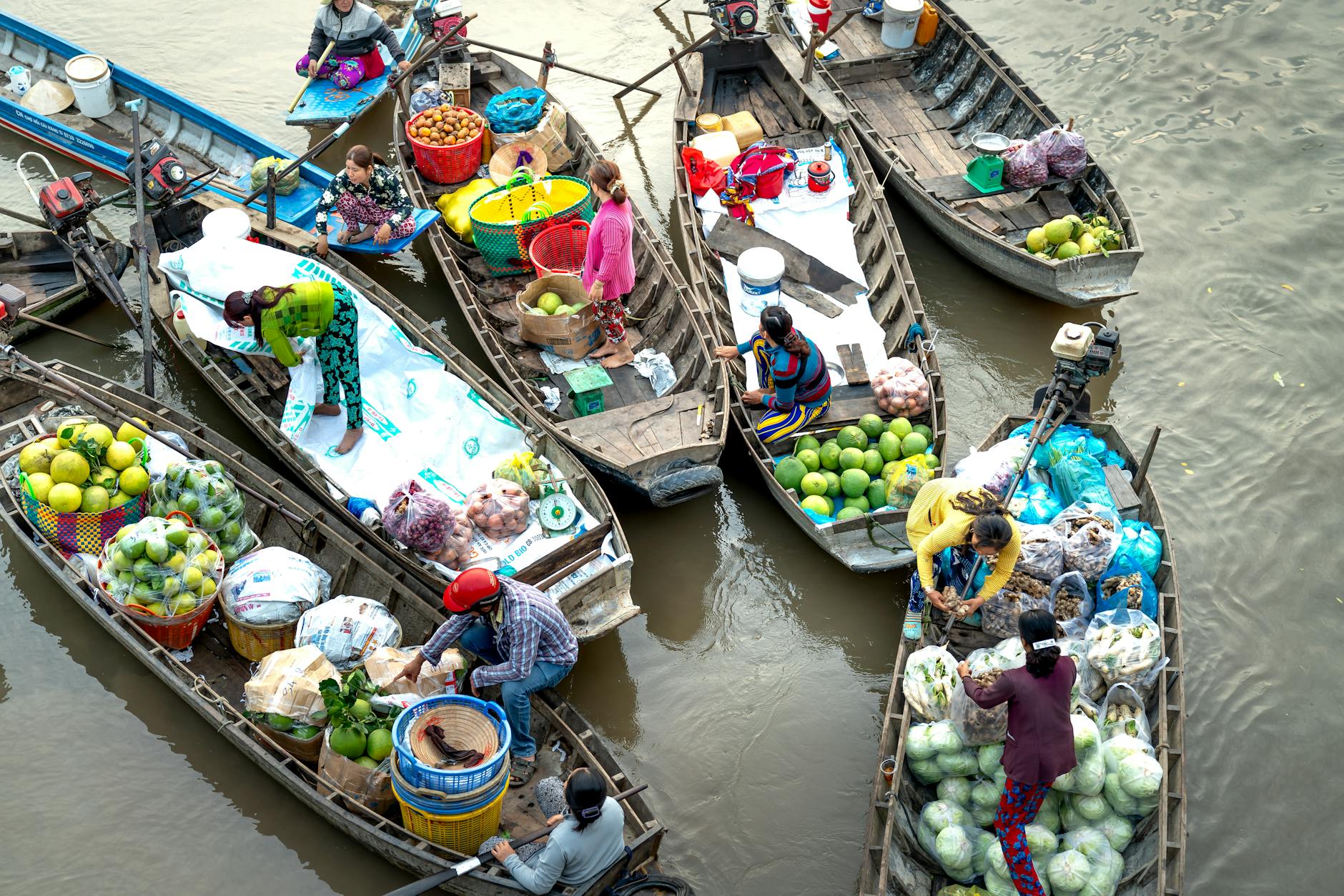
Floating markets, called chợ nổi in Vietnamese, were born from the river network of the Mekong Delta. For decades, locals exchanged fruits, vegetables, and goods directly on the water due to a lack of passable roads. Boats served as both shops and means of transport.
Today, the reality has changed. The construction of roads and land-based markets has reduced the number of merchant boats. Some markets have become tourist attractions. Others retain an authentic character, but they are more difficult to access.
This guide clearly distinguishes markets where you will see real commercial exchanges from those where you will only see tourists and souvenir vendors.
The 5 main floating markets of the Mekong Delta compared
Cai Rang Floating Market (Can Tho) — The most famous
Cai Rang is the most well-known floating market in Vietnam. Located 6 km from Can Tho city center, it attracts hundreds of tourists every morning.
What is actually sold there: exotic fruits (durian, mangosteen, rambutan), vegetables, and some prepared dishes. Large merchant boats display a long pole with products hanging from it, signaling what they are selling.
Tourist crowds: between 6 AM and 8 AM, dozens of tourist boats converge on the same spot. Postcard photos show a lively market. The reality is a crowd of motorboats circling around the few remaining merchant boats.
Pro tip: Cai Rang has lost about 70% of its merchant boats in ten years. If you want to see a real trading market, arrive before 6:30 AM and don't get distracted by the souvenir boats.
Prices: private boat rental from Can Tho: 400,000-600,000 VND (16-24 USD) for 2 hours. Fruits cost 30 to 50% more than at the land market.
Phong Dien Floating Market (Can Tho) — The authentic alternative
Phong Dien is located 20 km southwest of Can Tho. Less known than Cai Rang, it offers a more authentic experience.
What sets it apart: the boats are smaller, the sellers are mostly locals trading among themselves. Tourists are rare, especially on weekdays. The market starts around 4:30 AM and is in full swing between 5 AM and 7 AM.
Direct comparison with Cai Rang: Phong Dien has fewer boats (about 50 compared to 150 at Cai Rang), but the proportion of real merchants is higher. You will see actual transactions, not demonstrations for tourists.
Warning: The Phong Dien market ends earlier. If you arrive after 8 AM, there is almost nothing left. Plan to leave Can Tho at 5 AM.
Access: taxi or Grab from Can Tho: 200,000-300,000 VND (8-12 USD). Boat rental on site: 300,000-500,000 VND (12-20 USD).
Tra On Floating Market (Vinh Long) — The little-known one
Tra On is a small preserved market, located 30 km from Vinh Long and 40 km from Can Tho. It is almost exclusively frequented by locals.
Target audience: travelers seeking absolute authenticity, willing to make a detour. The market has about twenty boats, mainly traders supplying the surrounding villages.
Disadvantages: difficult to access, few tourist infrastructures, no English-speaking guides on site. You must negotiate directly with local boatmen.
Pro tip: Combine Tra On with a visit to the floating orchards of Vinh Long. Some boatmen offer tours including both.
Nga Bay Floating Market (Phung Hiep) — The largest in the delta
Nga Bay, also called Phung Hiep, is the largest floating market in the delta. It is a wholesale market where traders come to stock up.
Specifics: the boats are larger, loaded with tons of products. The atmosphere is industrial, not picturesque. The market is active 24/7, but the peak activity is between midnight and 4 AM.
Why visit it: to see the real economy of the delta, far from tourist clichés. Note that access is difficult from Can Tho (2 hours by road) and there are no tourist infrastructures.
Cai Be Floating Market (Tien Giang) — The semi-touristy one
Cai Be is located 2 hours by road from Ho Chi Minh City, making it the most accessible floating market from Saigon.
Advantages: easy to access, included in most day tours from HCMC. You can visit it without an overnight stay.
Disadvantages: the experience is very touristy. Authentic merchant boats have almost disappeared, replaced by restaurant boats and souvenir shops. Prices are inflated.
Warning: "Floating market" tours from HCMC almost always take you to Cai Be, not Cai Rang. Check before booking.
How to choose the right floating market based on your profile
| Market | Authenticity (1-5) | Tourist Crowds | Relative Prices | Visit Duration | Accessibility |
|---|---|---|---|---|---|
| Cai Rang | 2/5 | Very high | High | 2-3h | Easy (Can Tho) |
| Phong Dien | 4/5 | Low | Medium | 1-2h | Moderate (20 km Can Tho) |
| Tra On | 5/5 | Very low | Low | 1h | Difficult |
| Nga Bay | 3/5 | Very low | Low | 1h | Very difficult |
| Cai Be | 1/5 | High | Very high | 1-2h | Easy (2h from HCMC) |
Decision tree:
- Do you have one day from HCMC? Choose Cai Be, but accept the compromise on authenticity.
- Are you spending a night in Can Tho? Choose Cai Rang in the morning, then Phong Dien if you have time.
- Are you looking for absolute authenticity? Tra On or Nga Bay, but plan a full day.
- Do you have a tight budget? Phong Dien, with public transport and a shared boat.
Practical guide for organizing your visit
Best time to visit a floating market
The dry season (December to May) offers the best conditions. The waters are calm, the sky is clear. The rainy season (June to November) makes travel more difficult, but the markets are less crowded.
Optimal hours: between 5:30 AM and 8:00 AM. After 9 AM, activity declines sharply and the heat becomes difficult. Some boats leave as early as 7 AM.
Pro tip: Avoid Vietnamese public holidays (Tet, April 30, September 2). Markets are closed or packed with local tourists.
How to get there from Ho Chi Minh City or Can Tho
From HCMC to Can Tho:
| Option | Duration | Cost (VND/USD) | Comfort | Flexibility |
|---|---|---|---|---|
| Public bus | 4h | 120,000-180,000 VND (5-7 USD) | Medium | Low |
| Private car | 3h30 | 800,000-1,200,000 VND (32-48 USD) | High | High |
| Plane + taxi | 1h30 | 1,500,000-2,500,000 VND (60-100 USD) | Very high | Medium |
From Can Tho to the markets:
For Cai Rang, take a taxi or Grab (50,000-80,000 VND, 2-3 USD). For Phong Dien, expect 200,000-300,000 VND (8-12 USD) by taxi. For Tra On or Nga Bay, rent a car for the day (800,000-1,200,000 VND, 32-48 USD).
Warning: Taxi drivers in Can Tho may offer "floating market tours" at inflated prices. Always use Grab to compare rates.
Estimated budget for a visit
| Expense Item | Cai Rang (VND/USD) | Phong Dien (VND/USD) | Tra On (VND/USD) |
|---|---|---|---|
| Round-trip transport from Can Tho | 100,000-200,000 (4-8 USD) | 200,000-400,000 (8-16 USD) | 500,000-800,000 (20-32 USD) |
| Boat rental (private) | 400,000-600,000 (16-24 USD) | 300,000-500,000 (12-20 USD) | 200,000-400,000 (8-16 USD) |
| Boat rental (shared) | 150,000-250,000 (6-10 USD) | 100,000-200,000 (4-8 USD) | Not available |
| Meals and drinks | 100,000-200,000 (4-8 USD) | 50,000-100,000 (2-4 USD) | 30,000-50,000 (1-2 USD) |
| Purchases (fruits) | 50,000-150,000 (2-6 USD) | 30,000-80,000 (1-3 USD) | 20,000-50,000 (1-2 USD) |
What you can really buy and taste at a floating market
Typical Mekong fruits and vegetables
Floating markets are primarily fruit markets. Here is what you will actually find:
| Fruit | Season | Indicative Price (VND/kg) |
|---|---|---|
| Durian | May-August | 40,000-80,000 (1.6-3.2 USD) |
| Mangosteen | May-September | 30,000-60,000 (1.2-2.4 USD) |
| Rambutan | May-August | 15,000-30,000 (0.6-1.2 USD) |
| Jackfruit | Year-round | 20,000-40,000 (0.8-1.6 USD) |
| Dragon fruit | May-October | 20,000-50,000 (0.8-2 USD) |
| Lychee | May-July | 30,000-60,000 (1.2-2.4 USD) |
Pro tip: Prices are negotiable, but don't go below 50% of the quoted price. Sellers are poor and aggressive haggling is frowned upon.
Culinary specialties not to be missed
Several boats prepare dishes directly on the water. The most common:
- Hu tieu: pork noodle soup, 20,000-30,000 VND (0.8-1.2 USD)
- Banh mi: Vietnamese sandwich, 15,000-25,000 VND (0.6-1 USD)
- Cà phê sữa đá: iced coffee with condensed milk, 10,000-20,000 VND (0.4-0.8 USD)
- Bánh xèo: crispy pancake with pork and shrimp, 20,000-40,000 VND (0.8-1.6 USD)
Hygiene tips: boats that prepare hot dishes are generally safe. Avoid pre-cut fruits that have been sitting in the sun. Only drink bottled beverages or coffee prepared in front of you.
Tourist traps and how to avoid them
Overcharging and aggressive haggling
Prices at floating markets are often multiplied by 3 or 4 for foreigners. Common techniques:
- Quoting a price in US dollars instead of dong
- Offering "discovery packages" with poor-quality fruits
- Selling Chinese-made souvenirs as "local handicrafts"
Strategies for negotiating:
- Know the prices before you arrive (see the table above)
- Make a firm offer and stay polite
- If the price doesn't suit you, say "cảm ơn" (thank you) and walk away
- Use small bills to avoid receiving change in low-value notes
Misleading "all-inclusive" tours
Many agencies in HCMC offer "authentic floating market tours." The reality is often different:
- The tour takes you to Cai Be, not Cai Rang
- You spend more time in partner shops than at the market
- The "local guide" takes you to sellers who give them a commission
Warning: If an agency promises an "authentic floating market" for less than 500,000 VND (20 USD), be wary. Transport alone already costs that much.
Practical tips for a successful visit
What to bring
What to pack:
- SPF 50+ sunscreen (the sun is relentless on the water)
- Wide-brimmed hat
- Mosquito repellent (mosquitoes are active in the morning)
- Light but covering clothing (avoid too-short shorts)
- Waterproof camera (splashes are frequent)
- Reusable water bottle
Why avoid flip-flops: boats have slippery surfaces. A good pair of closed-toe sandals is safer.
Safety and health on the water
Real risks are limited but exist:
- Sunburn: the reflection on the water doubles exposure
- Dehydration: drink regularly, even if you don't feel thirsty
- Falling in the water: stay seated in the boat, don't lean over
- Water quality: do not touch the river water; it is polluted
Pro tip: If you fall in the water, get out immediately and change clothes. Mekong water contains bacteria that can cause skin infections.
Impact of tourism on floating markets — Trends and issues
Floating markets are changing rapidly. Here are the trends observed in 2026:
Decline in merchant boats: Cai Rang has lost 70% of its boats in ten years. Traders prefer to sell at land markets, which are more convenient and less exposed to weather.
Increase in tourist boats: at Cai Rang, tourist boats are now more numerous than merchant boats. Some days, the ratio is 5 tourists to 1 merchant.
Change in commercial practices: authentic sellers are replaced by traders targeting tourists. Prices rise, quality drops.
What to do as a responsible traveler:
- Visit less crowded markets (Phong Dien, Tra On)
- Buy directly from local sellers, not intermediaries
- Don't haggle aggressively over small purchases
- Don't take photos without asking permission
- Support tours organized by local operators who give back a portion of profits to communities
Alternatives to floating markets in the Mekong Delta
If you want to vary your water-based experiences:
Night floating markets: rare, but some exist around Can Tho. They are mainly frequented by fishermen.
Floating villages: visit villages on stilts or on boats. You will see the daily life of delta inhabitants.
Orchards on the Mekong islands: islands like An Binh (Vinh Long) or Thoi Son (Tien Giang) offer orchard visits with fruit tastings.
Pro tip: Combine a floating market in the morning with an orchard visit in the afternoon. It's the best way to discover the delta without exhausting yourself.
FAQ
Q: What is the most beautiful floating market in Vietnam?
A: There is no single answer. Cai Rang is the most photogenic but the most touristy. Phong Dien offers the best balance between authenticity and accessibility. Tra On is the most preserved but difficult to access. The "most beautiful" depends on what you are looking for: photos, authenticity, or tranquility.
Q: What is the largest floating market in Vietnam?
A: The Nga Bay (Phung Hiep) market is the largest in the delta, but it is a wholesale market, not a tourist attraction. Cai Rang is the largest tourist market.
Q: What time should you visit a floating market?
A: Between 5:30 AM and 8:00 AM. After 9 AM, activity declines sharply and the heat becomes difficult. Some boats leave as early as 7 AM.
Q: How much does a floating market visit cost?
A: Estimated total budget between 500,000 and 1,500,000 VND (20-60 USD) per person including transport, boat rental, and meals. Less touristy markets cost less.
Q: Can you visit a floating market without an agency?
A: Yes, especially for Cai Rang and Phong Dien. Take a public bus to Can Tho, then negotiate a water taxi on site. You will save 30 to 50% compared to organized tours.
Q: Which floating market should I choose for a half-day trip from HCMC?
A: Cai Be is the most accessible (2 hours by road), but the experience is very touristy. For a full day, prioritize Cai Rang with an overnight stay in Can Tho.
Q: Are floating markets still authentic in 2026?
A: Some are (Phong Dien, Tra On), others are not (Cai Rang is becoming an attraction). The trend is towards fewer real merchants and more tourist boats. To find authenticity, stay away from organized tours and visit early in the morning.