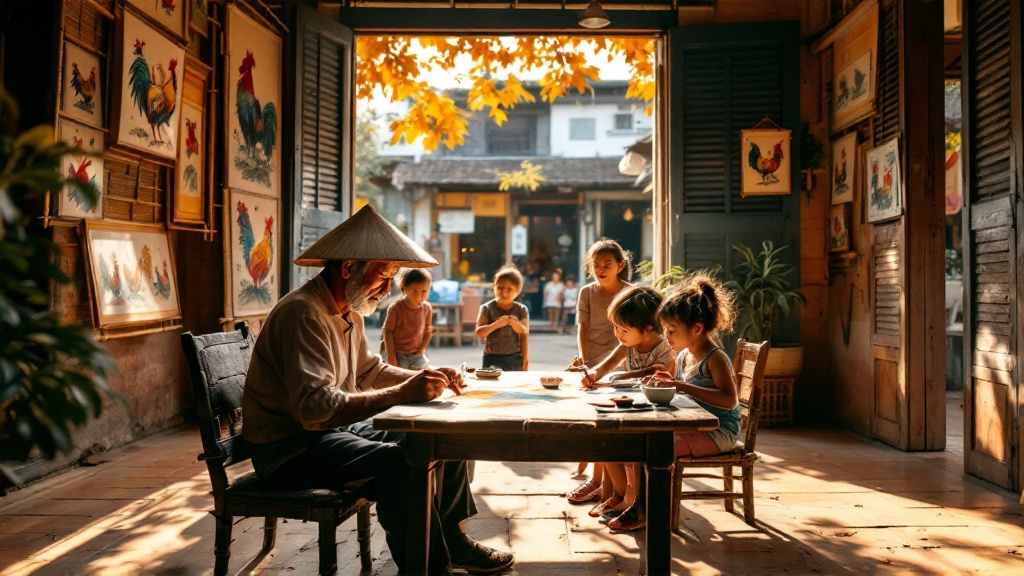
This guide explains exactly what dong ho painting is, why it matters, and how to experience it firsthand in 2026.
What is dong ho painting? A complete definition
Dong ho painting (tranh Dong Ho) is a traditional Vietnamese woodblock print folk art that originated in Dong Ho village, Bac Ninh province. The village sits about 30 km northeast of Hanoi in the Red River Delta.
The art form belongs to the broader category of Vietnamese folk painting (tranh dan gian). It differs from other Vietnamese painting traditions in several key ways. Silk painting and lacquer painting are fine art forms created by individual artists. Dong ho is a reproducible craft with standardized designs passed down through artisan families.
Hang Trong paintings from Hanoi use a single woodblock for outlines only, with colors hand-painted later. Dong ho uses multiple woodblocks, one for each color layer. This makes each print a true multi-block print rather than a hand-colored outline.
The history of dong ho painting: From village craft to national treasure
Dong ho painting traces its origins to the 17th century during the Le dynasty. The craft developed in Dong Ho village, where families specialized in papermaking, wood carving, and printing. For generations, these skills passed from parent to child within the same households.
The paintings served multiple purposes in traditional Vietnamese society. Families displayed them during Tet (Lunar New Year) for good luck. They decorated communal houses and temples. They also served as social commentary, using humor and satire to critique corrupt officials and social injustice.
The near-extinction came after 1975 during the subsidy period (bao cap). The government restricted private craft production. Many artisans stopped practicing. By the 1990s, only a handful of families continued the tradition.
Revival efforts began in the late 1990s. Researchers documented techniques. The government provided support. UNESCO recognized dong ho painting as an intangible cultural heritage element. Despite these efforts, the craft remains endangered.
How dong ho paintings are made: The complete process
The production process involves multiple stages, each requiring specific skills and materials.
Preparing the paper (gio diep paper)
The base material is handmade paper from the bark of the do tree (Rhamnoneuron balansae). This tree grows in northern Vietnam and produces long, strong fibers.
The crucial step is the coating process. Artisans crush white seashells (diep) into a fine powder. They mix this with cooked glutinous rice paste and water. The mixture is applied to the paper surface with a brush.
This coating creates a glossy, durable surface that resists moisture and insects. It also gives the paper its characteristic sheen and slight roughness. The coated paper takes about 24 hours to dry before it is ready for printing.
Carving the woodblocks
Each color requires a separate woodblock. A typical painting uses 4 to 7 blocks. One block for each color plus the black outline block.
The wood comes from jackfruit or pear trees. These woods are dense enough to hold fine details but soft enough to carve easily. Artisans carve the blocks in reverse, so the printed image appears correctly.
The black outline block is the most detailed. It defines the shapes and contours of the image. The color blocks are simpler, covering larger areas with solid tones.
Mixing natural colors
Traditional dong ho uses only natural pigments. Each color comes from a specific source material.
| Color | Vietnamese name | Source material | Preparation method |
|---|---|---|---|
| Black | Den | Charred bamboo leaves or burnt straw | Burn leaves to ash, grind with water |
| Red | Do | Red clay (son) or crushed laterite stone | Grind stone to powder, mix with binder |
| Blue | Xanh | Copper rust or indigo leaves | Scrape rust from copper, soak leaves |
| Green | Luc | Cajuput leaves or copper carbonate | Crush leaves, extract juice |
| Yellow | Vang | Turmeric or gardenia fruit | Grate turmeric, boil fruit |
| White | Trang | Crushed eggshells or seashell powder | Grind shells to fine powder |
| Orange | Cam | Jackfruit wood resin | Extract resin, dry and grind |
These natural pigments produce slightly uneven, muted tones. This is a hallmark of authentic dong ho. Synthetic dyes create bright, uniform colors that signal a reproduction.
Printing the layers
Printing follows a specific order. The lightest colors go first. The darkest colors come later. The black outline is always printed last.
The artisan applies water-based natural dye to the woodblock using a brush. The coated paper is placed on the block. Pressure is applied by hand or with a palm-leaf brush.
Each layer must dry completely before the next color is applied. A 4-color painting takes 3 to 5 days to complete. Complex pieces with 7 colors can take 1 to 2 weeks.
The most famous dong ho paintings and their meanings
Dong ho paintings cover a range of subjects from everyday village life to spiritual symbols and social satire.
"Rat's wedding" (Chuot len chuc tet)
This is the most famous dong ho painting. It shows rats carrying offerings to a cat. The scene satirizes corruption and bribery in feudal Vietnamese society. Low-ranking officials had to pay tribute to superiors. The painting uses humor to critique social injustice.
"Gathering coconuts" (Hai dua)
A woman climbs a coconut tree. The painting symbolizes fertility and the ideal of a hardworking wife. It reflects traditional gender roles in Vietnamese village society.
"Jealousy" (Ganh ghen)
A husband caught between two wives. The painting humorously depicts polygamy in traditional Vietnamese society. It remains popular for its relatable domestic comedy.
"Wrestling" (Dau vat)
Village wrestling matches represent strength, masculinity, and community spirit. These tournaments were major events in rural life.
"The carp" (Ca chep)
A carp swimming upstream to become a dragon. This is a Confucian symbol of perseverance and success in exams. It was traditionally given to students before examinations.
"Mother and piglets" (Lon dan)
One of the most popular household decorations. It symbolizes prosperity, abundance, and family unity. Many families display this painting during Tet.
"Vinh Hoa" (Prosperity and glory)
A rooster and peony flowers. The rooster represents wealth and success. The peony symbolizes good fortune. This painting is popular for business openings and New Year celebrations.
What makes dong ho painting unique compared to other Vietnamese art forms
Understanding the differences helps travelers identify authentic dong ho and appreciate its craftsmanship.
Dong ho vs. Hang Trong paintings
Hang Trong paintings come from Hanoi's Hang Trong street. They use a single woodblock for outlines only. Colors are hand-painted, not printed. This gives Hang Trong paintings a softer, more painterly appearance. Dong ho uses multiple blocks for each color layer, creating sharper edges and more consistent color.
Dong ho vs. Kim Hoang paintings
Kim Hoang paintings come from Ha Tay province. They use brighter colors and more Chinese-influenced motifs. The paper is coated differently, producing a glossier surface. Dong ho uses subtler, earthier tones and more distinctly Vietnamese subject matter.
Dong ho vs. modern Vietnamese paintings
Modern paintings (oil, acrylic, lacquer) are individual artistic expressions. Each piece is unique. Dong ho is a reproducible folk craft with standardized designs passed down through families. The value lies in the craftsmanship and materials, not in originality of composition.
Where to see authentic dong ho paintings in Vietnam
Several locations offer opportunities to see genuine dong ho paintings.
Dong Ho village (Lang Dong Ho), Bac Ninh province
This is the birthplace of the art form. The village is located in Song Ho commune, Thuan Thanh district, about 30 km northeast of Hanoi.
Getting there takes about 45 minutes by motorbike. Taxis and private cars also work. Public buses from Hanoi's Gia Lam bus station go to Thuan Thanh town, from where you can take a xe om (motorbike taxi) to the village.
The best time to visit is during Tet (Lunar New Year) when the village holds special exhibitions. The rest of the year, the village is quiet. Not all households are open to visitors. Call ahead or arrange a guide.
The village has 10 to 15 active artisan households. A communal house (dinh) displays paintings. A small museum shows historical pieces and tools.
Honest advice: The village is small and rural. Do not expect a polished tourist attraction. The experience is about meeting artisans and seeing real workshops.
Vietnam National Museum of Fine Arts, Hanoi
Address: 66 Nguyen Thai Hoc, Ba Dinh district. The museum houses a permanent collection of dong ho paintings, including rare 19th-century examples. Entry fee is 40,000 VND ($1.70 USD).
Vietnamese Women's Museum, Hanoi
Address: 36 Ly Thuong Kiet, Hoan Kiem district. The museum features dong ho paintings in its folk art collection.
Temple of Literature, Hanoi
The Van Mieu-Quoc Tu Giam complex sometimes hosts temporary exhibitions of folk paintings. Check the schedule before visiting.
Hoi An and other tourist centers
Many souvenir shops sell reproductions. Authenticity varies widely. See the buying guide section for how to identify genuine pieces.
How to identify authentic dong ho paintings (buying guide)
Travelers who want to purchase genuine pieces need to know what to look for.
Signs of authenticity
Paper texture: Authentic gio diep paper has a rough, matte surface with visible shell fragments. It should not feel smooth or glossy like machine-made paper.
Color quality: Natural pigments produce slightly uneven, muted tones. Bright neon colors indicate synthetic dyes.
Smell: Genuine paintings have a faint earthy smell from the natural materials. Chemical smells suggest modern reproductions.
Back of the paper: The characteristic shell coating should be visible on the back. It looks like a thin white layer with small fragments.
Price: Authentic pieces from artisans cost 200,000 to 1,000,000 VND ($8 to $40 USD) depending on size and complexity. Very cheap paintings are almost certainly reproductions.
What to avoid
Machine-printed reproductions on glossy paper are common in tourist markets. Paintings with bright neon colors use synthetic dyes. "Framed" paintings under glass are not traditional. Dong ho is displayed without glass. Sellers who cannot name the artisan or village are likely selling reproductions.
How to buy ethically
Purchase directly from artisans in Dong Ho village when possible. At craft markets, ask for the village of origin. Support social enterprises that work with Dong Ho artisans. Avoid bargaining too aggressively. These are handmade pieces supporting a declining craft.
The current state of dong ho painting: A craft at risk
The situation is serious. The number of active artisan families has declined from dozens to fewer than 10. The younger generation shows limited interest in learning the craft. The work is labor-intensive and not financially rewarding.
Competition from cheap machine-printed reproductions makes it harder for artisans to sell authentic pieces. Loss of natural pigment sources also threatens the tradition. Do trees have become less common. Specific minerals are harder to find.
Notable surviving artisan families include the Nguyen family (Nguyen Dang Che, Nguyen Huu Sam) and the Doan family. These families continue to produce authentic dong ho and train apprentices.
Government and UNESCO preservation programs are working to revive the tradition. But the number of active practitioners continues to decline. Visiting the village and buying authentic pieces directly supports the remaining artisans.
How to experience dong ho painting as a traveler
You can incorporate dong ho into your Vietnam itinerary in several ways.
Combine a visit to Dong Ho village with a trip to Bat Trang ceramic village. Both are in Bac Ninh province, about 15 km apart. A half-day trip from Hanoi can cover both.
Attend a woodblock printing workshop. Some artisan families offer hands-on classes for 100,000 to 200,000 VND ($4 to $8 USD) per person. You can print your own painting to take home.
Visit during Tet (Lunar New Year) when dong ho paintings are traditionally displayed in homes. The village holds special exhibitions during this period.
Look for dong ho motifs in contemporary Vietnamese design. Some hotels, restaurants, and fashion brands incorporate dong ho patterns into their decor and products.
Frequently asked questions about dong ho painting
Q: What is the traditional Vietnamese art form called dong ho painting?
A: Dong ho painting is a Vietnamese folk art form that uses woodblock printing on handmade do paper coated with crushed seashells. Originating in Dong Ho village (Bac Ninh province) over 300 years ago, these paintings use natural pigments from plants, minerals, and eggshells to depict village life, spiritual symbols, and satirical scenes.
Q: How long does it take to make a dong ho painting?
A: A complete dong ho painting takes several days to produce. The paper coating requires 24 hours to dry. Each color layer must dry before the next is applied. A typical 4-color painting takes 3 to 5 days. More complex pieces with 7 colors can take 1 to 2 weeks.
Q: Can I buy authentic dong ho paintings in Hanoi?
A: Yes, but authenticity varies. The Vietnam National Museum of Fine Arts gift shop sells verified pieces. Some craft shops in the Old Quarter carry genuine dong ho, but many sell machine-printed reproductions. For guaranteed authenticity, visit Dong Ho village directly or purchase from recognized artisan families.
Q: Are dong ho paintings still made today?
A: Yes, but the craft is endangered. Fewer than 10 artisan families in Dong Ho village continue the tradition. Notable surviving artisans include Nguyen Dang Che and Nguyen Huu Sam. Government and UNESCO preservation programs are working to train a new generation, but the number of active practitioners continues to decline.
Q: What is the meaning of the rat wedding dong ho painting?
A: "Rat's wedding" (Chuot len chuc tet) is a satirical painting showing rats carrying gifts to a cat. It critiques corruption and bribery in feudal Vietnamese society, where low-ranking officials had to pay tribute to superiors. The painting uses humor to comment on social injustice.
Q: How can I tell if a dong ho painting is authentic?
A: Check the paper texture (rough with visible shell fragments), color quality (muted natural tones, not bright), and smell (earthy, not chemical). The back should show the shell coating. Authentic pieces cost 200,000 to 1,000,000 VND ($8 to $40 USD). Machine-printed reproductions on glossy paper are the most common fakes.