What You Need to Know Before Visiting a Floating Market
The floating markets of the Mekong Delta have changed a lot. The reality in 2026 is simple: out of a dozen listed markets, only three or four retain real commercial activity. The others survive thanks to tourism or have nearly disappeared.
The operation is the same everywhere. Semi-wholesale boats arrive before dawn. Each vessel hangs a sample of its products at the end of a vertical pole. A boat with a pineapple at the top sells pineapples. Simple and effective.
The hours are strict. Activity starts around 4:30 AM, peaks between 5:30 AM and 7:30 AM, then declines rapidly. After 9:00 AM, only tourist boats and a few lingering vendors remain.
Practical tip: Arriving after 8:00 AM means accepting a degraded version of the market. The early wake-up is painful but necessary.
Several factors explain the decline of floating markets. Supermarkets and modern roads allow traders to buy and sell without going by water. Pollution of the Mekong complicates navigation. Climate change alters flood cycles. And COVID-19 accelerated the transition to land-based commerce.
The 3 Floating Markets Worth the Detour in 2026
Our selection is based on three criteria: real commercial activity, authenticity of the setting, and accessibility.
Cai Rang (Can Tho) — The Largest and Most Accessible
Cai Rang remains the most famous floating market in Vietnam, and for good reason. With hundreds of boats each morning, it is the most active in the delta.
The market is a semi-wholesale venue. Wholesalers sell fruits and vegetables to small resellers who ply the canals. You'll also find food boats preparing noodle soups, coffee, and donuts.
Location: 6 km from Can Tho city center, on the Hau River. Hours: Peak activity from 5:30 AM to 7:30 AM. The market remains calm until 9:00 AM. What you'll find: Tropical fruits (mangoes, durians, rambutans, watermelons), vegetables, coffee, breakfast on the water. Tourist level: High. Expect tourist boats and vendors who speak a few words of English.
Boat rental: Expect 300,000 to 500,000 VND (12 to 20 USD) per hour for a private boat. Organized tours charge 30 to 50 USD per person.
How to avoid scams: Negotiate the price before boarding. Refuse forced stops at coconut candy workshops or orchards where entry is overpriced. Specify that you only want the market.
Warning: Some boatmen add unsolicited stops to inflate the price. Set the itinerary and duration before departing.
What to do after the visit: Cai Rang market is easily combined with a visit to the My Khanh orchards or the Can Tho land market. See our complete guide on Can Tho and the Floating Markets.
Long Xuyen (An Giang) — Preserved Authenticity
Long Xuyen is the most authentic floating market in Vietnam in 2026. Very few tourists. Real commercial activity. Boats loaded with goods negotiating between professionals.
The market is held on the Hau River, upstream from Can Tho. The atmosphere is radically different from Cai Rang. Here, no food boats offering you coffee at 5 USD. No souvenir vendors. Just traders working.
Location: On the Hau River, at the level of Long Xuyen city. Hours: Stricter than Cai Rang. Activity starts at 4:30 AM and decreases sharply after 7:00 AM. By 8:00 AM, the market is almost empty. What you'll find: Fruits, vegetables, fish, local artisanal products. Tourist level: Very low. You will likely be the only tourist.
Access: Long Xuyen is 2 hours by road from Can Tho. Accommodation options on site are limited. Plan a day trip from Can Tho.
Culinary specialties: Don't miss the bun ca (fish soup) and banh xeo (crispy pancake) prepared on the boats.
Phong Dien (Can Tho) — The Ideal Compromise
Phong Dien is the floating market everyone should visit. Less known than Cai Rang, more active than declining markets, it offers a perfect balance between authenticity and accessibility.
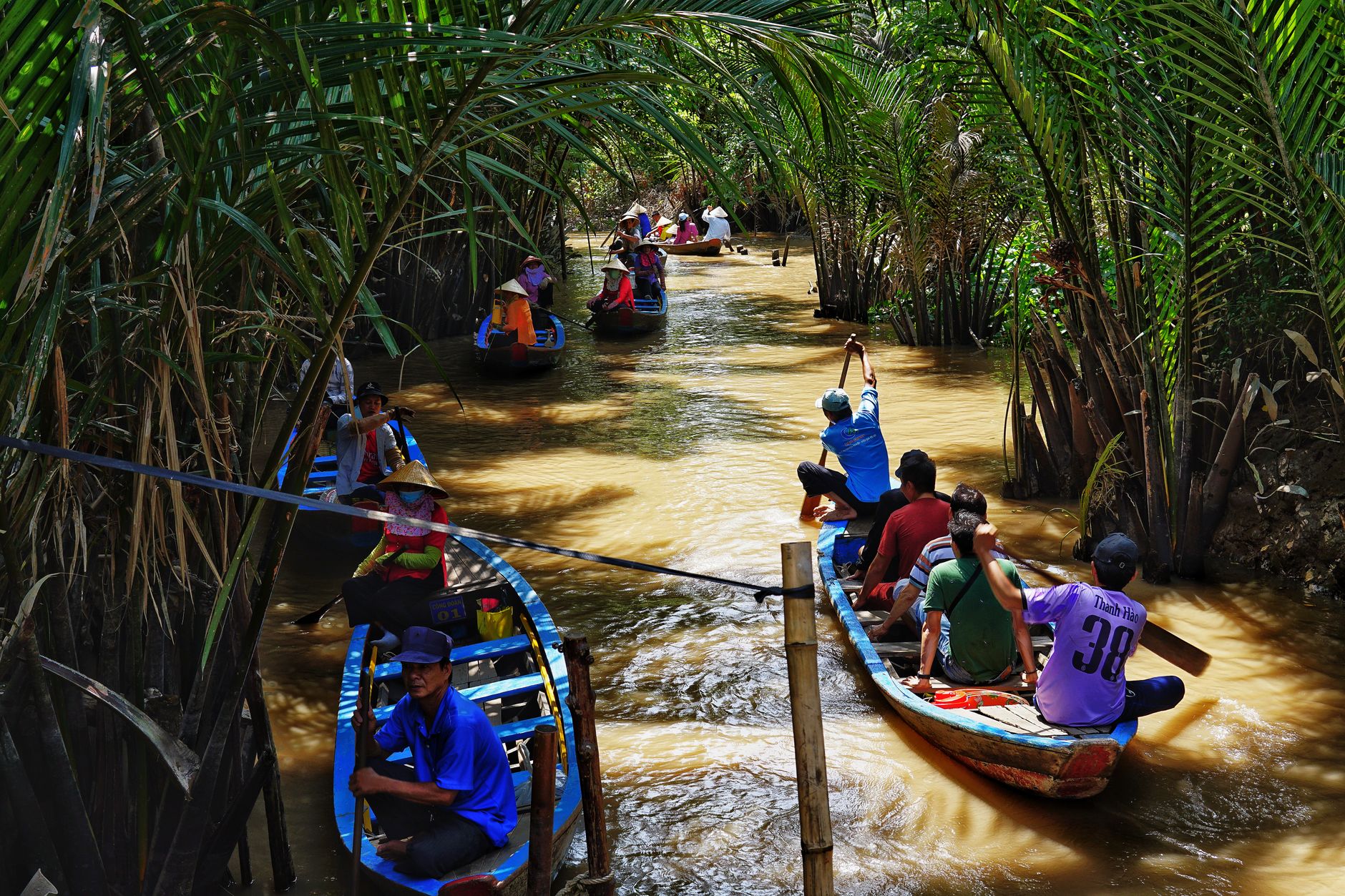
The market is held on a river narrower than Cai Rang's, creating a more intimate atmosphere. Boats are smaller, often rowed rather than motorized. The fruits come directly from the surrounding orchards.
Location: 20 km southwest of Can Tho. Hours: 5:30 AM to 8:00 AM. Slightly later than Long Xuyen. What you'll find: Seasonal fruits, vegetables, local specialties. Tourist level: Moderate. Some organized groups but bearable.
Price: Boat rental costs 200,000 to 350,000 VND (8 to 14 USD), cheaper than at Cai Rang.
Ideal combination: Visit Phong Dien early in the morning, then follow up with a visit to the Tra On orchards or the Phong Dien land market.
Declining Floating Markets: Which to Avoid?
Not all floating markets are equal. Some are no longer worth the detour, except in special cases.
Cai Be (Tien Giang) — Nearly Disappeared
Cai Be was once a bustling market. Today, real commercial activity is residual. A few scattered boats very early in the morning, then fleets of tourist boats.
Why avoid: The market has become a tourist attraction. Prices are inflated. The experience is no longer authentic.
Exception: If you are already in the Tien Giang region to visit orchards or old houses, an early stop might be worthwhile for photographers. But don't make a special detour.
Nga Nam (Soc Trang) — Remote and Irregular
Nga Nam is interesting for its unique setting: the market is held at the confluence of five river branches. But activity is irregular and the market is difficult to access.
Why avoid: The journey from Can Tho takes 2 to 3 hours. Activity depends on seasons and days. You risk making the trip for nothing.
Secondary interest: The Soc Trang region is home to a large Khmer community with magnificent pagodas. Combine the visit with a cultural tour if you have time.
Tra On (Vinh Long) — A Shadow of Its Former Self
Tra On was a lively market ten years ago. Today, activity is limited to a few boats. Interest is limited, except for photographers seeking shots of traditional boats in a peaceful setting.
Nga Bay / Phung Hiep (Hau Giang) — Specialized but Declining
Nga Bay is known for its unusual products: exotic animals, snake wine, medicinal herbs. Activity has decreased but the market retains a local clientele for these specialties.
Good to know: The snake wine sold here is often of dubious quality. Avoid buying it. Exotic animals are sometimes protected. Do not participate in this trade.
How to Organize Your Visit: Practical Guide
Best Time to Visit
The dry season (December to May) offers the best conditions. The sky is clear, the heat is bearable in the morning, and fruits are abundant.
The rainy season (June to November) is not a deal-breaker. Markets remain open. Showers are often short and refreshing. The downside: fruits are less varied and the water is higher, which can make navigation less pleasant.
Preferred period: February and March offer the best balance between favorable weather and seasonal fruits (mangoes, rambutans, durians).
During Tet (Lunar New Year, late January or early February), markets are particularly lively with boats of flowers and watermelons. However, markets close for the 4 main days of Tet.
Hours to Respect
The following table summarizes the hours to remember:
| Market | Recommended Arrival Time | Latest Limit |
|---|---|---|
| Cai Rang | 6:00 AM | 8:30 AM |
| Long Xuyen | 5:00 AM | 7:00 AM |
| Phong Dien | 5:30 AM | 8:00 AM |
| Cai Be | 5:30 AM | 7:30 AM |
| Nga Nam | 5:00 AM | 7:00 AM |
How to Get There from Ho Chi Minh City
Several options are available:
| Transport | Duration | Cost | Comfort | Independence |
|---|---|---|---|---|
| Public bus | 4h | 150,000 VND (6 USD) | Low | Low |
| Limousine bus | 3h30 | 300,000 VND (12 USD) | Medium | Low |
| Private car | 3h | 1,500,000 VND (60 USD) | High | High |
| Organized tour | 12h (round trip) | 600,000-1,000,000 VND (24-40 USD) | Medium | None |
Recommendation: Prioritize staying overnight. Leaving Ho Chi Minh City at 5:00 AM to arrive at 8:00 AM in Can Tho means missing the markets. Take a bus in the late afternoon, sleep in Can Tho, and visit the markets the next morning.
For more details on transport options, consult our guide on How much is a sleeper bus in Vietnam?.
Budget to Plan
| Expense Item | Low Budget | Comfort Budget | Notes |
|---|---|---|---|
| Transport HCMC-Can Tho (round trip) | 300,000 VND (12 USD) | 600,000 VND (24 USD) | Bus vs limousine |
| Accommodation (1 night) | 200,000 VND (8 USD) | 600,000 VND (24 USD) | Hostel vs 3-star hotel |
| Boat rental (1h) | 200,000 VND (8 USD) | 400,000 VND (16 USD) | Negotiation mandatory |
| Breakfast on the water | 30,000 VND (1.20 USD) | 60,000 VND (2.40 USD) | Noodle soup or coffee |
| Fruits and purchases | 50,000 VND (2 USD) | 150,000 VND (6 USD) | Depending on season |
| Total | 780,000 VND (31 USD) | 1,810,000 VND (72 USD) |
What to Eat and Buy at the Floating Markets
Breakfast on the Water
Food boats are one of the pleasures of floating markets. The most common dishes:
- Hu tieu (noodle soup): 20,000-30,000 VND (0.80-1.20 USD)
- Bun ca (fish soup): 25,000-35,000 VND (1-1.40 USD)
- Banh mi (sandwich): 15,000-25,000 VND (0.60-1 USD)
- Filter coffee: 10,000-15,000 VND (0.40-0.60 USD)
Fruits and Local Products
Fruits are the main reason to visit a floating market. Here are the fruits available month by month:
| Fruit | Jan-Feb | Mar-Apr | May-Jun | Jul-Aug | Sep-Oct | Nov-Dec |
|---|---|---|---|---|---|---|
| Mango | Yes | Yes | Yes | No | No | Yes |
| Durian | No | Yes | Yes | Yes | No | No |
| Rambutan | No | Yes | Yes | Yes | No | No |
| Watermelon | Yes | Yes | Yes | Yes | Yes | Yes |
| Pineapple | Yes | Yes | Yes | Yes | Yes | Yes |
| Dragon fruit | Yes | Yes | Yes | Yes | Yes | Yes |
| Longan | No | No | Yes | Yes | Yes | No |
| Mangosteen | No | Yes | Yes | Yes | No | No |
How to buy without getting ripped off: Prices are usually displayed or negotiable. A kilo of mangoes costs 15,000-25,000 VND (0.60-1 USD). A whole durian costs 50,000-100,000 VND (2-4 USD). If a vendor offers you a triple price, it's a scam.
What to Avoid
- Industrial souvenirs: Keychains, magnets, statuettes. These products come from China and cost 5 to 10 times their real value.
- Exotic animals: Turtles, snakes, birds. The trade is often illegal. Do not encourage this practice.
- Snake wine: The quality is dubious. Most bottles contain low-grade rice alcohol with a dead snake added for appearance.
Tips for an Authentic Experience
Choosing the Right Transport on Site
Two options: private boat or shared boat.
A private boat offers you freedom and flexibility. You decide the itinerary and duration. Expect 200,000-500,000 VND (8-20 USD) per hour.
A shared boat is cheaper but imposes a fixed itinerary. You share the vessel with other tourists. The experience is less authentic.
Tip: Always negotiate the price before boarding. Ask for the price for one hour, then for two hours. The difference is often minimal and worth it.
Interacting with Vendors
A few words of Vietnamese facilitate exchanges:
- Xin chào (Hello)
- Cảm ơn (Thank you)
- Bao nhiêu tiền? (How much does it cost?)
- Đắt quá! (Too expensive!)
Haggling is normal but should remain respectful. Don't offer a ridiculously low price. A smile and a friendly tone make all the difference.
Cultural tip: Buying a fruit from a vendor means establishing human contact. Take the time to exchange a few words, even with gestures. Vietnamese people appreciate the effort.
For more tips on negotiation, consult our guide on Bargaining in Vietnam.
Combining the Visit with Other Activities
A morning at a floating market can be combined with:
- My Khanh Orchards (Can Tho): Fruit tasting, boat ride, traditional lunch.
- Khmer Pagodas (Soc Trang, Tra Vinh): Colorful architecture, spiritual atmosphere.
- Old Houses (Cai Be, Vinh Long): 19th-century dwellings, period furniture.
- Fish Farms (An Giang): Aquaculture on the Mekong, visit to floating cages.
The Impact of Tourism and Current Challenges
Why Floating Markets Are Disappearing
The decline of floating markets is not a theory. It's a measurable reality. In 2010, Cai Rang market had over 500 boats each morning. In 2026, that number has fallen to around 200.
The causes are multiple:
- Competition from supermarkets: Traders prefer to buy wholesale at shopping centers rather than go through river intermediaries.
- Road development: Canals were once the only transport routes. Today, roads allow faster and cheaper transport.
- Pollution: The Mekong is increasingly polluted by plastic waste and industrial discharges. Navigation becomes less pleasant and less safe.
- Climate change: Flood cycles are altered. Seasons are less predictable. Fruit crops suffer.
Mass Tourism vs. Authenticity
Tourism has transformed some markets into attractions. Cai Rang is the most striking example. Tourist boats have become more numerous than traders' boats. Prices have risen. The atmosphere has changed.
But all is not lost. Long Xuyen and Phong Dien retain a rare authenticity. The key is to choose the right market and visit at the right times.
Responsible tip: Prefer small independent boatmen over large companies. Buy directly from local vendors. Don't negotiate prices that would jeopardize their daily income.
Frequently Asked Questions
Q: What is the most famous floating market in Vietnam?
Cai Rang market, near Can Tho, is the best known and most visited. It is also the largest in the Mekong Delta, with hundreds of boats each morning. However, its popularity has made it a very touristy site.
Q: Is Can Tho worth it?
Yes, Can Tho is the best base for visiting floating markets. The city offers a good choice of accommodation and restaurants, and allows easy access to Cai Rang (6 km) and Phong Dien (20 km). Plan at least one night on site.
Q: What is worth buying in Vietnam?
At floating markets, prioritize fresh local fruits (mangoes, durians, rambutans depending on the season), artisanal coconut candies, and local coffee. Avoid industrial souvenirs and snake wine, whose quality is unregulated.
Q: Do you really have to get up at 4 AM to see a floating market?
Yes, for most markets, peak activity is between 5:30 AM and 7:30 AM. Arriving after 8:00 AM risks seeing only tourist boats and a few lingering vendors. For Cai Rang, 6:00 AM is a good compromise.
Q: Which floating market is the most authentic in 2026?
Long Xuyen market (An Giang) remains the most authentic with very few tourists and real local commercial activity. Phong Dien (Can Tho) is a good second choice, more accessible but less touristy than Cai Rang.
Q: Can you visit a floating market without an organized tour?
Yes, it's possible and often cheaper. From Can Tho, take a taxi to An Binh wharf (Cai Rang market) and negotiate directly with a boatman. Expect 15-25 USD for a one-hour ride, compared to 30-50 USD for an organized tour.
Q: Are floating markets open all year round?
Yes, except during the 4 main days of Tet (Lunar New Year, usually late January or February). Approaching Tet, activity is on the contrary more intense with boats of flowers and watermelons. The rainy season (June-November) does not close the markets but can make navigation less pleasant.