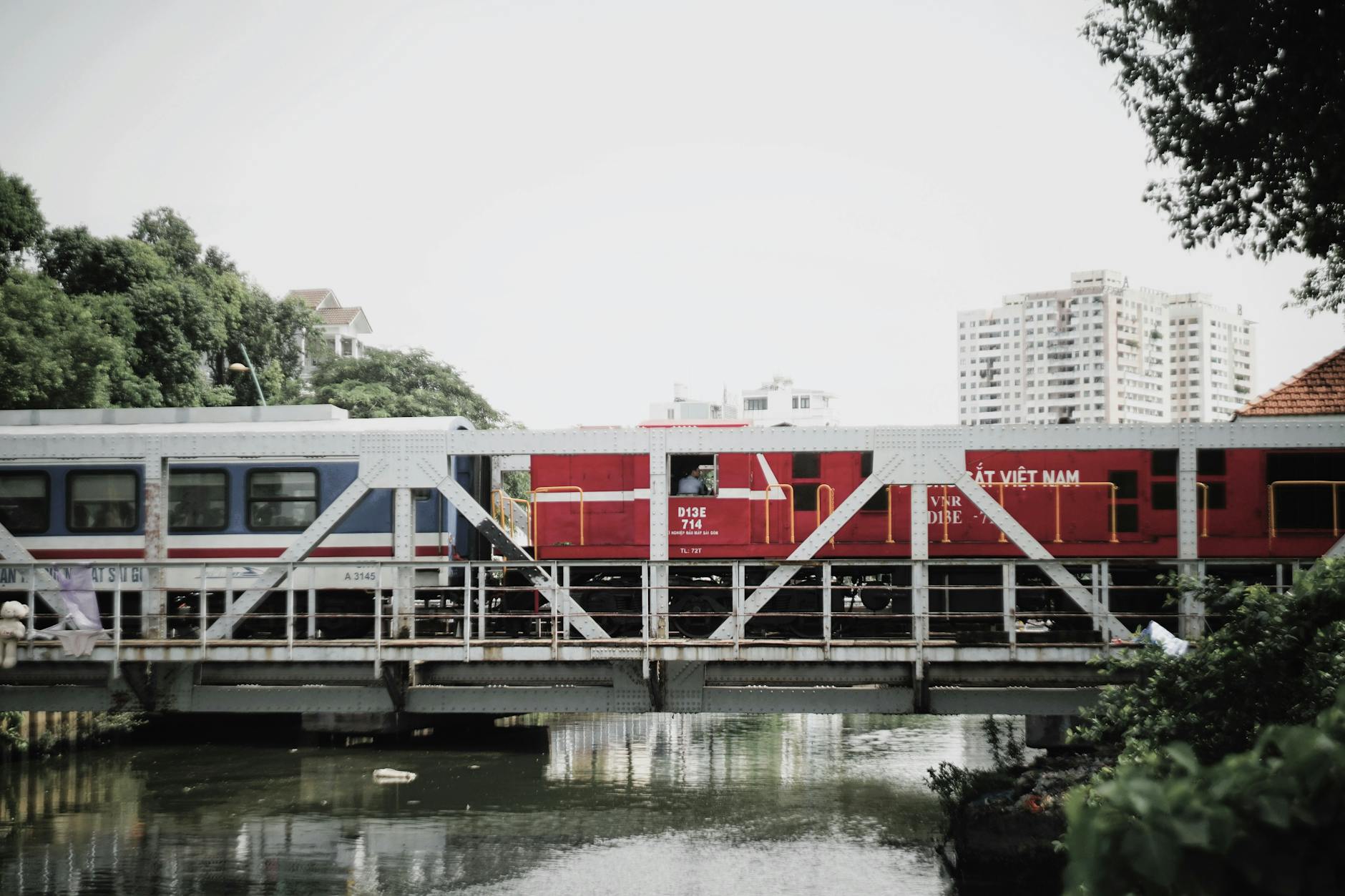
A full end-to-end journey takes 32 to 36 hours depending on the service. It is slower than flying, more expensive than the bus on a per-hour basis, and the toilets are not glamorous. Yet for travelers who want to watch the country unfurl through a window — rice paddies, fishing villages, the Hai Van Pass, jungle-covered mountains — there is no better option.
This guide covers what to expect from each carriage class, the food situation, the toilets (yes, in detail), the scenery segment by segment, and how to book in 2026.
Choosing Your Train: SE1 to SE22
Vietnam Railways runs several daily services on the North-South line. The fastest and most modern are the SE1/SE2, SE3/SE4, SE5/SE6, and SE7/SE8 pairs. Odd numbers run southbound from Hanoi; even numbers run northbound from Saigon.
| Train | Direction | Approx. Duration | Notes |
|---|---|---|---|
| SE1 / SE2 | HAN ↔ SGN | ~32 hours | Fastest, newer carriages |
| SE3 / SE4 | HAN ↔ SGN | ~33 hours | Popular with travelers |
| SE5 / SE6 | HAN ↔ SGN | ~35 hours | More stops |
| SE7 / SE8 | HAN ↔ SGN | ~36 hours | Slowest, cheapest |
In 2024 Vietnam Railways introduced refurbished "Hanoi–Saigon Luxury" carriages on SE1/SE2 and SE3/SE4, with USB ports, reading lights, and improved bedding. As of 2026 these remain the most comfortable option on the line.
Pro tip: If you want to sleep through the longest stretch, board in the late afternoon or evening. SE3 departs Hanoi around 19:20; SE4 leaves Saigon around 19:00 — both timings put you in bed during the dullest sections.
Soft Sleeper vs Hard Sleeper: The Real Difference
This is the question that matters most. Vietnamese trains have four main classes:
| Class | Layout | Approx. Price HAN–SGN (2026) | Comfort |
|---|---|---|---|
| Hard seat | Upright, padded | 750,000–950,000 VND ($30–38) | Punishing for long hauls |
| Soft seat (AC) | Reclining | 950,000–1,200,000 VND ($38–48) | Tolerable for 6–8 hours |
| Hard sleeper | 6 berths per cabin | 1,300,000–1,650,000 VND ($52–66) | Cramped but workable |
| Soft sleeper | 4 berths per cabin | 1,750,000–2,400,000 VND ($70–96) | Best standard option |
| VIP 2-berth (select trains) | 2 berths per cabin | 2,800,000–3,600,000 VND ($112–144) | Private, with door lock |
Hard sleeper means six bunks stacked three-high on either side of a narrow cabin. The top bunk is the cheapest, sits about 50 cm from the ceiling, and is impossible to sit up in. The middle bunk is the compromise. The bottom bunk doubles as daytime seating for everyone in the cabin, so privacy is minimal.
Soft sleeper means four bunks — two lower, two upper — in a cabin of the same size. The mattresses are thicker, there is room to sit upright on the lower bunks, and most cabins have a small folding table by the window. For the price difference (roughly 400,000–600,000 VND / $16–24), soft sleeper is the obvious choice on a 36-hour trip.
Warning: Top bunks in either class have no easy way down in the dark. If you are over 60, traveling with children, or expect to use the toilet at night, request a lower berth at booking.
The cabin doors do not lock from the inside on standard trains. Valuables should be kept in a small bag used as a pillow, or in a locked daypack chained to the bed frame.
Food on Board: What to Expect, What to Bring
A trolley service passes through the carriages roughly every two to three hours during daylight, selling rice boxes (cơm hộp), instant noodles, boiled eggs, water, beer, and snacks. A standard pork-and-rice box costs around 50,000–70,000 VND ($2–3). The quality is acceptable but repetitive.
There is a dining car on most SE trains, though its condition varies. Meals there cost slightly more (80,000–120,000 VND / $3–5) and the menu is similar.
The real food culture happens at station stops. Trains pause for 10–20 minutes at major stations — Vinh, Đồng Hới, Huế, Đà Nẵng, Diêu Trì, Nha Trang — and vendors swarm the platforms with local specialties. Vinh is famous for cháo lươn (eel porridge), Huế for bánh lọc, Quảng Ngãi for sugarcane juice. Cash in small denominations is essential.
What to bring:
- A 1.5L water bottle (refilled from hot/cold dispensers in each carriage)
- Instant noodles or oats — hot water is free and reliable
- Wet wipes and hand sanitizer
- Snacks for the night hours when the trolley stops
- A small thermos cup if you drink coffee or tea
The Toilet Situation
Honest assessment: by hour 20, the toilets will not smell good. Each carriage has two — one Western-style with a seat, one squat. Both flush directly onto the tracks (do not use them while stationary at a station). Toilet paper is sometimes provided, often not. Bring your own roll and a small bottle of hand soap.
The Western toilet seats are often wet. Many experienced travelers prefer the squat toilet for hygiene reasons — there is less contact and it tends to be cleaner. Both have a small sink with cold water only.
Showers exist only on the VIP carriages of select SE1/SE2 services. On standard sleepers, plan for a wet-wipe routine and a real shower at your destination.
Pro tip: The toilets at the rear of each carriage are usually cleaner than those at the front, as foot traffic concentrates near the trolley path.
Scenery, Segment by Segment
The Reunification line is not equally beautiful throughout. Knowing when to stay awake matters.
Hanoi to Ninh Bình (2 hours): Flat Red River delta, rice fields, brick kilns. Pleasant but unremarkable.
Ninh Bình to Vinh (4 hours): Limestone karsts appear briefly around Tam Cốc, then flatten out through Thanh Hóa. Mostly agricultural.
Vinh to Đồng Hới (5 hours): This stretch usually runs overnight on southbound trains. Not much lost by sleeping through it.
Đồng Hới to Huế (3 hours): The line approaches the coast. Lagoons, fishing boats, war-era bridges. Worth being awake for.
Huế to Đà Nẵng (2.5 hours) — THE HIGHLIGHT: The Hai Van Pass. The track clings to cliffs above the South China Sea, weaving through tunnels and around headlands. Lang Co Lagoon appears on the right (southbound) in turquoise shallows. This is the single most photographed segment of the line. Sit on the right side southbound (left side northbound) for the best sea views.
Đà Nẵng to Quảng Ngãi (3 hours): Rural coast, fishing villages, the occasional glimpse of the sea.
Quảng Ngãi to Diêu Trì / Quy Nhơn (3 hours): Mountains push closer to the track. Beautiful in late afternoon light.
Diêu Trì to Nha Trang (4 hours): Often runs in darkness southbound. Northbound, this is a dramatic morning ride along the coast.
Nha Trang to Phan Thiết (4 hours): Dry, scrubby country with cactus, dragon fruit farms, and red earth — visibly different from the lush north.
Phan Thiết to Saigon (4 hours): Increasingly built-up. The journey ends in the chaotic outskirts of Ho Chi Minh City.
When to Choose the Train Over the Plane
A Hanoi–Saigon flight takes two hours and costs 1,200,000–2,500,000 VND ($48–100) on Vietnam Airlines, Vietjet, or Bamboo Airways. The train takes 16 times longer and, in soft sleeper, costs about the same.
Take the train if:
- You want to actually see Vietnam between its two endpoints
- You are breaking the journey into segments (Hanoi–Huế, Huế–Đà Nẵng, Nha Trang–Saigon)
- You enjoy slow travel and unstructured time
- You want to save a hotel night by sleeping on board
- You are nervous about flying or want to reduce carbon footprint
Take the plane if:
- Your trip is under two weeks and you want to maximize destinations
- You have mobility issues
- You need to arrive on a strict schedule (trains do run late, sometimes by 2–4 hours)
The most popular compromise is to break the journey: fly into Hanoi, train to Huế or Đà Nẵng, explore central Vietnam, then fly the final leg to Saigon. The Đà Nẵng–Huế segment alone (2.5 hours, 150,000–400,000 VND / $6–16) is worth doing for the Hai Van Pass.
Booking Tips for 2026
Vietnam Railways operates the official site dsvn.vn, which accepts international cards and prints e-tickets. Booking opens 60 days in advance. Prices are fixed by the railway and do not surge.
Third-party platforms (Baolau, 12Go, Bookaway) add a 10–25% markup but offer English interfaces and easier refunds. For straightforward bookings, dsvn.vn saves money; for complex itineraries or last-minute changes, third parties are worth the fee.
Peak periods to book early (4–8 weeks ahead):
- Tết (Lunar New Year): late January to mid-February 2026
- Reunification Day / Labour Day: 30 April – 3 May 2026
- National Day: 2 September 2026
- July and August (domestic summer holidays)
Outside these periods, soft sleeper berths are usually available a week ahead.
Pro tip: When booking on dsvn.vn, you can choose your specific berth on a seat map. Avoid berths directly adjacent to the toilet and the connecting door between carriages — both are noisier and smell worse over time.
Tickets are checked at the station gate and again on board. Bring your passport — the name on the ticket must match.
FAQ
Is the Reunification Express safe? Yes. Vietnam Railways has a strong safety record, and theft on board is rare though not unheard of. Standard precautions — keeping valuables close, not leaving bags unattended at stations — are sufficient.
Can you buy tickets at the station on the day of travel? Yes, for non-peak dates. Hanoi (Ga Hà Nội) and Saigon (Ga Sài Gòn) stations have English-capable ticket windows. For specific berth preferences or peak dates, book online in advance.
Is there Wi-Fi or reliable phone signal? No on-board Wi-Fi. Vietnamese SIM cards (Viettel has the best rural coverage) work along most of the route, with dead zones in mountain tunnels and remote stretches between Đồng Hới and Quảng Ngãi.
Can you bring alcohol on board? Yes. Beer and rice wine are sold by the trolley and at stations. Drinking is common but loud behavior is not tolerated by conductors.
What is the luggage allowance? There is no strict weight limit, but you must store luggage in your cabin. Soft sleeper cabins have space under the lower bunks and a shelf above the door. A 20 kg suitcase fits; two large suitcases per person become awkward.
Are there family cabins or female-only cabins? There are no officially designated female-only cabins, though some travelers request all-female cabins at booking and Vietnam Railways will accommodate where possible. Families booking four berths effectively get a private cabin in soft sleeper class.
What happens if the train is delayed? Delays of 1–3 hours are routine, especially on southbound services arriving in Saigon. There is no compensation system. If you have a connecting flight, allow at least four hours buffer at your arrival city.