Understanding Dong Van Market Before You Go
What is Dong Van Market?
Dong Van Market is an ethnic Sunday market held in the district capital of Dong Van, Ha Giang province. Unlike tourist markets set up for visitors, this one remains first and foremost a place of exchange for local people. The Hmong, Tay, Nung, Dao, and Lo Lo gather here every week to sell their products, exchange news, and share a meal.
This is not a show organized for tourists. It is an economic and social gathering that has existed for nearly a century.
Where Exactly is the Market Located?
The market is located in Dong Van town center, at the intersection of the main road and the street leading to the old quarter. The exact address is 1 Tran Hung Dao Street. You can't miss it: the limestone building dominates the central square.
What is the History of the Market?
The market was built between 1925 and 1928 by the French colonial administration. Its U-shaped architecture uses local limestone, giving it its massive and characteristic appearance. Originally, it served to control and tax commercial exchanges between the ethnic groups of the high valleys. Today, it is classified as a historical monument and remains the economic heart of the region.
Days and Times You Absolutely Must Know
The Official Day: Every Sunday
Dong Van Market takes place every Sunday without exception. Unlike some markets in Northern Vietnam that change days according to the lunar calendar, this one follows the Gregorian calendar. Miss a Sunday, and you wait a week.
What Time Does It Really Start?
The first vendors arrive as early as 5:30 AM to set up their stalls. Peak local attendance is between 7:00 AM and 10:00 AM. After 10:00 AM, tourists arrive in large numbers and vendors start packing up. By 2:00 PM, almost no one is left.
Pro tip: Arrive at 6:30 AM to see the market in its most authentic state. At this hour, you'll mainly encounter locals, not organized groups.
Special Night Markets
A few times a year, night markets are organized on the 14th, 15th, and 16th days of the lunar month. These events attract more young people and feature music, dance, and nighttime culinary specialties. Inquire at the Dong Van tourist office for exact dates.
How Much Time to Allow On-Site?
1.5 to 2 hours is enough to make a complete tour of the market. If you add a meal on-site and photos, allow 2.5 hours maximum. Don't spend the whole day: the market loses its appeal after 11:00 AM.
Ethnic Groups Present at Dong Van Market
The Hmong: Majority, Black Costumes and Berets
The Hmong represent about 70% of vendors and visitors. Women wear pleated black skirts, embroidered aprons, and black berets. Men also wear the black beret, a legacy of French influence. The Hmong dominate the livestock area and textile stalls.
The Tay, Nung, Dao, Lo Lo: Their Specialties
- Tay: Indigo cotton clothing, selling rice, vegetables, and medicinal herbs
- Nung: Specialists in weaving and basketry
- Dao: Recognizable by their red turbans or headdresses adorned with coins
- Lo Lo: The smallest ethnic group present, about 4,000 people in all of Vietnam. Their costumes are the most colorful, with complex geometric patterns
Why Do Hmong Men All Wear the Black Beret?
The black beret is a direct legacy of French colonization. French soldiers wore berets, and the Hmong adopted this accessory after World War II. Today, it has become a strong identity marker. A Hmong man without a beret is as surprising as a Breton without a hat.
What to See and Do at Dong Van Market
The Livestock Area: The Most Impressive Spectacle
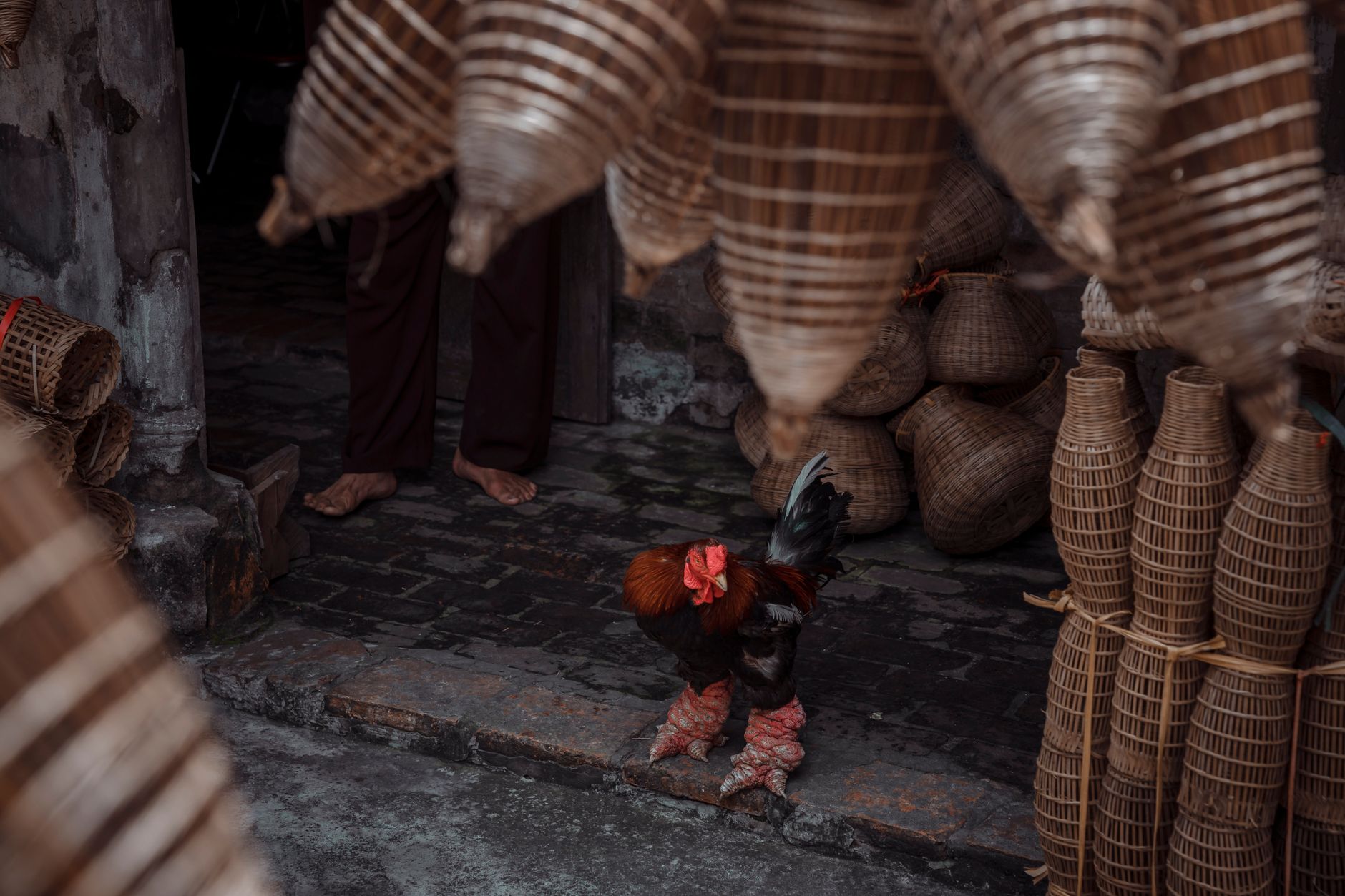
Behind the main building, a vast area hosts animals: buffaloes, cows, pigs, goats, and chickens. Transactions are done by hand, without words, through coded signs under a blanket. It's one of the liveliest areas of the market, and the most photographed.
Traditional Clothing and Textile Stalls
Hmong women sell clothes they have made themselves. The embroidery is done by hand, with patterns varying by clan. A complete outfit can cost between 500,000 and 2,000,000 VND ($20 to $80 USD). Check the quality of the stitching: genuine handmade items have irregular stitches.
The Food Section: Eateries and Specialties
In the center of the market, about a dozen eateries serve local dishes. Locals sit on low plastic stools around low tables. It's noisy, it smells strong, and it's exactly where you should eat.
Unusual Products
Besides food and textile products, you'll find:
- Traditional medicine: roots, bark, dried insects
- Corn alcohol (ruou ngo) sold in plastic containers
- Low-end Chinese electronics
- Knives and agricultural tools
Street Vendors on the Periphery
Around the main building, vendors set up their goods directly on the ground. They sell fruit, herbs, tobacco, and small items. These vendors are often the poorest and oldest. Buying from them directly contributes to their livelihood.
What to Eat at Dong Van Market
Must-Try Dishes
| Dish | Description | Risk Level | Indicative Price |
|---|---|---|---|
| Thang co | Horse meat and offal soup, cooked with local herbs | High (offal, variable hygiene) | 30,000 - 50,000 VND |
| Chao au tau | Glutinous rice porridge with pork and quail eggs | Low | 20,000 - 30,000 VND |
| Banh cuon | Rice flour rolls stuffed with minced meat | Low | 25,000 - 40,000 VND |
| Xoi ngu sac | Five-color glutinous rice, dyed with natural leaves | Low | 15,000 - 25,000 VND |
Corn Alcohol (Ruou Ngo): Tradition and Moderation
Ruou ngo is a home-distilled corn alcohol. It ranges between 30 and 50 percent alcohol by volume. Locals drink it from morning, often before 8:00 AM. Try a sip out of politeness, but don't drink on an empty stomach and don't get on the road afterward. Quality varies enormously from one vendor to another.
Food Risks and How to Avoid Them
Thang co is the riskiest dish. It contains intestines, blood curd, and meat pieces that have cooked for a long time. If you have a sensitive stomach, skip it. Prefer chao au tau or banh cuon, which are cooked at high temperatures and present fewer risks.
Warning: Avoid meats that seem to have been sitting at room temperature for several hours. Watch if locals are eating at an eatery before sitting down. An empty eatery is a bad sign.
Where to Eat
Look for eateries where Hmong people are eating in groups. The busier it is, the better the food. Avoid stalls that target exclusively tourists with prices displayed in English. Dish prices range from 15,000 to 50,000 VND ($0.60 to $2 USD).
How to Get to Dong Van Market
By Motorbike: The Most Common Solution
Renting a motorbike in Ha Giang city costs between 150,000 and 250,000 VND per day ($6 to $10 USD). The journey from Ha Giang city to Dong Van is about 150 km and takes 4 hours. The road is winding, with mountain passes and sometimes degraded sections.
Pro tip: Check the condition of brakes and tires before leaving. The descents toward Dong Van are long and steep.
With an Easy Rider (Local Driver)
An Easy Rider takes you on their motorbike. Expect to pay between 600,000 and 1,000,000 VND per day ($24 to $40 USD). It's more expensive but safer if you're not an experienced rider. The driver knows the roads, the timings, and can advise you on stops.
By Private Car
A private car with driver costs between 1,500,000 and 2,500,000 VND per day ($60 to $100 USD). It's comfortable but less authentic. You won't be able to stop everywhere and will be dependent on main roads.
From Ha Giang City
The journey from Ha Giang city to Dong Van takes 4 hours by motorbike, 3.5 hours by car. The road passes through Quan Ba Pass, Heaven's Gate, and the karst plateau. Plan photo stops; the scenery is spectacular.
Combining with Meo Vac and Ma Pi Leng Pass
Dong Van Market and Meo Vac are only 20 km apart, connected by Ma Pi Leng Pass. It's possible to visit both on the same day, but the itinerary is tight. Leave Dong Van at 8:30 AM, cross Ma Pi Leng Pass (limited photo stops), arrive at Meo Vac before 10:00 AM. Allow 1 hour of driving and count on returning via the same pass if you need to go back through Dong Van.
Integrating the Market into the Ha Giang Loop
Planning Your Loop According to the Day of the Week
The Ha Giang loop typically lasts 3 to 5 days. To include Dong Van Market, organize your departure from Ha Giang city to arrive in Dong Van on Saturday evening or Sunday morning.
Recommended Itinerary for a Sunday
- Saturday: Depart Ha Giang city, overnight in Dong Van
- Sunday morning: Dong Van Market from 6:30 AM to 9:00 AM
- Sunday 9:00 AM-12:00 PM: Ma Pi Leng Pass and photo stops
- Sunday afternoon: Meo Vac, overnight on-site or return toward Ha Giang
How Much Time for Each Stage
| Stage | Recommended Duration |
|---|---|
| Dong Van Market | 1.5 to 2 hours |
| Ma Pi Leng Pass (crossing + stops) | 2 to 3 hours |
| Meo Vac (quick visit) | 1 to 2 hours |
Where to Sleep the Night Before and on Market Day
In Dong Van, several guesthouses and homestays are available. Expect to pay between 150,000 and 300,000 VND ($6 to $12 USD) per night. Book in advance if traveling in high season (October-November). Dong Van's old quarter offers homestay accommodations, more authentic.
Practical Tips for a Successful Visit
Arrive Early: Why 6:30 AM is the Ideal Time
At 6:30 AM, the market is calm, vendors are setting up their stalls, locals are arriving. You can observe the preparations and chat without being jostled. By 8:00 AM, attendance increases. By 9:00 AM, tourist buses arrive.
Cash: The Only Accepted Payment Method
There are no ATMs at the market or in the immediate vicinity. The nearest one is in Ha Giang city, 4 hours away. Withdraw enough money before leaving. Budget 500,000 to 1,000,000 VND per person for purchases and food.
What to Wear
In the morning in Dong Van, temperatures are cool, even in summer. In winter (December-February), it can be 5°C to 10°C (41°F to 50°F). Bring a jacket, a hat, and closed-toe shoes. The market floor is dirt, sometimes muddy.
Photographing Locals: Rules of Courtesy
Always ask permission before taking a photo. A smile and a hand gesture suffice. Offering 10,000 to 20,000 VND for a photo is common and accepted practice. Never photograph people while they are negotiating, praying, or eating. Don't insist if the person refuses.
Pro tip: Large markets like Dong Van are less conducive to portraits than small markets. Vendors are used to tourists and can be tired of cameras. Be respectful.
Toilets On-Site
There are public toilets near the market, but their condition varies greatly. Bring your own toilet paper and hand sanitizer. Eatery toilets are often cleaner.
Pitfalls to Avoid at Dong Van Market
Crowded Hours
Between 9:30 AM and 11:00 AM, the market is packed. Moving through the aisles becomes difficult. Tourist groups block the passage. If you want to avoid this, leave before 9:30 AM.
Mass Tourism
Dong Van is one of the most visited markets in Northern Vietnam. Expect to encounter groups of Vietnamese and foreign tourists. Authenticity remains preserved early in the morning (before 8:00 AM). After 10:00 AM, it's a tourist attraction like any other.
Industrial Souvenirs Sold as Handicrafts
Beware of cotton items with perfectly regular patterns. These are often Chinese imports sold as handicrafts. Real Hmong textiles have imperfections, loose threads, slightly asymmetrical patterns. Local honey is a safe bet, as are dried medicinal herbs.
Animals: A Sometimes Shocking Reality
The livestock area is noisy, smelly, and can be unsettling. Animals are transported in basic conditions. Pigs are tied up, chickens crammed into cages. If you are sensitive to animal welfare, avoid this area.
Dong Van Market vs. Other Markets in Northern Vietnam
Comparison of Northern Vietnam Markets
| Name | Day | Main Ethnic Groups | Atmosphere | Accessibility | Authenticity Rating |
|---|---|---|---|---|---|
| Dong Van | Sunday | Hmong, Tay, Nung | Lively, touristy | Easy (town center) | 7/10 |
| Meo Vac | Sunday | Hmong, Dao | Calmer, less touristy | Easy (town center) | 8/10 |
| Bac Ha | Sunday | Hmong, Phu La, Dao | Very touristy | Easy (from Sapa) | 6/10 |
| Can Cau | Saturday | Hmong, Phu La | Authentic, small scale | Difficult (road) | 9/10 |
| Coc Ly | Tuesday | Hmong, Dao | Intimate, uncrowded | Difficult (road) | 9/10 |
| Lung Phin | Sunday (once/month) | Hmong, Lo Lo | Very authentic | Difficult (road) | 10/10 |
Dong Van vs. Meo Vac: Which to Choose?
Meo Vac is smaller, less touristy, and more authentic than Dong Van. If you can only visit one, choose Dong Van for its size and variety, or Meo Vac for its calm. Both take place on Sunday, so you can combine them.
Dong Van vs. Bac Ha: Major Differences
Bac Ha is the most famous market in Northern Vietnam, located near Sapa. It's more accessible but also more touristy. Dong Van is more remote, less crowded, and offers a rawer experience. Bac Ha is better for photos, Dong Van for immersion.
Dong Van vs. Can Cau, Coc Ly, Lung Phin
These markets are smaller, more difficult to access, but much more authentic. Can Cau (Saturday) is 1 hour from Dong Van by road. Lung Phin (one Sunday per month) is 30 minutes away. If you have time, combine Dong Van with one of these markets for a complete experience.
Frequently Asked Questions About Dong Van Market
Q: What to do in Dong Van outside of the market?
Visit the old quarter with red lanterns, Vuong Palace (15 km), Lung Cu Flag Tower, Ma Pi Leng Pass, and the buckwheat fields in Sung La (season September-November).
Q: What is the best time to visit Dong Van Market?
Arrive at 6:30 AM to see stall setup and peak local attendance. The market is most lively between 7:00 AM and 10:00 AM. After 10:30 AM, vendors start packing up and tourists flood in.
Q: Can you visit Dong Van Market and Meo Vac on the same day?
Yes, but the itinerary is tight. Leave Dong Van at 8:30 AM, cross Ma Pi Leng Pass (limited photo stops), arrive at Meo Vac before 10:00 AM. Allow 1 hour of driving and count on returning via the same pass if you need to go back through Dong Van.
Q: Do you need a guide to visit Dong Van Market?
Not mandatory, but a local guide facilitates exchanges with ethnic groups and provides access to cultural information you won't find on your own. Without a guide, arrive with basic Vietnamese or Hmong phrases.
Q: Is Dong Van Market touristy?
Yes, it's one of the most visited markets in Northern Vietnam. Expect to encounter groups of Vietnamese and foreign tourists, especially between 9:00 AM and 11:00 AM. Authenticity remains preserved early in the morning (before 8:00 AM).
Q: Can you buy authentic souvenirs at Dong Van Market?
Yes, but with discernment. Hmong clothing and embroidery are authentic if bought directly from the women wearing them. Beware of industrial items imported from China sold as handicrafts. Local honey is a safe bet.
Q: Are there ATMs at Dong Van Market?
No. No ATMs at the market or in the immediate vicinity. Withdraw money in Ha Giang city before leaving. Budget 500,000 to 1,000,000 VND per person for purchases and food.
Q: How to photograph locals without disturbing them?
Always ask permission with a smile and possibly a hand gesture. Offering 10,000-20,000 VND for a photo is common and accepted practice. Avoid photographing people while they are negotiating or praying. Never insist.